Morning Brief: Oil Fire and AI Fever Are Driving Markets at the Same Time
 ai oil
Renewed tensions between the United States and Iran are pushing oil prices higher and reviving inflation fears, yet global markets continue to be powered by the artificial intelligence boom. While concerns over the Strait of Hormuz have lifted Brent crude back above $100 per barrel, Asian equity markets are rallying sharply thanks to surging semiconductor and AI-related stocks. Investors are now turning their attention to today’s critical U.S. employment data for clues about the Federal Reserve’s next move.
Markets entered the final trading day of the week caught between two powerful forces: geopolitical anxiety driven by the Middle East conflict and optimism surrounding the global AI investment boom.
Although Washington and Tehran had previously signaled a ceasefire, fresh military exchanges around the Strait of Hormuz have once again rattled investor sentiment.
Iran accused the United States of carrying out attacks near the strategic waterway and claimed it had responded militarily. Washington, meanwhile, defended the strikes as acts of self-defense.
Despite the renewed confrontation, President Donald Trump attempted to calm markets by insisting that the ceasefire remains technically in place.
The result is a confusing but familiar market environment: simultaneous military escalation and diplomatic messaging.
For now, investors appear to believe that the worst-case scenario — a full-scale regional war — is still avoidable.
Oil Climbs Back Above $100
Energy markets remain highly sensitive to developments around the Strait of Hormuz, through which a major share of global oil and LNG shipments pass.
Brent crude, which had briefly fallen toward $96 per barrel during the previous session, recovered strongly overnight and traded near $101 in early Friday trading.
The renewed U.S.-Iran clashes pushed oil prices modestly higher, though the market response remained relatively controlled.
Rather than panic, investors are showing what could best be described as cautious concern.
Analysts warn that sustained energy price increases could once again place upward pressure on global inflation just as major central banks were beginning to consider eventual policy easing.
Gold and Silver Reflect Persistent Anxiety
Precious metals continue to signal lingering geopolitical stress.
Silver, which has surged nearly 13% over the past two trading sessions, climbed above $82 per ounce before surrendering part of its gains during Thursday evening’s renewed tensions. Even so, silver continues to trade near the $80 level.
Gold also remains elevated. After testing $4,765 during intraday trading, spot gold eased back toward $4,725 early Friday.
Taken together, oil and precious metal prices suggest that investors are still operating under a “controlled risk” scenario rather than a panic-driven environment.
AI Mania Continues to Drive Asian Markets
Despite geopolitical risks, the dominant force in global equities remains artificial intelligence.
Strong demand for semiconductor manufacturers continues to fuel record-breaking gains across Asian markets.
South Korea’s benchmark index has risen more than 12% on a weekly basis, marking its strongest performance since 2008. Taiwan’s market has gained roughly 7%, while Japan’s Nikkei index is up about 4.5%.
Technology giants are leading the rally.
Samsung Electronics has surged 120% this year, pushing its market capitalization above $1 trillion for the first time and making it the first South Korean company ever to reach that milestone.
Chipmaker SK hynix has also posted powerful gains as investors continue betting aggressively on AI-related infrastructure demand.
The message from markets is clear: despite wars and oil shocks, investors are still buying into the AI growth narrative.
Fears of an AI “Jobs Apocalypse” Remain Limited
One of the biggest questions facing markets is whether artificial intelligence will destroy employment or generate new economic opportunities.
So far, incoming data does not fully support the more catastrophic predictions.
Hiring activity remains relatively resilient in software engineering, accounting, customer service and financial services.
Many investors and economists increasingly believe AI will improve productivity and create new categories of employment rather than simply eliminate human labor entirely.
For that reason, markets continue treating AI primarily as a growth and profitability story.
All Eyes on U.S. Jobs Data
Attention now turns to Friday’s U.S. nonfarm payrolls report, one of the most closely watched data releases for the Federal Reserve.
With the Fed balancing inflation control and employment stability, today’s numbers could significantly influence expectations for future interest rate decisions.
The U.S. unemployment rate remains historically low at 4.3%, but investors are beginning to question how long the labor market can maintain its resilience.
According to Reuters analysis, hiring activity in March showed the fastest increase in six years. However, expectations for April point to a much weaker nonfarm payroll increase of only 62,000 jobs.
Meanwhile, gasoline prices in the United States have jumped more than 40% since late February, climbing above $4 per gallon and signaling that the energy shock is increasingly reaching consumers directly.
Markets will closely analyze whether rising energy costs and AI-driven structural changes are beginning to affect employment dynamics.
Global Markets Turn More Defensive
U.S. equities closed slightly lower overnight as geopolitical uncertainty weighed on sentiment.
Asian markets are also trading modestly weaker Friday morning, with losses near 1%.
At the same time, U.S. equity futures are showing limited gains, suggesting investors are not yet preparing for a broader risk-off selloff.
The yield on the benchmark U.S. 10-year Treasury note is approaching 4.40%, while the U.S. dollar has strengthened modestly.
The dollar index has moved higher, pulling the euro/dollar pair back toward 1.1730.
Bitcoin continues to trade near $79,000.
Although gold and silver prices have eased slightly, investors appear determined to maintain long positions heading into the weekend despite elevated geopolitical risks.
Technically, markets are closely watching support levels near $76 for silver and $4,600 for gold.
Turkish Markets Continue to Outperform
Turkish financial markets continued to display resilience despite global volatility.
The banking index gained 1.8% on Thursday, while the benchmark BIST 100 index rose 0.8% to fresh record highs.
The USD/TRY exchange rate climbed toward 45.32 in Monday-settlement transactions due to weekend funding effects, while Türkiye’s CDS risk premium declined to around 230 basis points.
Turkey’s benchmark two-year government bond yield eased slightly toward 40.70%.
Investors are expected to remain cautious heading into the weekend as they monitor both the U.S. employment report and any further developments in the Middle East.
Turkish Central Bank Data Offers Few Surprises
Weekly data released by the Central Bank of the Republic of Türkiye showed a largely stable picture in currency markets.
The central bank’s net foreign exchange position recovered by roughly $3 billion during the last two business days after previously declining by $4.4 billion earlier in the week.
As of May 6, the headline reserve position stood at $27.4 billion.
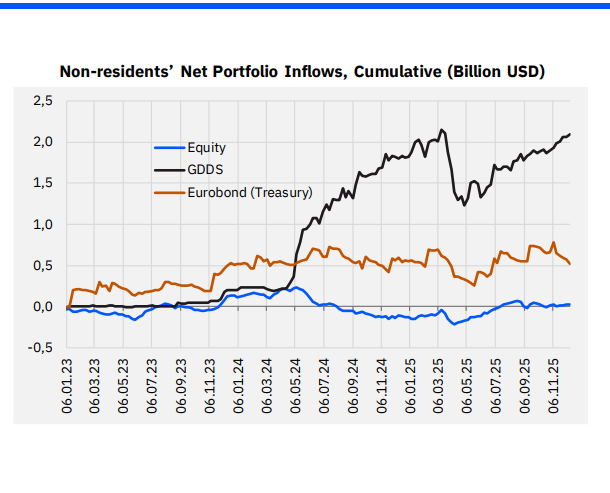
Domestic residents reduced foreign currency deposits by $2.4 billion during the week, while foreign investors recorded approximately $400 million in net outflows from Turkish securities.
Overall, the weekly figures did not indicate any major shift in market direction.
Trump’s China Visit Raises Hopes for Controlled Competition
Markets are also closely watching the upcoming China visit by President Donald Trump’s administration next week.
The inclusion of CEOs from companies such as NVIDIA, Apple, Boeing and ExxonMobil in the delegation is being interpreted as a sign that Washington and Beijing may be seeking a more business-focused relationship despite ongoing strategic rivalry.
Particular attention is being paid to reports of a potential 500-aircraft Boeing 737 MAX order, which could carry major implications not only for aviation but also for global trade relations.
The presence of major technology and industrial executives at the negotiating table suggests that the U.S.-China rivalry may evolve toward a model of controlled economic competition rather than outright decoupling.
For global markets, that balance between geopolitical confrontation and technological optimism continues to define the investment landscape.
Emre Degirmencioglu, Kıbrıs İktisat Bank
PA Turkey intends to inform Turkey watchers with diverse views and opinions. Articles in our website may not necessarily represent the view of our editorial board or count as endorsement.
Follow our English language YouTube videos @ REAL TURKEY: https://www.youtube.com/channel/UCKpFJB4GFiNkhmpVZQ_d9Rg