ANALYSIS: How Rising Oil Prices Could Impact Inflation in Türkiye
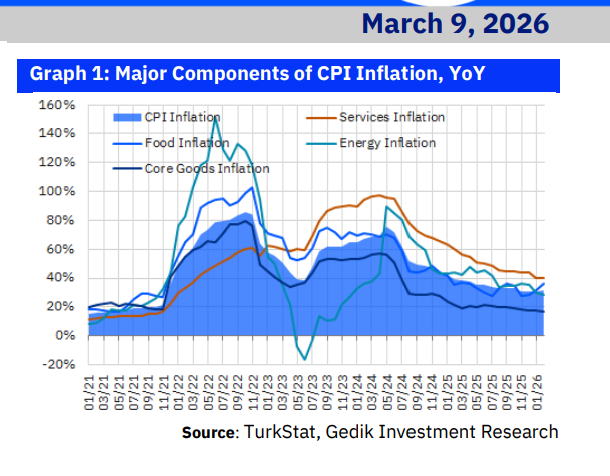 gedik cpi
A sustained increase in oil prices could significantly increase inflationary pressures in Türkiye. Estimates suggest that if Brent crude stabilizes around $100 per barrel, the total impact on consumer inflation could reach 6–8 percentage points. Government intervention through tax adjustments could partially offset this effect, but not eliminate it.
Oil prices could significantly push up inflation
Preliminary calculations suggest that if Brent crude remains around $100 per barrel, the total impact on Türkiye’s consumer price inflation (CPI) could reach approximately 6–8 percentage points, including both direct and indirect effects.
This estimate is based on a comparison with a baseline scenario in which Brent crude averages around $65 per barrel.
Türkiye’s fuel price equalization mechanism (eşel-mobil) could partially cushion the impact by adjusting fuel taxes to limit retail price increases. Analysts estimate that this mechanism could absorb around 1.5–2 percentage points of the inflationary effect.
However, implementing such a policy would impose a significant fiscal cost. Estimates suggest the mechanism could cost the central government budget roughly 45–50 billion Turkish liras per month.
Even with this policy in place, the net inflationary impact could still range between 4.4 and 6.3 percentage points.
Inflation impact without the equalization mechanism
If the equalization mechanism is not applied, rising oil prices would affect inflation through two main channels: direct effects and indirect effects.
Direct effects
Energy prices are the first channel through which higher oil prices feed into inflation.
Estimated direct effects include:
-
Fuel prices: approximately 1.1–1.2 percentage points
-
Electricity, natural gas and water: about 1.5 percentage points
This implies a total direct inflation impact of around 2.6–2.7 percentage points.
Indirect effects
Indirect effects arise because higher energy costs increase production, transportation and logistics costs across the economy.
These effects are estimated at at least 3.3–3.4 percentage points, and could reach as high as 5.0–5.5 percentage points in some scenarios.
As a result, the total inflationary impact could reach 6–8 percentage points.
Minister Mehmet Şimşek Speaks as Brent Oil Surges: “This Shock is Temporary”
Inflation impact with the equalization mechanism
If the eşel-mobil mechanism is applied, some of the fuel price increases would be offset by tax adjustments.
In that case the direct impact would be lower:
-
Fuel prices: around 0.5 percentage points
-
Electricity, natural gas and water: about 1.5 percentage points
This implies a total direct effect of roughly 2 percentage points.
Indirect effects are estimated to range between 2.5 and 4.3 percentage points.
Under this scenario, the overall inflation impact would likely fall between 4.4 and 6.3 percentage points.
Timing of the inflationary impact
The magnitude of indirect effects will depend heavily on how strongly higher oil prices feed into other commodity prices.
Another potential transmission channel is the exchange rate. Rising inflation expectations can put pressure on the Turkish lira, while currency depreciation itself can further increase inflation through import prices.
These calculations combine econometric studies conducted by the Central Bank of the Republic of Türkiye (CBRT) with market observations and independent analytical estimates.
Persistence of oil prices will determine final impact
The ultimate inflationary impact will largely depend on how persistent the increase in oil prices proves to be.
Even if oil prices remain elevated, the government could initially delay the pass-through to electricity and natural gas tariffs through subsidies from the central budget.
However, past experience suggests that these costs are eventually reflected in consumer energy prices.
In practice, such policies tend to delay rather than eliminate inflationary pressures.
Author: Serkan Gonencler, Gedik Invest
PA Turkey intends to inform Turkey watchers with diverse views and opinions. Articles in our website may not necessarily represent the view of our editorial board or count as endorsement.
Follow our English YouTube channel (REAL TURKEY):
https://www.youtube.com/channel/UCKpFJB4GFiNkhmpVZQ_d9Rg
Twitter: @AtillaEng
Facebook: Real Turkey Channel: https://www.facebook.com/realturkeychannel/
Related articles
Turkish external account turns negative in November, but improves year-on-year

Yapı Kredi Research: Markets Stabilize After Ceasefire, but Uncertainty Lingers
Commentary: Headline CPI inflation in line, but core inflation considerably high