Trump’s ‘Peace Through Construction’ Has One Real Test Case: The South Caucasus
 aliyev trump ermeni dude
Summary:
President Donald Trump has argued that economic integration and infrastructure can succeed where traditional diplomacy has failed. While similar ideas have been floated for Gaza, Ukraine, and Syria, the South Caucasus stands out as the only place where “peace through construction” could realistically turn a frozen conflict into a durable settlement. With Armenia and Azerbaijan closer to a final peace agreement than at any point in decades, U.S.-backed connectivity and investment may determine whether the moment becomes a legacy—or another missed opportunity.
Ceasefires Without Settlements
President Donald Trump frequently claims credit for ending wars. In 2025, U.S. diplomacy did contribute to pausing several conflicts, most notably in Gaza, while preventing others from escalating further. Yet most of the conflicts Trump cites remain frozen rather than resolved. Ceasefires have reduced violence but have not produced stable political settlements or durable regional orders.
To bridge this gap, the Trump administration has increasingly leaned on what could be described as “peace through construction”—the belief that infrastructure, economic incentives, and commercial logic can succeed where formal diplomacy stalls. The approach relies less on multilateral institutions and more on business-oriented envoys such as Jared Kushner, Steven Witkoff, and Thomas Barrack. Variants of this idea have been discussed for Gaza, Ukraine, and Syria, but so far they have amounted largely to conceptual plans and promotional presentations.
There is, however, one region where this strategy could plausibly work: the South Caucasus.
Why Armenia–Azerbaijan Is Different
Among the conflicts Trump points to as diplomatic successes, Armenia–Azerbaijan stands apart. The core territorial dispute has already been resolved—albeit violently—following Azerbaijan’s 2023 reconquest of Nagorno-Karabakh and the displacement of its Armenian population. That episode effectively closed a chapter that had fueled decades of war.
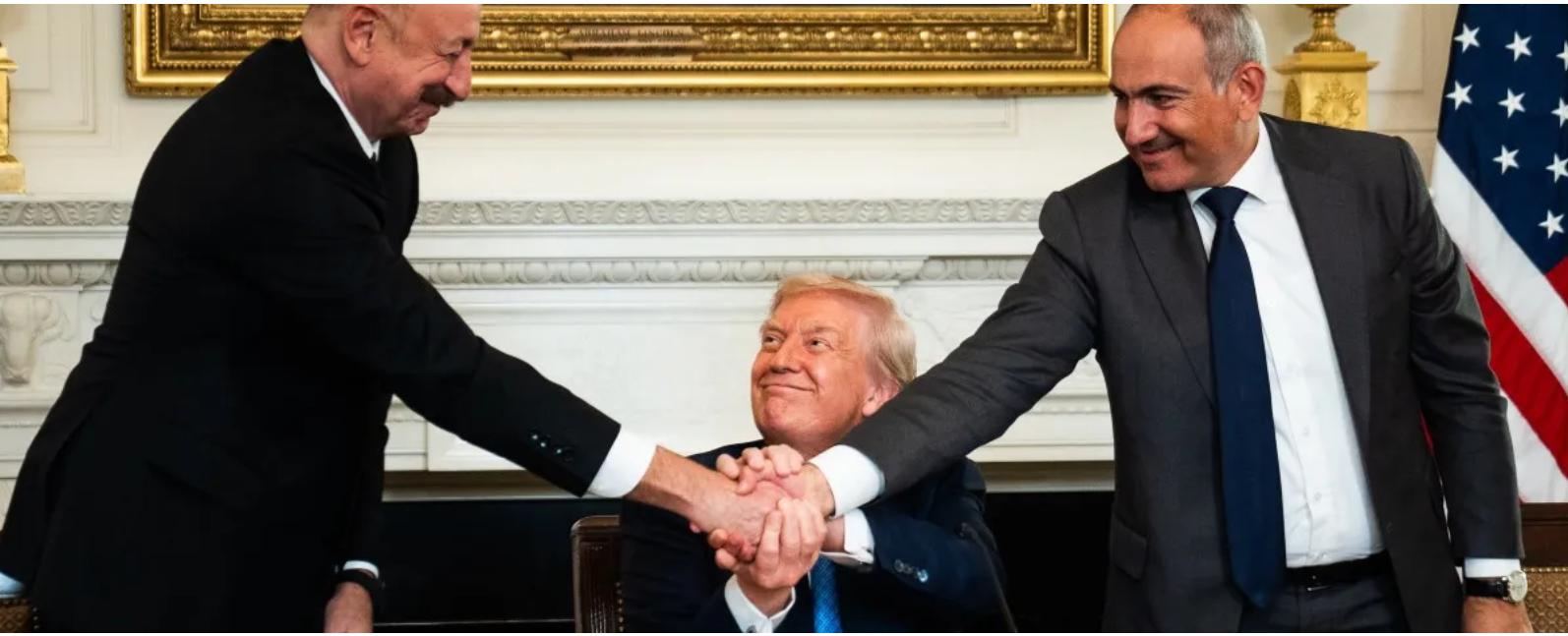
For the first time since the collapse of the Soviet Union, Armenia and Azerbaijan are closer to institutionalized peace than renewed conflict. In August, Armenian Prime Minister Nikol Pashinyan and Azerbaijani President Ilham Aliyev visited the White House to sign a U.S.-brokered declaration that moved both sides closer to a comprehensive peace treaty. The agreement formalized mutual recognition of territorial integrity based on Soviet-era borders and included commitments to renounce the use of force.
Remaining issues—border delimitation, regional connectivity, and confidence-building mechanisms—are complex but manageable and already tied to agreed roadmaps.
U.S. Engagement Gains Momentum
Diplomatic engagement has continued to advance. Armenia is seeking closer alignment with the West, and Foreign Minister Ararat Mirzoyan’s recent visit to Washington underscored Yerevan’s strategic recalibration. During the visit, Secretary of State Marco Rubio described peace as beneficial not only for Armenia and Azerbaijan but as a potential model for broader conflict resolution.
Washington’s interest remains visible. Vice President JD Vance is scheduled to visit Armenia and Azerbaijan in February, signaling that the region continues to feature on the U.S. strategic agenda.
Russia’s Declining Role Creates an Opening
The broader geopolitical environment also favors progress. Russia’s credibility as a security guarantor in the South Caucasus has eroded sharply since the 2020 Armenia–Azerbaijan war and Moscow’s invasion of Ukraine. Neither Yerevan nor Baku appears eager to see Russia reassert its influence once the war in Ukraine subsides.
The European Union has expressed readiness to support reconciliation and post-conflict development, while Turkey—despite its close alliance with Azerbaijan—supports a peace framework that would reopen east–west trade routes through Armenia toward Central Asia.
What sets this moment apart is that the United States now has a clear strategic and economic stake in the outcome.
The Trump Road and a Transactional Vision of Peace
Trump’s preference is to deploy American firms rather than American troops. His administration has shown limited appetite for traditional peacekeeping but strong interest in projects that offer visibility, leverage, and commercial returns. This logic underpins the proposed Trump Road for International Peace and Prosperity (TRIPP), referenced in the August declaration.
The corridor would run through Armenia, linking Azerbaijan to its exclave Nakhichevan and onward to Turkey. While unmistakably transactional and branding-driven, TRIPP could evolve into a genuine geoeconomic framework connecting Europe to Central Asia via rail, road, energy, and digital infrastructure.
Unlike past mediation efforts focused on crisis containment, this approach embeds peace in connectivity. Stability becomes a prerequisite for investment, and economic integration becomes the enforcement mechanism. For Washington, influence would come through integration rather than coercion.
Strategic Stakes for the United States
The South Caucasus lies along the emerging Middle Corridor linking Europe with Central Asia. As the U.S. seeks to diversify supply chains away from China and Russia, access to Central Asia’s energy resources and critical minerals has gained importance. These resources, however, require stable transit routes to reach global markets.
A durable Armenia–Azerbaijan peace would transform the region from a geopolitical chokepoint into a transit hub, reducing Russian leverage and complementing Europe’s energy diversification. It would also anchor Turkey—rather than Russia—as a central player in a new regional economic order.
This outcome aligns closely with Trump’s stated preference for economic gains without permanent military commitments.
Turkey’s Central—but Cautious—Role
Turkey is indispensable to this process, yet remains cautious. Ankara’s alliance with Baku, framed as “one nation, two states,” underpins its regional policy. Turkish officials have said the border with Armenia will open only after a final peace treaty is signed, using normalization as leverage.
President Recep Tayyip Erdoğan has promised symbolic steps toward normalization, and Ankara is expected to open the border to third-country citizens and diplomatic passport holders in March. Still, full normalization remains conditional.
Turkey has strong incentives to move faster. Reopening transit routes through Armenia would reinforce its role as a regional trade, energy, and logistics hub. Here, Trump’s pragmatic relationship with Erdoğan could prove instrumental, particularly if Washington presses Ankara to accelerate border opening once a treaty is signed.
Armenia’s Political Window Is Narrow
Domestic politics in Armenia add urgency. Azerbaijan has demanded constitutional changes before signing a final treaty—an issue fraught with political risk. Parliamentary elections scheduled for June place additional pressure on Pashinyan, who has tied his political future to the peace agenda.
He has already taken steps that would have been politically unthinkable a decade ago, including formally recognizing Azerbaijan’s territorial integrity and reframing Armenia’s security doctrine around normalization rather than confrontation. However, opposition forces—particularly pro-Russian factions—are mobilizing against the process.
Without visible economic and security dividends, public support for compromise could erode quickly.
What Washington Can Still Do
Early 2026 represents a critical window. The diplomatic breakthrough has largely been achieved; the risk now lies in the post-agreement phase, where many Trump-era initiatives have faltered.
Washington could anchor peace by promoting a regional economic compact involving Turkey, Armenia, and Azerbaijan—covering trade, energy, data infrastructure, tourism, and joint ventures. A South Caucasus stability fund, pooling U.S., EU, regional, and Gulf capital alongside international financial institutions, could help synchronize projects and ensure peace dividends are tangible.
In parallel, restoring Soviet-era railways could jump-start cross-border trade more quickly than waiting years for new infrastructure. Operationalizing TRIPP by 2027 would help sustain momentum and public confidence.
From Slogan to Legacy
Trump has argued that ending wars matters, but he has yet to demonstrate that economic interdependence can stabilize geopolitical flashpoints. Among the conflicts he cites, Armenia–Azerbaijan is the clearest case where sustained U.S. engagement could determine the final outcome.
The war has ended. The framework exists. Incentives align. If “peace through construction” is more than a slogan, the South Caucasus is where it could become a legacy.
By Garo Paylan, Carnegie Endowment
PA Turkey intends to inform Turkey watchers with diverse views and opinions. Articles in our website may not necessarily represent the view of our editorial board or count as endorsement.
Follow our English YouTube channel (REAL TURKEY): https://www.youtube.com/channel/UCKpFJB4GFiNkhmpVZQ_d9Rg
Twitter: @AtillaEng
Facebook: Real Turkey Channel: https://www.facebook.com/realturkeychannel/
Related articles
FIRST TAKE: Trump Pushes Turkey to Halt Russian Oil Imports, Signals Possible End to F-35 Sanctions
ANALYSIS: Corridor Wars: Turkey pushes two logistics corridors to replace IMEC

Armenia–Turkey Normalization Faces Final Hurdle Before 2026 Deadline