SAMEKS PMI Signals Slowdown as Turkey’s Economic Momentum Weakens before the War
 sameks march2026
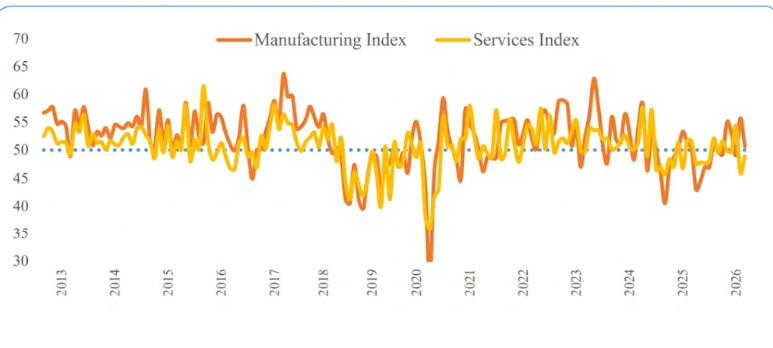
Turkey’s SAMEKS composite PMI index fell below the critical 50 threshold in March, signaling a continued slowdown in economic activity. While the industrial sector showed limited resilience, weakness in services and deteriorating confidence indicators point to a broader loss of momentum across the economy.
Composite Index Remains in Contraction Territory
The seasonally and calendar-adjusted SAMEKS Composite Index declined by 0.3 points in March 2026 to 49.1, remaining below the key 50 threshold.
A reading below 50 indicates contraction, suggesting that economic activity in Turkey continues to slow and that business momentum remains weak.
The data reinforce concerns that growth dynamics are losing traction as the year progresses.
Divergence Between Industry and Services
March data revealed a notable divergence between the industrial and services sectors:
- Industrial SAMEKS Index: 50.7 (above threshold)
- Services SAMEKS Index: 48.9 (below threshold)
While the industrial sector managed to stay in expansion territory, the services sector continued to contract, highlighting uneven conditions across the economy.
Industrial Sector: Mixed Signals Emerge
The industrial SAMEKS index fell by 5 points to 50.7, indicating a slowdown in momentum despite remaining above the expansion threshold.
Key sub-components showed a mixed picture:
- Production: Slight improvement
- New orders: Sharp decline
- Input purchases: Significant drop
- Employment: Strong increase
- Supplier delivery times: Improvement
The data suggest that while production and employment remain relatively supported, weakening new orders signal softening demand conditions that could weigh on output in the coming months.
Atilla Yesilada: Damage Assessment: Taking Stock of the Economic Fallout
Services Sector: Weakness Persists
The services SAMEKS index rose by 3 points but remained below the threshold at 48.9, indicating continued contraction.
Sub-index trends show:
- Business volume: Increased
- Inventories: Improved
- Supplier delivery times: Slight improvement
- Input purchases: Declined
- Employment: Remains weak
The continued weakness in employment highlights that recovery in the services sector remains fragile and incomplete.
Broader Picture: Loss of Economic Momentum
Overall, the March SAMEKS data point to a clear slowdown in economic activity:
- Demand conditions are weakening
- Business momentum is losing pace
- Sectoral divergence is widening
These trends suggest that downside risks to growth remain elevated.
Economic Confidence Turns Negative
Supporting the SAMEKS data, Turkey’s economic confidence index also deteriorated in March.
- The index fell by 2.8% to 97.9, down from 100.7 in February
- Falling below 100 signals a shift from optimism to cautious pessimism
This marks a notable deterioration in sentiment across the economy.
Sharp Declines in Industry and Construction Confidence
The most pronounced declines were observed in:
- Real sector (manufacturing)
- Construction sector
Both confidence indices dropped by approximately 3.9%.
- Construction confidence remained low at 80.6
- Real sector confidence slipped to the 100 threshold
These sectors are key leading indicators for production and employment, making their weakness particularly concerning.
Robin Brooks: Türkiye’s Growing External Imbalance Raises Red Flags
Consumer Confidence Remains Weak
Consumer confidence also edged lower:
- Down 0.8% to 85.0
This suggests households remain cautious, with weak spending appetite and continued pressure on domestic demand.
Conclusion: Downside Risks Persist
March data confirm that Turkey’s economy is experiencing a loss of momentum.
While the industrial sector shows limited signs of stabilization, persistent weakness in services, declining new orders, and falling confidence indicators point to a fragile outlook.
Unless demand conditions improve, the economy may continue to operate below its potential in the coming months.