Iran War Begins to Hit Türkiye’s Economy: April Data Signals Slowdown, Risks Rise for May
 stagflasyon
Economic data released for April suggests the first clear signs that the Iran war is beginning to weigh on Türkiye’s economy. Manufacturing activity has weakened sharply, leading indicators point to continued slowdown, and growth forecasts have been revised downward. While consumer confidence showed a modest rebound, analysts warn that the overall outlook remains fragile, with risks skewed to the downside heading into May.
Manufacturing Activity Falls to Sixteen-Month Low
Türkiye’s manufacturing sector took a significant hit in April, as the Istanbul Chamber of Industry (ISO) Manufacturing PMI dropped from 47.9 to 45.7, marking its lowest level since October 2024. The reading remains well below the 50 threshold, indicating contraction, and extends the sector’s slowdown to 25 consecutive months.
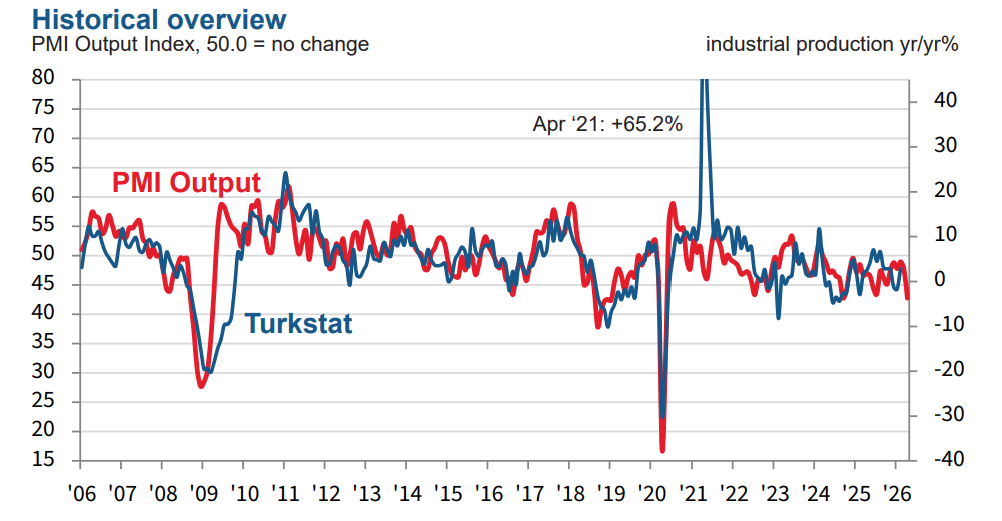
In its official assessment, ISO highlighted that the impact of the Middle East conflict became more pronounced during April. Firms reported a combination of rising input costs, supply chain disruptions, and weakening demand conditions—factors closely tied to escalating geopolitical tensions.
The report pointed to several key developments:
- Rising raw material and energy costs
- Disruptions in supply chains and procurement
- Weakening domestic and external demand
- Declines in both production and new orders
- Lengthening delivery times
As a result, companies have continued to cut back on employment, purchasing activity, and inventories. Notably, the decline in input inventories reached its fastest pace in six years, reflecting growing caution among manufacturers.
Broad-Based Weakness Across Sectors
Sectoral PMI data reinforced the negative picture. Of the 10 sectors surveyed, only the clothing and leather products segment recorded growth in both output and new orders.
All other sectors reported contraction, with particularly sharp declines observed in:
- Chemicals, plastics, and rubber (largest production drop)
- Textile sector (steepest decline in new orders)
Export demand also remained weak across most sectors, while inflationary pressures intensified. Longer supplier delivery times further indicated persistent bottlenecks in the production chain.
Taken together, the data suggest that the slowdown in manufacturing is not isolated but widespread across the industrial base.
Consumer Confidence Improves—But Fragile
In contrast to the weakness in manufacturing, consumer sentiment showed a modest recovery in April. The BloombergHT Consumer Confidence Index rose by 4.7% to 71.3.
Sub-components of the index showed:
- Expectations Index: up 5.7% to 71.5
- Consumption Tendency Index: up 5% to 73.8
The improvement was largely attributed to easing geopolitical expectations, particularly hopes for a ceasefire between the United States and Iran. Additional support came from rising equity markets and relative stability in exchange rates.
However, analysts caution that this rebound may prove temporary. The divergence between weakening industrial activity and improving consumer sentiment raises questions about the durability of domestic demand.
Inflation in Türkiye Sparks Urgent Calls for Policy Revision
Growth Forecast Revised Downward
Reflecting the deteriorating outlook, Türkiye’s 2026 growth forecast has been revised down from 4% to 3.2%.
The latest PMI data suggest that manufacturing weakness is likely to persist into the second quarter. At the same time, rising cost pressures and soft external demand continue to pose risks to overall economic performance.
While consumer confidence has shown signs of improvement, it remains unclear whether this will translate into sustained consumption growth. As a result, downside risks to the growth outlook remain firmly in place.
S&P: War Impact Deepening
Commenting on the data, Andrew Harker, Economics Director at S&P Global Market Intelligence, noted that the impact of the Middle East conflict has intensified.
According to Harker:
- Demand conditions remain weak
- Inflationary pressures are increasing
- Supply chain disruptions persist
- Firms are responding by cutting employment and inventories
He added that uncertainty over how long the conflict will last is forcing companies to adopt a more cautious stance. A meaningful recovery, he suggested, will depend heavily on a rapid resolution of geopolitical tensions.
Composite Indicators Confirm Slowdown
Further evidence of slowing activity came from the SAMEKS Composite Index, which fell by 1.8 points to 47.2 in April. This indicates that overall economic activity remains in contraction territory.
The data also highlight a divergence between sectors:
- Industrial activity continues to weaken sharply
- The services sector shows limited resilience but no strong recovery
This mixed picture suggests that the broader economy is struggling to regain momentum.
Economic Confidence Weakens
Türkiye’s Economic Confidence Index also declined in April, falling to 96.4—its lowest level in nine months and below the critical threshold of 100.
While consumer and construction confidence improved slightly, weakness in services, retail, and manufacturing sectors dragged the overall index lower.
The data point to increasing uncertainty across the economy, with businesses and households remaining cautious.
Outlook: May Could Bring Greater Pressure
April’s data indicate that the economic effects of the Iran war are only beginning to materialize. Looking ahead, several risks could intensify:
- Continued increases in energy prices
- Prolonged supply chain disruptions
- Weak external demand
- Further contraction in industrial production
These factors suggest that May could prove even more challenging for Türkiye’s economy.
Although consumer sentiment has shown some resilience, the broader trend points to a fragile and uneven recovery. Without a de-escalation in geopolitical tensions, economic pressures are likely to persist.
PATurkey newsdesk