Erdoğan–Mitsotakis Meeting: Managed Calm in a Troubled Relationship
 rte mitsotakis
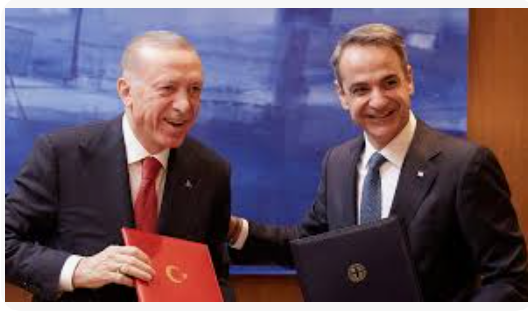
President Recep Tayyip Erdoğan and Greek Prime Minister Kyriakos Mitsotakis met in Ankara under the framework of the 6th High-Level Cooperation Council, reaffirming their commitment to dialogue despite persistent disputes in the Aegean and Eastern Mediterranean. While both leaders emphasized cooperation, trade expansion, and regional coordination, no breakthrough was announced on core sovereignty issues.
Erdoğan’s carefully worded reference to “international law” and “constructive dialogue” signals diplomatic flexibility — but not a concession to international arbitration.
Dialogue Continues, Core Disputes Remain


President Recep Tayyip Erdoğan said he “sincerely believes” that Türkiye and Greece must keep dialogue channels open as neighbors and NATO allies. Speaking at a joint press conference with Kyriakos Mitsotakis, Erdoğan described discussions on the Aegean and Eastern Mediterranean as “open and frank.”
“Although the existing issues are complicated, they are not unsolvable within the framework of international law,” Erdoğan said, adding that goodwill and constructive dialogue are essential.
Mitsotakis echoed the positive tone, describing the meetings as evidence of the value of good neighborly relations and reaffirming Greece’s commitment to political dialogue and confidence-building measures.
Yet beyond the reaffirmation of process, no concrete agreement was reached on long-standing disputes — particularly the delimitation of continental shelf and exclusive economic zones (EEZs).
Trade and Migration: Areas of Convergence
Both leaders reiterated their shared target of raising bilateral trade from roughly $7 billion to $10 billion. Infrastructure upgrades at border crossings and increased private-sector cooperation were highlighted as practical steps toward that goal.
Mitsotakis also emphasized cooperation on irregular migration, noting a reported 60% decline in irregular crossings in 2026. He praised the short-term visa scheme that facilitated Turkish tourism to Greek islands, calling it a bridge between the two societies.
These incremental gains reflect what diplomats often describe as the “positive agenda” — advancing low-risk areas of cooperation while shelving the most sensitive sovereignty questions.
Cyprus’ EU Presidency: Symbolic but Not Transformative?
As of January 1, the Republic of Cyprus holds the rotating presidency of the European Union Council. While rotating presidencies carry limited institutional authority, they do influence agenda-setting.
Ankara-watchers note that Cyprus has assumed the role during a relatively calm phase in Turkish-Greek relations. No major crisis occurred during Cyprus’ previous presidency in 2012.
However, diplomatic friction may arise if invitations are extended to Turkish officials for EU-related meetings hosted in southern Cyprus. Reports suggest the Greek Cypriot foreign minister may invite Turkish Foreign Minister Hakan Fidan to an informal EU Foreign Affairs Council (Gymnich) meeting in spring 2026.
It remains unclear whether Ankara would accept such an invitation, given Türkiye’s non-recognition of the Republic of Cyprus. Analysts say such moves may be more symbolic positioning than transformative diplomacy.
What Did Erdoğan Really Mean?
The most closely scrutinized portion of the meeting was Erdoğan’s statement:
“Although the existing issues are complicated, they are not unsolvable within the framework of international law. What is needed is goodwill, constructive dialogue and the will to reach a solution.”
At first glance, the reference to “international law” may appear to signal openness to judicial arbitration — possibly even referral to the International Court of Justice (ICJ). However, the phrasing reflects a carefully calibrated diplomatic middle ground rather than a legal concession.
1️⃣ “Within the Framework of International Law”
For Greece, international law often implies the UN Convention on the Law of the Sea (UNCLOS), which supports Athens’ right to extend territorial waters to 12 nautical miles.
Türkiye, however, is not a signatory to UNCLOS. When Turkish officials refer to international law, they typically invoke principles of equity, proportionality, and historical rights rather than strict treaty-based interpretations that could significantly limit Turkish maritime access in the Aegean.
The wording therefore preserves Ankara’s flexibility.
2️⃣ Emphasis on Dialogue Over Arbitration
Erdoğan’s stronger emphasis was on “goodwill” and “constructive dialogue.” This reflects Türkiye’s long-standing preference for bilateral negotiations rather than third-party adjudication.
Ankara has historically been cautious about international courts strictly applying UNCLOS provisions, fearing that the geographic configuration of Greek islands near the Turkish coast could sharply narrow Türkiye’s maritime zone.
Referral to the ICJ would require a formal “compromis” — a mutually agreed legal framework specifying exactly what issues the court may decide. Greece has generally favored limiting such a case to continental shelf and EEZ delimitation, while Türkiye has sought broader inclusion of issues such as island demilitarization.
No indication emerged from the Ankara meeting that such a formal legal path is imminent.
3️⃣ The “Similar Understanding”
Erdoğan’s reference to a “similar understanding” likely points back to the 2023 Athens Declaration, which emphasized:
-
Avoiding provocations
-
Reducing military tensions
-
Expanding cooperation in trade, tourism, and climate
-
Postponing high-risk territorial disputes
In effect, both sides appear committed to managing rather than resolving core disputes — at least for now.
No Breakthrough — But No Escalation Either
The Ankara meeting did not produce a breakthrough on Aegean territorial waters, continental shelf boundaries, or EEZ delimitation. Nor did it suggest Türkiye is ready to accept binding international arbitration under terms defined solely by Greece.
However, it did reaffirm a strategic choice made in 2023: contain tensions, expand economic ties, and preserve diplomatic channels.
For now, the message is one of controlled stability. The “thaw” continues — but the hard questions remain frozen.
Compiled by PA Turkey Staff
PA Turkey intends to inform Turkey watchers with diverse views and opinions. Articles in our website may not necessarily represent the view of our editorial board or count as endorsement.
Follow our English YouTube channel (REAL TURKEY):
https://www.youtube.com/channel/UCKpFJB4GFiNkhmpVZQ_d9Rg
Twitter: @AtillaEng
Facebook: Real Turkey Channel: https://www.facebook.com/realturkeychannel/