Legal Battle Halts Aegean Demarcation: Turkey Challenges Full Island Rights in Maritime Dispute
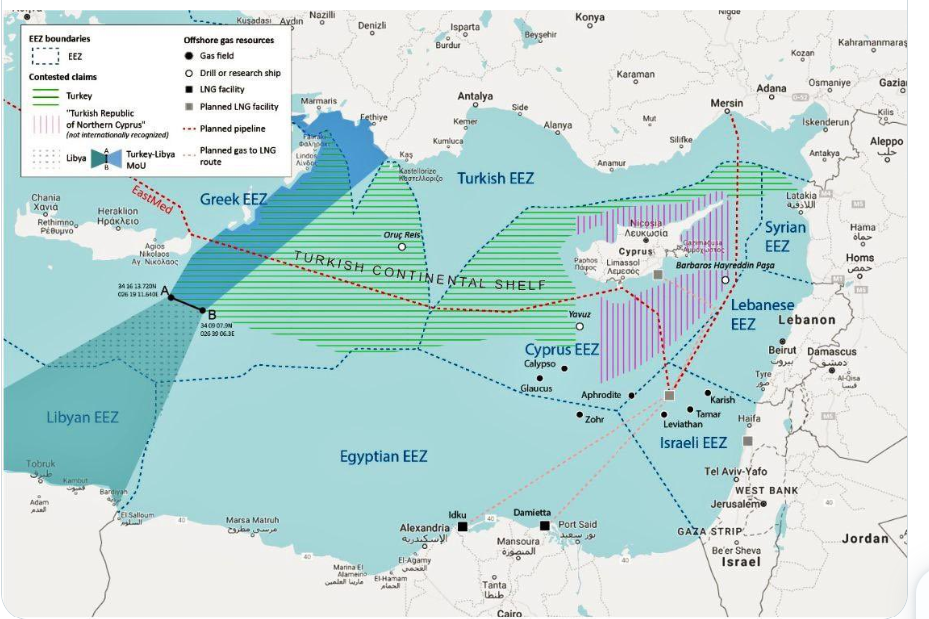 tr eez
ISTANBUL, November 29, 2025 — The decades-long conflict between Turkey and Greece over the delineation of the continental shelf and Exclusive Economic Zones (EEZ) in the Aegean and Eastern Mediterranean remains deadlocked, centered on a fundamental legal disagreement over the maritime rights of islands.
Analysis of the dispute highlights the core Turkish position: that international jurisprudence requires prioritizing long mainland coastlines and substantially reducing the weight of islands—particularly small features—to prevent the unjust carving up of the sea.
The Aegean Sea: Island Effect vs. Mainland Predominance
The failure to agree on a boundary stems from two fundamentally opposing legal interpretations of the Law of the Sea:
-
The Greek Position (Maximalist): Greece, a party to the UN Convention on the Law of the Sea (UNCLOS), insists that its islands are entitled to full EEZs, just like mainland states (per UNCLOS Article 121). This interpretation would grant Greek islands, including those situated directly on Turkey’s Anatolian coast (such as Kastellorizo), vast maritime zones that effectively seal off the Turkish mainland from its natural access to the Mediterranean.
-
The Turkish Position (Equitable Reduction): Turkey argues this “maximalist” interpretation is invalidated by established precedents in customary international law and rulings from the International Court of Justice (ICJ). Cases like the 1969 North Sea Continental Shelf ruling emphasize that delimitation must be based on equity, proportionality, and relevant circumstances. Turkey maintains that allowing small islands to generate a full EEZ would cause a severe “cut-off” effect, distorting the natural projection of the dominant Anatolian coastline.
Turkish analysts stress that this approach—prioritizing mainland coasts and giving reduced effect to small islands—is not “revisionist” but is consistent with major international maritime rulings, including the Libya–Malta (1985) and Romania–Ukraine (2009) cases.
The Cyprus Complication: Two Coastlines, No Agreement
The dispute is further inflamed in the Eastern Mediterranean by the unresolved political status of Cyprus, particularly concerning lucrative offshore hydrocarbon exploration.
The internationally recognized Greek Cypriot Administration (Republic of Cyprus – RoC) has unilaterally signed EEZ agreements claiming the maritime space around the entire island.
The Turkish position rejects this entirely, resting on two points:
-
Erosion of Turkish Cypriot Rights: Turkey argues the RoC lacks the authority to sign maritime treaties for the entire island and that such agreements illegally ignore the maritime entitlements of the Turkish Republic of Northern Cyprus (TRNC).
-
Geographical Fact: Maritime law deals with geography, not recognition politics. The northern coastline of Cyprus is a physical fact that must be accounted for in any equitable demarcation, and it cannot be erased by the RoC’s unilateral agreements.
The UNCLOS Divide
A major factor complicating the resolution of the dispute is Turkey’s stance on the primary multilateral treaty governing the seas.
Turkey is not a party to UNCLOS.
While this means Turkey cannot be forced to accept UNCLOS’s maximalist island interpretations or its dispute-resolution mechanisms, it confirms that Turkey is bound only by the portions of the treaty that reflect customary international law—namely, the principles of equity and proportionality that Turkish analysts argue support their non-encroachment position. This divergence remains a significant political and legal hurdle to any negotiated settlement.
Commentary by Tugay Er, Strategist
News report detailing the core legal reasons for the Turkey-Greece maritime dispute, focusing on the conflicting interpretations of the Law of the Sea regarding the rights of islands versus the projection of the Turkish mainland coast, and the complication caused by the divided island of Cyprus.
Related articles
Turkey Advocates for Two-State Solution in Cyprus Ahead of UN Peace Talks

Fitch raises Turkey’s credit rating, the country is heading for a currency crisis

UPDATE: Turkey Unveils Major Rare-Earth Discovery, Seeks Global Partners Amid U.S.–China Rivalry