WEF Country Strategy Meeting Highlights Türkiye’s Role in a Fragmenting Global Economy
 rte wef
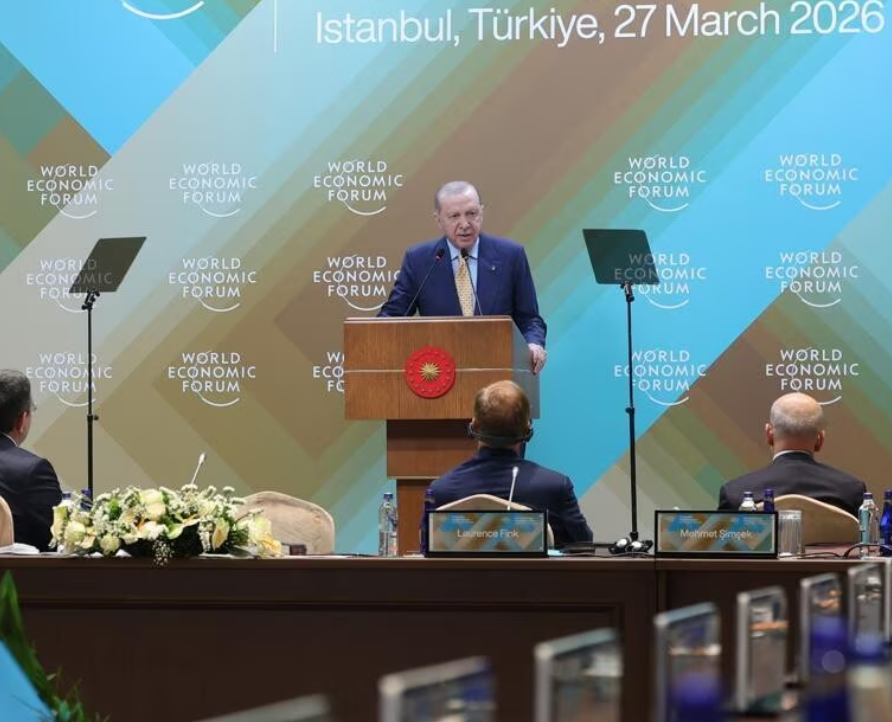
The World Economic Forum (WEF), in collaboration with the Government of Türkiye, convened a high-level Country Strategy Meeting in Istanbul on March 27, 2026. Bringing together senior policymakers and global business leaders, the meeting focused on Türkiye’s strategic position amid rising geopolitical uncertainty and economic fragmentation.
Türkiye at the Center of a Changing Global Order
Positioned at the crossroads of Europe, Asia, and the Middle East, Türkiye is emerging as a critical hub in an evolving geopolitical and economic landscape.
As a:
- G20 economy
- Major industrial producer
- Regional geopolitical actor
Türkiye plays a key role in:
- Global trade flows
- Investment networks
- Production supply chains
Its geographic connectivity and access to major markets place it in a strong position to expand its role in global value chains.
Reform Agenda and Growth Potential
Participants highlighted Türkiye’s ongoing reform agenda and dynamic private sector as key drivers of future growth.
Key priorities include:
- Strengthening economic resilience
- Enhancing competitiveness
- Improving the investment environment
These factors are seen as essential for sustaining growth in an increasingly volatile global economy.
High-Level Participation from Government and Business
The meeting brought together top-level representatives from both the public and private sectors.
Participants included:
- President Recep Tayyip Erdoğan
- Vice President Cevdet Yılmaz
- Foreign Minister Hakan Fidan
- Treasury and Finance Minister Mehmet Şimşek
- Energy Minister Alparslan Bayraktar
- Central Bank Governor Fatih Karahan
President Erdoğan delivered a keynote address and participated in a high-level strategic dialogue.
A Platform for Public-Private Dialogue
The meeting served as a key platform for dialogue between governments and global business leaders.
Discussions focused on:
- Economic policy direction
- Reform priorities
- Investment climate
A dedicated session on regional dynamics and geopolitical developments was led by Foreign Minister Hakan Fidan.
Rising Geoeconomic Uncertainty
Business leaders emphasized growing concerns about global volatility.
Key risks identified include:
- Energy market instability
- Financial fragmentation
- Supply chain disruptions
These factors are:
- Increasing uncertainty
- Delaying investment decisions
- Weighing on global growth prospects
Energy Volatility: A Systemic Risk
Energy markets were highlighted as a major source of global vulnerability.
Concerns include:
- Dependence on fossil fuels
- Supply disruptions
- Price shocks
Executives stressed that energy instability can quickly cascade into:
- Food insecurity
- Economic disruption
- Political instability
The transition to renewable energy was framed as both an economic and strategic necessity.
Financial Fragmentation and Investment Risks
Financial sector leaders warned that geopolitical tensions are accelerating fragmentation in global markets.
Potential consequences include:
- Disruptions to capital flows
- Increased volatility
- Pressure on global trade
This fragmentation could:
- Reduce efficiency
- Slow productivity growth
- Delay long-term investments
The Critical Role of Public-Private Cooperation
A central theme of the meeting was the importance of cooperation between governments and the private sector.
- Governments: provide regulatory clarity and stability
- Private sector: delivers capital, innovation, and execution
This collaboration is essential for:
- Financing the energy transition
- Advancing digital transformation
- Developing infrastructure
Türkiye’s Opportunity for Regional Leadership
Participants noted that Türkiye has the potential to become a regional leader in several key areas:
- Energy transition
- Bioeconomy and innovation
- Trade and logistics
With the right policy framework and investment environment, Türkiye could strengthen its role as a regional growth hub.
A Fragmenting World, A Strategic Moment
The meeting underscored a broader shift in the global system:
- Trade, finance, and infrastructure are becoming increasingly fragmented
- Geopolitical uncertainty is reshaping economic priorities
In this environment:
- Strategic corridors
- Energy systems
- Supply chains
are becoming central to global competition.