Iran war may accelerate Armenia–Azerbaijan peace push and reshape regional trade routes
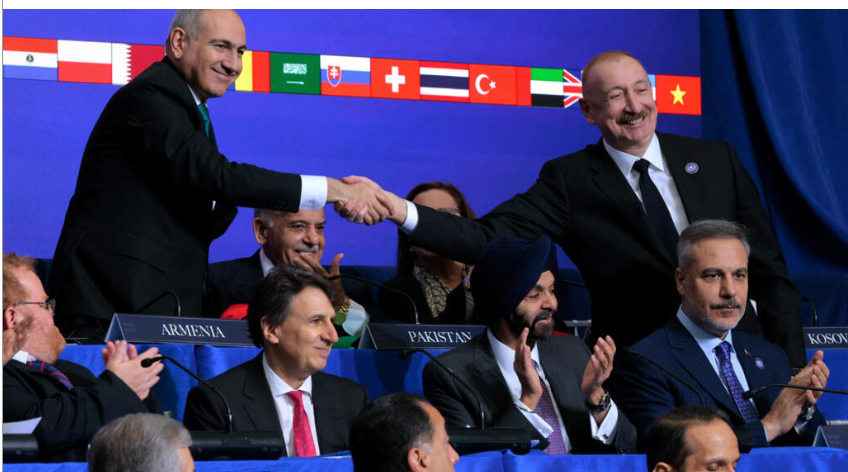 pashinyan aliev
The war in Iran is emerging as an unexpected catalyst for reconciliation between Armenia and Azerbaijan, as both countries seek to capitalize on new trade opportunities linking Europe to Central Asia. The conflict has underscored Europe’s energy vulnerability and boosted interest in alternative transit corridors, including the US-backed TRIPP project. Analysts say the shifting geopolitical landscape could create a rare window for lasting peace—while also reshaping regional power dynamics.
War reshapes incentives for regional cooperation
The escalation of conflict in Iran is prompting a strategic reassessment across the South Caucasus.
- Armenia and Azerbaijan, both bordering Iran, face rising geopolitical and economic risks
- The disruption of Middle Eastern energy flows has highlighted the need for alternative trade routes
Armenian Prime Minister Nikol Pashinyan recently signaled renewed urgency in advancing regional connectivity projects, particularly with Azerbaijan.
TRIPP corridor gains renewed importance
At the center of these efforts is the US-backed TRIPP (Trans-Regional Infrastructure and Partnership Project) agreement.
- Signed as part of a broader normalization framework
- Aims to connect mainland Azerbaijan to Nakhchivan via Armenian territory
- Forms a key segment of the so-called “Middle Corridor”
This route would link Central Asia’s energy resources to Europe via Türkiye, bypassing both Russia and Iran.
The Iran war is also strengthening Türkiye’s strategic position in the region.
“We also shouldn’t forget the benefits of the Iran war,” said Turkey analyst Atilla Yesilada of Global Source Partners. “They [Ankara] want a weak Iran so that they can expand their footprint in the South Caucasus against Iran.”
Yesilada added that the conflict increases the likelihood of the TRIPP corridor becoming viable:
“We get the Trump Road because nobody would want to traverse Iran under these conditions… and you get not immediate but gradual, but permanent, development boost from trade and investment along that route.”
Europe seeks alternatives to Middle East energy
The war has reinforced Europe’s need to diversify energy supply.
- Roughly 20% of global energy flows are affected by Middle East disruptions
- Central Asia—particularly Turkmenistan’s vast gas reserves—has become more attractive
However, experts warn that:
- Infrastructure costs are high
- Political risks remain elevated
A fragile but real opportunity for peace
Despite lingering tensions over Nagorno-Karabakh, analysts see a rare diplomatic opening.
- Economic interdependence could reduce incentives for conflict
- Trade and infrastructure projects may anchor long-term stability
“There is a sort of window of opportunity,” said regional experts, pointing to growing fatigue with conflict and desire for economic normalization.
Challenges remain: geopolitics and investment risks
The region remains highly volatile:
- Russia’s ongoing war in Ukraine
- Iran conflict to the south
- Uncertainty over large-scale European investment
Additionally, EU reluctance to fund fossil fuel infrastructure could complicate financing for energy corridors.
Strategic shift: Türkiye and the Caucasus
The evolving dynamics also highlight Türkiye’s expanding role:
- Acting as a bridge between Europe and Central Asia
- Strengthening influence in the South Caucasus
- Leveraging geopolitical shifts to advance economic goals
Conclusion: Conflict may unlock long-term transformation
While the Iran war is destabilizing in the short term, it may accelerate structural change in the region.
- New trade corridors could reshape global energy flows
- Armenia–Azerbaijan rapprochement may gain momentum
- Türkiye’s regional influence is likely to expand
If sustained, these trends could turn a geopolitical crisis into a long-term strategic realignment.
Dorian Jones
Related articles
Ties with Turkey Are Progressing in the Right Direction: Pashinyan
Carnegie International: Why the EU Needs Turkey to Stabilize the South Caucasus
Trump’s ‘Peace Through Construction’ Has One Real Test Case: The South Caucasus