Türkiye’s Trade Deficit Widens in January as Robin Brooks Warns of Currency Risks
 current account dec2025
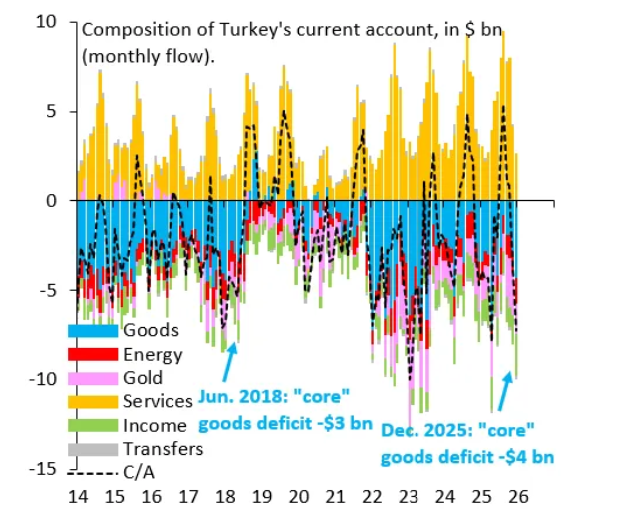
Türkiye’s foreign trade deficit expanded in January 2026 as exports declined and imports remained broadly stable, according to official data. The deterioration in the core trade balance—excluding energy and gold—has drawn renewed scrutiny from analysts. Former IIF chief economist Robin Brooks warned that Türkiye’s “core” deficit is now wider than before the 2018 balance of payments crisis, raising concerns over renewed pressure on the lira if current trends persist.
Exports Fall, Deficit Expands
Türkiye’s exports declined while imports edged slightly higher in January, widening the foreign trade gap compared with the same month last year, provisional figures from the Turkish Statistical Institute (TurkStat) showed.
Under the general trade system:
-
Exports fell 4.0% year-on-year to $20.3 billion
-
Imports rose 0.1% to $28.7 billion
-
The foreign trade deficit increased 11.6% to $8.38 billion
-
The export-to-import coverage ratio dropped to 70.8% from 73.8% a year earlier
The data signal renewed pressure on the external balance at the start of 2026.
Core Trade Balance Shows Deeper Weakness
Excluding energy and non-monetary gold—often referred to as the “core” balance—exports declined 2.0% to $19.1 billion, while imports rose 5.3% to $21.9 billion.
This left a core deficit of $2.8 billion, with the export coverage ratio in this category at 87.2%.
Total foreign trade volume rose 1.8% to $41.0 billion.
Seasonally adjusted data showed exports down 5.8% and imports down 3.7% month-on-month. Calendar-adjusted figures indicated exports declined 1.5% year-on-year, while imports increased 3.4%.
Under the special trade system, exports fell 3.3% to $18.6 billion and imports rose 2.4% to $27.5 billion, pushing the deficit up 16.6% to $8.9 billion.
Composition of Trade: Manufacturing Dominates
Manufacturing continued to account for the bulk of exports, representing 92.7% of the total.
-
Agriculture, forestry and fishing: 4.8%
-
Mining and quarrying: 1.8%
-
High-technology goods: 3.3% of manufacturing exports
On the import side:
-
Intermediate goods: 72.1%
-
Capital goods: 14.3%
-
Consumption goods: 13.1%
-
High-tech products: 12.9% of manufacturing imports
The data suggest Türkiye remains structurally dependent on imported intermediate inputs.
Main Trade Partners
Germany was Türkiye’s top export destination in January, with shipments totaling $1.78 billion, followed by the United Kingdom, the United States, Italy and Iraq. The top five markets accounted for 30.7% of exports.
China ranked as the leading source of imports at $4.28 billion, followed by Russia, Germany, the United States and Switzerland. These five countries accounted for 42.9% of total imports.
Robin Brooks: “Back in the Danger Zone”

Robin Brooks, a senior fellow at the Brookings Institution and former chief economist at the Institute of International Finance, warned that Türkiye’s “core” goods deficit has widened to levels exceeding those seen just before the August 2018 balance of payments “sudden stop,” which triggered a sharp depreciation of the lira.
According to Brooks, the December 2025 data show a pronounced surge in core imports—excluding energy and gold—resembling the spike seen during the credit-driven stimulus of the COVID period.
He argues that such import surges in Türkiye have historically ended in currency devaluation.
Political Economy Risks
Brooks attributes the widening deficit partly to political constraints. He argues that President Recep Tayyip Erdoğan’s fragile hold on power limits policy flexibility, pushing authorities to stimulate growth artificially.
This growth model, he suggests, results in persistent and wide current account deficits.
Türkiye has experienced repeated cycles over the past decade in which rapid credit expansion fueled imports, widened external imbalances, and ultimately led to sharp currency corrections.
Structural Vulnerability
The chart referenced by Brooks highlights the divergence between exports and imports excluding energy and gold. While exports remain relatively stable, core imports have spiked sharply.
Historically, similar dynamics preceded episodes of lira depreciation, as external financing conditions tightened and foreign investor confidence weakened.
With global liquidity conditions uncertain and geopolitical risks elevated, the trajectory of Türkiye’s trade deficit may become increasingly significant for currency stability.
Conclusion: Rising External Pressures
January data confirm renewed strain on Türkiye’s external accounts. While headline import growth remains modest, the widening core deficit suggests underlying demand pressures and structural import dependence persist.
Analysts caution that if the import surge continues without corresponding export strength or capital inflows, renewed volatility in the Turkish lira could follow.
PA Turkey intends to inform Turkey watchers with diverse views and opinions. Articles in our website may not necessarily represent the view of our editorial board or count as endorsement.
Follow our English YouTube channel (REAL TURKEY):
https://www.youtube.com/channel/UCKpFJB4GFiNkhmpVZQ_d9Rg
Twitter: @AtillaEng
Facebook: Real Turkey Channel: https://www.facebook.com/realturkeychannel/