OPINION: Al-Sharaa’s Blitzkrieg: Is the Kurdish Entity in Syria Reaching Its End?
 kurtler suriye
Summary:
Syrian President Ahmad al-Sharaa’s formal recognition of Kurdish citizenship and cultural rights has been presented internationally as a gesture of inclusion. Yet developments on the ground suggest a very different trajectory. Military pressure on Kurdish-held territories, the steady dismantling of autonomous institutions, and shifting regional dynamics point to a rapid consolidation strategy that may ultimately spell the end of the Kurdish political project in Syria.
A Cosmetic Recognition
On January 16, Syrian President Ahmed al-Sharaa officially recognized Kurds as full Syrian citizens, granting them the right to use their language in public life and declaring Nawruz (March 21) a national holiday. The announcement came immediately after violent clashes in Aleppo’s Kurdish district of Sheikh Maqsoud, which triggered the displacement of an estimated 150,000 civilians toward Syria’s northeast—territory still controlled by the Kurdish-led Syrian Democratic Forces (SDF).
The timing raised eyebrows. According to diplomatic sources, dissatisfaction within Washington had been mounting, with U.S. Vice President James Vance reportedly warning that the Caesar Act sanctions regime could be reactivated. Against this backdrop, al-Sharaa’s recognition of Kurdish rights appeared less a structural shift than a tactical move aimed at reassuring Western governments ahead of key diplomatic engagements, including an official visit to Germany.
In this reading, Kurdish recognition functions largely as a symbolic concession—designed to project inclusivity abroad while leaving the balance of power on the ground unchanged.
The March 10 Agreement and Its Limits
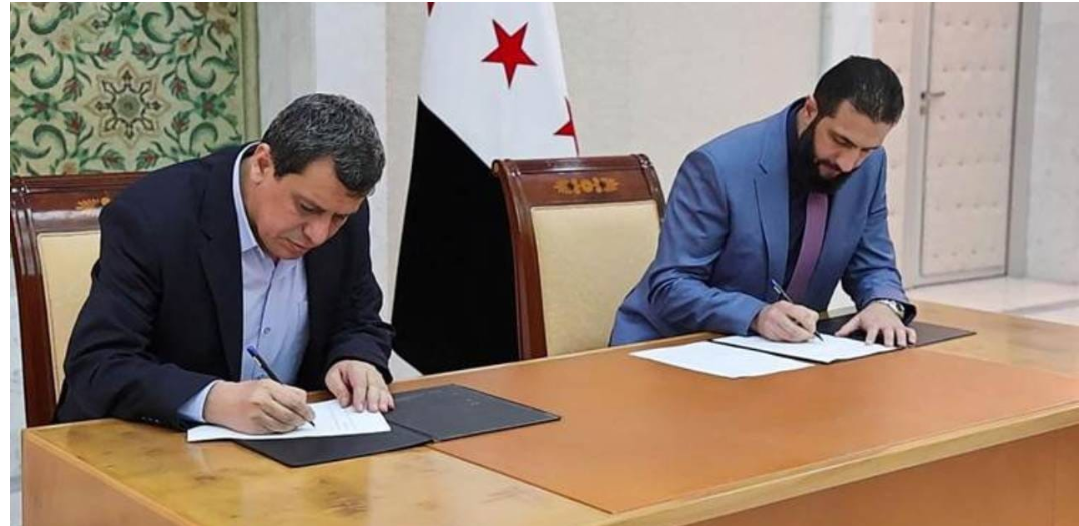
The March 10, 2025 agreement between SDF commander Mazloum Abdi and al-Sharaa, outlining a framework for integrating the SDF into Syria’s national structures, was announced shortly after mass killings of Alawites had shaken international confidence in the new Syrian leadership.
The deal was widely interpreted as an attempt to demonstrate to the United States and the European Union that Syria could be reunified peacefully. Its timing—just days before the annual Syria conference in Brussels—was also politically convenient. Yet the agreement failed to prevent subsequent violence against Druze communities in July, continued repression of Alawites, and renewed military pressure on Sheikh Maqsoud and SDF-held areas.
Rather than marking a genuine power-sharing arrangement, the agreement increasingly looks like a transitional instrument in a broader strategy of centralization.
Dismantling the AANES
Since early 2025, Damascus has steadily moved to dismantle the Autonomous Administration of North and East Syria and neutralize the SDF as an autonomous force. No form of local self-rule appears acceptable to the new regime. Negotiations with Kurdish authorities have repeatedly stalled, with responsibility placed squarely on Kurdish actors accused of obstructing national reunification.
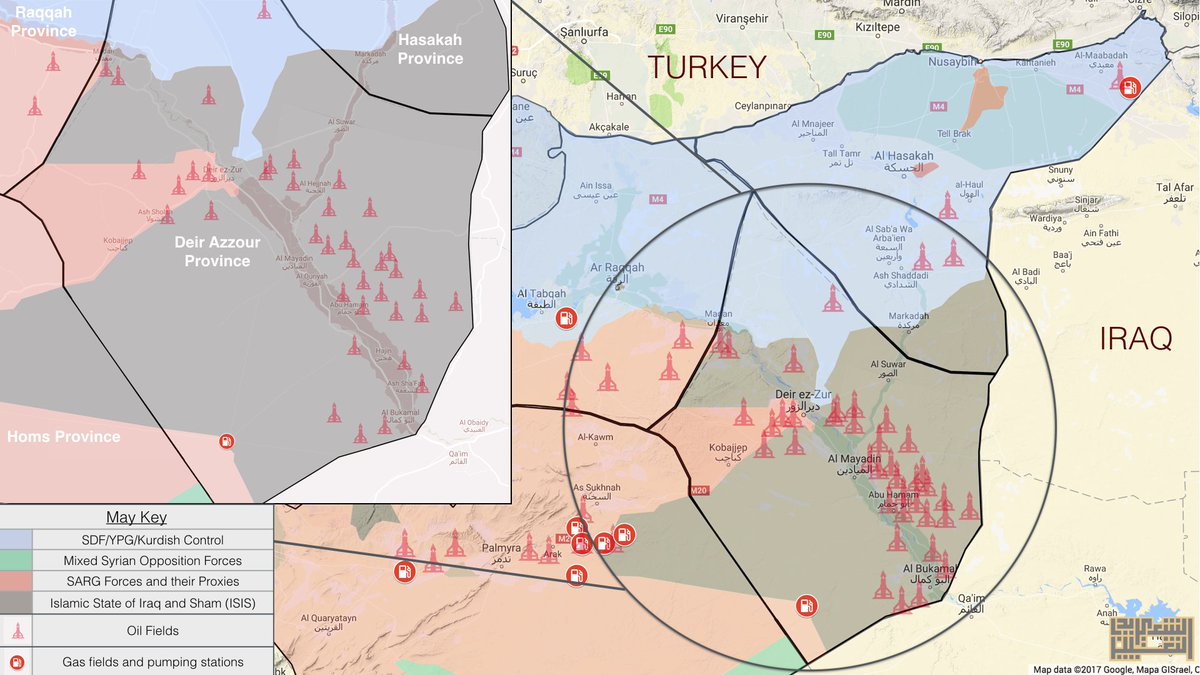
The SDF’s withdrawal from areas west of the Euphrates—following the evacuation of Deir al-Hafar on Lake Assad—has been widely interpreted as the first step in a broader rollback. Observers expect Damascus to next demand Kurdish withdrawals from Raqqa, Deir al-Zor, and eventually the entire Euphrates Valley.
For al-Sharaa, Deir al-Zor is the strategic prize. The province contains a significant share of Syria’s oil reserves, and reopening it to foreign energy companies would provide critical revenue for the regime.


Raqqa and the Arab Factor
Raqqa remains the political center of the AANES and the symbolic heart of the Kurdish-Arab federal experiment. Yet its demographic reality complicates that vision. The city itself, like most of the Euphrates Valley stretching to the Iraqi border, is overwhelmingly Arab.
Kurdish forces have maintained their presence by granting wide autonomy to local Arab tribes, seeking to avoid confrontation. Still, many tribal leaders have long favored an Arab-led central government—sentiment that has intensified since the fall of Bashar al-Assad.
This latent tension provides Damascus with a powerful lever, allowing it to frame its campaign not as ethnic repression but as the restoration of national sovereignty.
Kobani, Hasakah, and Qamishli: Shrinking Safe Havens
Kobani, the emblem of Kurdish resistance against the Islamic State, is increasingly vulnerable. The city is hemmed in by Turkey to the north, Turkish-controlled territories to the east (Tel Abyad) and west (Jarablus), and hostile Arab areas to the south. Analysts warn that a siege similar to Afrin in 2018 could force Kobani’s fall and trigger the mass departure of its Kurdish population—replicating the demographic transformation already seen in Afrin.
In Hasakah, a city of roughly 500,000, demographic pressure runs in the opposite direction. The population is predominantly Arab, and resentment toward Kurdish authorities has deepened amid prolonged water shortages since Turkey’s 2019 offensive in Ras al-Ayn. Kurds are widely blamed for the resulting hardship, further eroding social cohesion.
Only Qamishli and the so-called “duck’s beak” region remain Kurdish-majority. Even there, relations with surrounding Arab tribes are tense, and Turkey’s proximity looms large. Kurdish leaders view the presence of U.S. military bases as the last credible deterrent—provided Washington does not withdraw.


The West’s Minimal Objective
Western policy toward Syria appears increasingly narrow: prevent a mass slaughter of Kurds and contain security risks linked to thousands of detained former ISIS fighters. Beyond that, support for Kurdish political autonomy has all but evaporated.
The dismantling of the SDF is already underway. Despite their pivotal role in defeating the Islamic State, Kurdish forces now find themselves isolated. History suggests that a reconstituted Syrian army—particularly one dominated by Islamist militias aligned with al-Sharaa—is unlikely to show restraint toward minorities, as recent violence against Alawites and Druze has demonstrated.
Consolidation Through Conflict
For al-Sharaa, eliminating the AANES has become a central political objective. Crushing Kurdish autonomy offers a powerful rallying point for Syria’s Arab majority, where anti-Kurdish sentiment remains widespread. Celebrations in Aleppo following the fall of Sheikh Maqsoud underscored how deeply this sentiment runs.
Militarily, defeating the Kurds also serves a symbolic purpose: forging a new Syrian army through victory over America’s former allies and avenging the humiliations suffered at the hands of Druze forces and Israel in mid-2025.
Outlook
Al-Sharaa’s strategy resembles a political blitzkrieg—combining selective concessions, diplomatic signaling, and relentless military pressure. While framed as national reunification, it risks entrenching ethnic grievances and sowing the seeds of future instability.
The Kurdish entity in Syria, once buoyed by Western backing and battlefield success against ISIS, now faces its most serious existential threat. Whether it can survive will depend less on declarations of citizenship than on hard power, regional alignments, and the still-uncertain calculus of the United States.
By Fabric Balanche
PA Turkey intends to inform Turkey watchers with diverse views and opinions. Articles on our website may not necessarily represent the view of our editorial board or count as endorsement.
Follow our English YouTube channel (REAL TURKEY): https://www.youtube.com/channel/UCKpFJB4GFiNkhmpVZQ_d9Rg
Twitter: @AtillaEng
Facebook: Real Turkey Channel: https://www.facebook.com/realturkeychannel/
Related articles
U.S. official: No plans to withdraw troops from northeast Syria or establish a base near Damascus
Kurdish party optimistic Ocalan will make a call for peace, albeit with some delay

Robert Ellis: Turkey is the Hole in the Western Security Bucket