Why Türkiye Was Absent from Washington’s Critical Minerals Summit
 kritik mineraller zirve
Türkiye’s absence from Washington’s Critical Minerals Ministerial in February 2026 raised eyebrows, given its geographic proximity to Europe, industrial capacity and strategic relevance to Western supply chains. Analysts argue the issue was not geopolitical exclusion, but Türkiye’s failure to present a coherent, institutionally anchored critical minerals strategy that links mining, processing, industry and end markets.
Washington’s push to counter China’s dominance
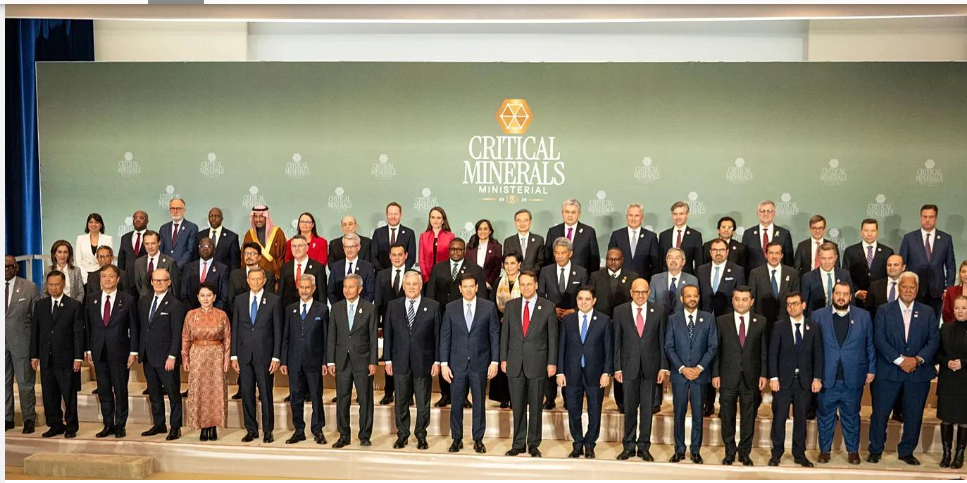
On February 4, 2026, Washington hosted the Critical Minerals Ministerial, bringing together representatives from 54 countries and the European Commission. With 43 ministers in attendance, the meeting aimed to coordinate a new global supply chain for minerals essential to electric vehicles, smartphones, defence systems and power grids.
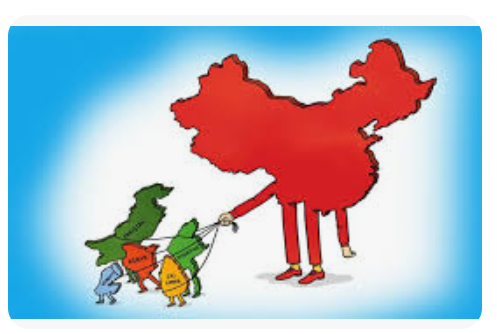
The political motivation was explicit. China dominates both the mining and processing of many critical minerals, in some cases controlling more than 90% of global supply. US Secretary of State Marco Rubio framed this concentration as a risk not only to markets, but also to global security and stability.
China’s leverage extends beyond domestic production. Through the Belt and Road Initiative, Beijing has secured long-term access to mineral resources across Asia, Africa and Latin America, and has demonstrated its willingness to weaponise supply chains during political disputes.
Against this backdrop, Türkiye’s absence appeared striking—particularly given the participation of countries with far smaller production capacity.
A missed seat, not a closed door
Türkiye was not represented at the ministerial. However, the following day in Istanbul, a panel titled US Critical Minerals Policies and Türkiye’s Geoeconomic Position was held by the İstanbul Maden İhracatçıları Birliği (IMIB) in cooperation with TABA–AmCham.
According to Sait Uysal, founder of the Critical Minerals Initiative Türkiye, the absence does not reflect a lack of international interest, but rather a domestic coordination failure.
“There is constant outreach from different countries and official institutions asking about rare earths and cooperation opportunities,” Uysal said. “I am certain similar requests reach Türkiye as well, but most likely they cannot find the right counterpart.”
Speaking to Türkiye Today, Uysal argued that Türkiye has yet to articulate a unified strategy that integrates mining, processing, manufacturing and downstream markets. Without such an ecosystem, participation in critical minerals alliances risks remaining symbolic rather than transformative.
Why mining alone does not create strategic value
Experts stress that critical minerals—particularly rare earth elements—generate strategic and economic value only when they are processed and embedded into industrial supply chains.
“If you produce rare earths but do not process them, the only buyer today is China,” Uysal said. “Once you turn them into magnets, motors or components, you need a domestic or allied market capable of absorbing that output.”
Processing rare earths requires a strong chemical industry, advanced engineering capabilities and strict environmental oversight. Radioactive waste management—due to thorium and uranium by-products—also demands institutional capacity that Türkiye has yet to fully develop.
Lithium as Türkiye’s more viable entry point
Rather than focusing narrowly on rare earths, Uysal believes Türkiye’s comparative advantage lies in lithium. He points to lithium content embedded in boron mining waste—an underutilised resource with significant upside potential.
“Türkiye could become one of the world’s largest lithium producers,” Uysal said, noting that the country already has battery manufacturing capacity.
By converting domestically produced lithium into batteries and, eventually, electric vehicles, Türkiye could anchor value within its own industrial ecosystem. “Once lithium is turned into batteries, value is locked in,” he said, highlighting the multiplier effects across the supply chain.
Beyond lithium: defence-critical metals
Türkiye’s potential extends beyond lithium. Titanium-bearing iron ores could reduce dependence on imported scrap and pig iron—key vulnerabilities in the Turkish steel sector. These deposits often also contain vanadium, a high-value metal used in energy storage and advanced alloys.
There is also evidence of gallium and germanium in historical mining waste, particularly in central Anatolia. These metals are critical for defence and semiconductor industries, yet Türkiye lacks a comprehensive national inventory of such resources.
Compared with Europe—where opening a new mine can take up to two decades—Türkiye benefits from shorter regulatory timelines, existing energy and transport infrastructure, port access and a skilled workforce. This positions the country as a natural candidate for near-shoring and friend-shoring strategies.
The real barrier is internal, not geopolitical
Uysal sees no structural reason for Türkiye to remain outside emerging critical minerals alliances.
“There is no reason not to join,” he said. “What prevents it is our own mindset.”
He points to bureaucratic inertia, fragmented authority and a tendency to overstate existing capabilities. In one example, a project proposing to produce tens of thousands of tonnes of lithium carbonate from solid waste stalled for years, despite high-level political backing.
“We often convince ourselves that we already know everything and can do everything,” Uysal said. “That leads to the belief that we do not need partnerships, technology transfer or new strategies.”
Strategic potential, policy gap
With its resource base, industrial capacity and proximity to European markets, Türkiye remains well positioned to become a key node in non-Chinese critical mineral supply chains. Achieving this, however, requires acknowledging institutional gaps and committing to a clear, credible and coordinated national strategy.
As Uysal put it:
“Türkiye has no shortage of potential. What it needs is the willingness to break its own internal barriers and turn that potential into policy.”
Türkiye’s absence from Washington does not rule out future participation. But as supply chains harden and partnerships deepen elsewhere, delay carries rising strategic and economic costs.
Source: Turkiye Today
Related articles
Turkey between War and Peace | Atilla Yesilada video
Gonul Tol: This week in Ankara
TRT News: Turkey’s Mega Find: How 694 Million Tons of Rare Earth Elements Could Break China’s Global Monopoly