Why Marmara’s Underwater Faults Differ from the 1999 Quake
 istanbul-earthquake
Prof. Dr. Osman Bektaş has provided a compelling geological analysis regarding the seismic behavior of the Marmara Sea. By comparing the historical 1935 Erdek-Marmara Island and 1963 Çınarcık earthquakes with the recent 2025 Silivri-Kumburgaz event, Bektaş highlights a phenomenon he calls the “Seismic Brake.” He argues that underwater fault segments in the Marmara often exhibit “fault creep” and “fragmented rupture,” which prevents the catastrophic, continuous energy release seen during the 1999 Izmit earthquake.
The “Sledgehammer” vs. The “Fragmented” Rupture
The core of Bektaş’s theory lies in the mechanical state of the faults. In the 1999 Izmit earthquake 7.4), the fault was completely locked, allowing tension to build over decades before it snapped along a continuous 145-kilometer-long rupture. This resulted in a massive, instantaneous energy discharge that caused widespread devastation.
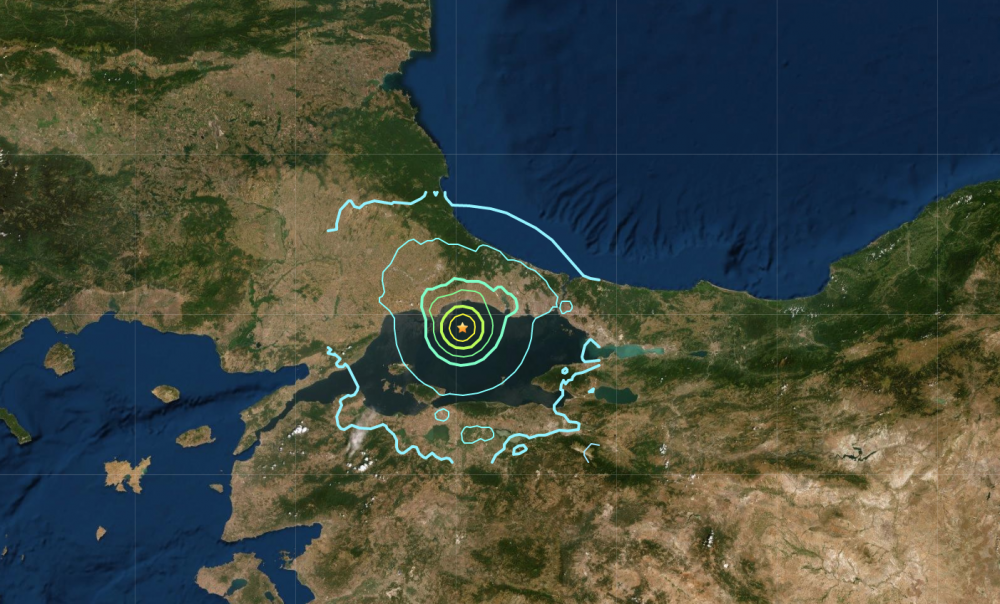
In contrast, the Marmara Sea Type earthquakes—such as the 6.2-6.3 event on April 23, 2025—behave differently. Bektaş suggests that because parts of these underwater faults are “creeping” (moving slowly without snagging), they act as buffers. When a rupture starts in a locked section, it slows or stops upon encountering a creeping zone, limiting the earthquake’s overall destructive reach.
Marmara’s Underwater Faults: 1935, 1963, and 2025
Scientific records support the idea that Marmara’s internal quakes, while significant, tend to stay localized:
-
1935 Erdek-Marmara Island (6.4): Heavily damaged the Marmara Islands but failed to trigger a basin-wide disaster.
-
1963 Çınarcık (6.3): Concentrated damage in Yalova and Çınarcık, notably causing a small tsunami, but lacked the “mega-rupture” characteristic of land-based faults.
-
2025 Silivri-Kumburgaz (6.2-6.3): Despite triggering over 500 aftershocks and causing significant panic in Istanbul, it activated only a 20-kilometer segment, sparing the city from a 1999-scale structural collapse.
Scientific Consensus: A “Partial Luck” with Remaining Risks
While Bektaş views the creeping segments as a “partial seismic risk” for Istanbul, global research institutions, such as GFZ (the German Research Center for Geosciences), and journals, such as Seismica, maintain a cautious stance. Studies confirm that while the western Marmara shows high creep rates, the segment directly south of Istanbul remains locked and continues to accumulate stress.
The “seismic brake” might prevent a single earthquake from tearing through the entire 150-kilometer Marmara line at once, but it does not eliminate the risk of a high-magnitude event on the remaining locked segments.
Source: karar
Related articles
Istanbul Quake May Be Smaller Than Feared, Says Geologist
NYT Warns Istanbul Could Face One of the Worst Humanitarian Disasters in Recent History
Two Major Earthquake Scenarios Threaten Istanbul, New Study Warns