Turkey’s Inflation Outpaces OECD Peers at Record Rates
 OECD-Turkey-inflation
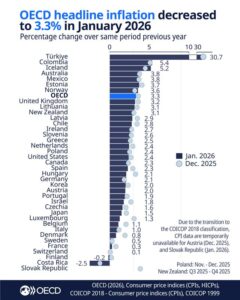
The latest January 2026 Consumer Price Index (CPI) data from the OECD reveals a stark divergence in global economic trends. While member nations are successfully cooling their economies with average inflation dropping to 3.3%, Turkey remains a global outlier. With a staggering 30.7% inflation rate, Turkey’s inflation has effectively decoupled from the price-stability trajectories of the world’s most developed economies.
A Growing Chasm: Turkey’s Inflation vs. The Global Average
The distance between Turkey and its closest OECD peers has reached unprecedented levels. While Turkey’s inflation battles a 30.7% headline rate, its nearest competitor, Colombia, recorded a significantly lower 5.4%. This “inflation gap” highlights a structural decoupling from the G7 and Eurozone nations, where price increases are hovering near or below the ideal 2% target.
Key comparisons from the report include:
-
USA & Germany: Stable at 2.4% and 2.1% respectively.
-
Switzerland & France: Near-zero growth at 0.1% and 0.3%.
-
OECD Average: Down to 3.3%, signaling a successful global disinflationary period.
The Cost of Living: Turkey’s Food and Energy Crisis
Turkey’s Food and Energy Crisis is growing rapidly. The most painful disparity for Turkish citizens lies in essential goods. Food inflation in Turkey hit 31.7% in January, nearly nine times the OECD average of 3.7%. While countries like Estonia (6%) and Iceland (5.9%) followed Turkey, major economies like Germany and the US kept food price hikes around a manageable 2%.
The energy sector tells an even more contrasting story. Across the OECD, energy prices actually fell by 0.6% on average, with countries like Denmark seeing a massive 15% drop. In contrast, energy prices in Turkey surged by 28.2%, placing the country at the top of the list for rising utility and fuel costs.
OECD Growth Outlook: Turkey Among European Economies Set to Expand the Fastest
G7 Resilience and the Path Ahead
The G7 nations continue to show economic resilience. Despite global geopolitical tensions, inflation in the UK (3.2%) and Japan (1.5%) remains under control. The OECD data suggests that while the rest of the world is transitioning into a post-inflationary era, Turkey’s internal dynamics, ranging from currency volatility to supply chain disruptions, continue to fuel a unique and aggressive inflationary cycle.