Treasury Starts 2026 with a Deficit: Interest Burden Tightens Its Grip on Public Finance
 butce1
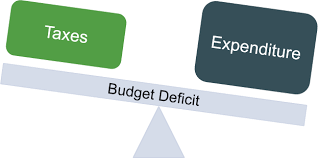
The Ministry of Treasury and Finance has published the “Cash Realizations” report for January 2026. The data indicates that the gap between budget revenues and expenditures continues to widen, with interest payments maintaining a dominant and restrictive role over public finance.
January 2026 Figures: Revenues Fall Short of Spending
In January, the Treasury recorded a cash inflow of 1 trillion 365 billion TL, while total expenditures reached 1 trillion 611 billion TL. As a result, the Treasury cash balance posted a deficit of 246.2 billion TL in the first month of the year.
A closer look at the spending details reveals that non-interest expenditures amounted to 1 trillion 157 billion TL. However, the most striking figure lies on the interest side: interest payments made in January totaled 453.7 billion TL, accounting for approximately 28% of total expenditures.
Jan 2025 vs. Jan 2026: What Has Changed in a Year?
A comparison with January data from the previous year clearly illustrates the inflationary impact and the surge in borrowing costs through massive nominal increases:
| Headline (Billion TL) | Jan 2025 (Estimated/Actual) | Jan 2026 | Change (%) |
| Cash Revenues | ~850 | 1,365 | ~60% |
| Cash Expenditures | ~1,050 | 1,611 | ~53% |
| Cash Balance (Deficit) | ~200 | 246.2 | ~23% |
| Interest Payments | ~280 | 453.7 | ~62% |
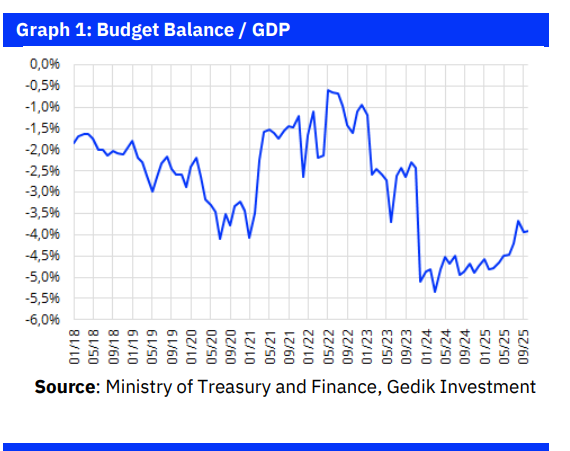
While the growth rate of revenues appears high due to tax adjustments and base effects, the 62% spike in interest expenses remains the primary threat to fiscal discipline. Due to the month-to-month shifts in tax revenue collections typical of every year, comparing the narrowing or expansion of the deficit is difficult; however, according to headline data, the inflation-adjusted narrowing of the budget deficit continued in the first month of the year.
2025 Retrospective: A Year in Review
The year 2025 passed under the shadow of “fiscal tightening” and “post-earthquake rehabilitation” expenditures for the Turkish economy.
-
Deficit Record: In 2025, the budget deficit is expected to materialize at around 3.5% of GDP. While this is considered a success compared to the 2022 deficit swollen by earthquake spending, experts argue that fiscal policy still offers almost no support to the Central Bank’s (CBRT) inflation-fighting targets.
-
Spending Pressures: Public sector wage hikes, the burden of the early retirement (EYT) law on social security, and defense industry investments were the primary items straining the 2025 budget.
-
Revenue Performance: Tax revenues, particularly indirect taxes like VAT (KDV) and SCT (ÖTV), met targets. However, the slowdown in the real sector created pressure on corporate tax collections.
2026 Projections: What Lies Ahead?
The Medium-Term Program (OVP) and the budget law for 2026 foresee a more cautious fiscal path:
-
Focus on Fiscal Discipline: The government aims to pull the budget deficit-to-GDP ratio down to the 3.4% band in 2026. However, the 246 billion TL deficit in January suggests that achieving this target will be a challenge.
-
Interest Burden: Due to the tight monetary policy stance and high borrowing costs, interest expenses are expected to consume 15-20% of the total budget throughout 2026.
-
Tax Reform: Reforms aimed at combating the informal economy and increasing the share of direct taxes, set to be implemented in the second half of 2026, may support the revenue side.
In summary: 2026 will be a year of balancing “debt rollover costs” with “fiscal discipline” for the Treasury. The January data has once again confirmed that interest payments are the most significant “rigidity” factor in public finance.