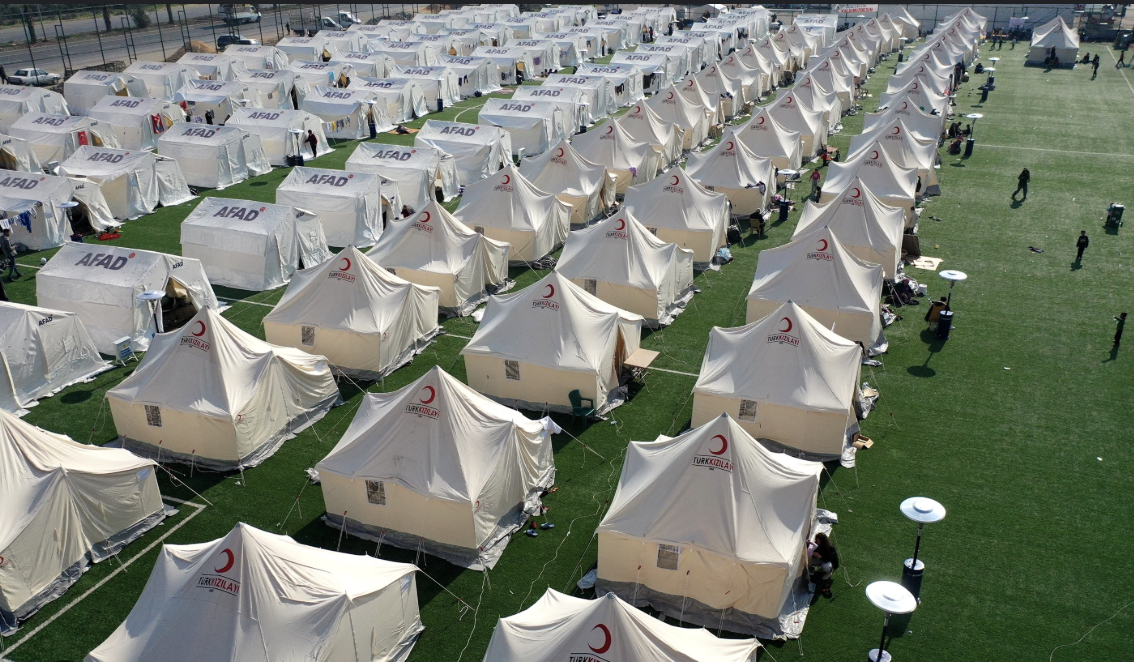
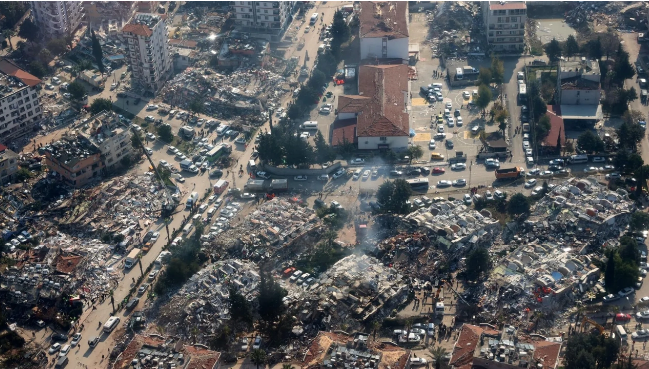
Three years after Hatay quake, industry struggles with labour shortages as opposition questions accountability
 deprem3
Three years after the devastating February 6 earthquakes, industrial production in southern Türkiye has largely resumed, but structural problems—most notably labour shortages and financing constraints—continue to weigh on the region’s economic recovery. While the government highlights massive reconstruction spending, opposition leader Ekrem İmamoğlu says accountability for failures before and after the disaster remains unresolved.
As Türkiye marks the third anniversary of the Kahramanmaraş-centered earthquakes that killed more than 53,000 people, business leaders in the disaster zone say industrial activity has restarted but has yet to return to pre-quake capacity.
Speaking to Bloomberg HT, Adana Chamber of Industry President Zeki Kıvanç said factories in heavily affected provinces such as Adana, Hatay and Kahramanmaraş were largely back online, but companies were struggling to find skilled workers.
“Production has resumed to a significant extent, but our biggest problem is labour,” Kıvanç said. “Industrialists who want to continue producing are back, yet they cannot find qualified employees.”
Earthquake Warning: Experts Say the Threat Goes Far Beyond Istanbul
Labour shortages and financing pressures
According to Kıvanç, the earthquakes triggered lasting disruptions in the regional labour market as workers relocated permanently or remained hesitant to return. He added that while the overall picture shows gradual recovery, sector-specific difficulties persist.
Kıvanç also criticised the government’s foreign-exchange conversion incentive for exporters, which provides a 3% support payment. He said only about 20% of exporters were able to benefit from the scheme, calling for a broader and unconditional mechanism.
“If exporters bring foreign currency into the country and complete their exports, the FX conversion support should be granted without restrictive conditions,” he said, adding that access to finance remained a major bottleneck for post-quake recovery.
Similar concerns were raised in Malatya, another city severely affected by the disaster. Malatya Chamber of Commerce and Industry President Oğuzhan Ata Sadıkoğlu said more than 100,000 residents had left the province after the earthquake, significantly weakening its production base.
Sadıkoğlu urged the government to extend sixth-region investment incentives to accelerate recovery, warning that rising land prices were discouraging new industrial investment. He said the number of active factories in Malatya’s organised industrial zone had fallen from 436 to around 390.
360,000 Still in Containers as Earthquake Region Lags Behind
Reconstruction bill exceeds $90 billion
Official data show that reconstruction and recovery spending has surpassed $91 billion over the past three years, approaching earlier estimates that placed the total cost of the disaster at more than $100 billion.
The February 6, 2023 earthquakes—measuring 7.7 and 7.6 magnitude—affected 11 provinces with a combined population of nearly 15 million. Almost 37,000 buildings were completely destroyed, while more than 300,000 were rendered uninhabitable.
According to the Presidency’s Strategy and Budget Directorate, total earthquake-related spending from the central government budget reached 3.6 trillion lira between 2023 and 2025, with an additional 653 billion lira allocated in the 2026 budget.
Authorities say more than 433,000 housing units and nearly 22,000 workplaces have been completed so far, while infrastructure, healthcare, education and transport projects continue across the region. Roughly 85% of residents who left after the disaster have returned, according to official estimates.
Opposition: economic rebuilding without accountability is incomplete
Marking the anniversary, Ekrem İmamoğlu, speaking from detention in Silivri prison in a message read publicly by his wife, framed the disaster as both an economic and governance failure.
İmamoğlu said that while public solidarity after the earthquake was historic, responsibility for the scale of destruction and delays in emergency response had not been properly addressed.
“Those who bore responsibility for the losses continue their lives without consequence, while those who rushed to help remain behind bars,” he said, referring to detained opposition municipal officials.
İmamoğlu argued that Türkiye’s ability to rebuild safer cities and protect economic assets was undermined by weak oversight, politically driven urban development, and the exclusion of experienced planners and local administrators from disaster preparedness efforts.
He said long delays in accountability were compounding economic losses by slowing the transition from temporary housing to permanent production and employment, particularly in small and medium-sized enterprises.
Outlook
While the government highlights the scale of reconstruction spending as evidence of recovery, business groups warn that without targeted labour policies, improved financing access, and stronger institutional trust, the region risks falling short of its pre-quake economic potential.
Three years on, the disaster’s economic legacy remains a central fault line in Türkiye’s broader debate over governance, resilience and growth.
PA Turkey intends to inform Turkey watchers with diverse views and opinions. Articles in our website may not necessarily represent the view of our editorial board or count as endorsement.
Follow our English YouTube channel (REAL TURKEY):
https://www.youtube.com/channel/UCKpFJB4GFiNkhmpVZQ_d9Rg
Twitter: @AtillaEng
Facebook: Real Turkey Channel: https://www.facebook.com/realturkeychannel/***