The Iran War and the Global Economy: Navigating the 2026 Energy Shock
 world economy iran
As the conflict with Iran moves into its second week, the focus of the international community is shifting from the immediate military theater to the long-term mathematical reality of global economic stability. For economists, war is not merely a clash of ideologies but a violent disruption of trade routes, commodity pricing, and currency valuations. The current data suggests that the fallout from this conflict will be profoundly uneven, rewarding energy-independent nations while threatening a period of “stagflation” for those reliant on the Middle East’s energy exports.
The Immediate Toll: Regional Contraction
The heaviest economic burden is inevitably falling on the combatants and their neighbors. Historical precedents, such as the brief 2024 regional skirmishes, saw Israel’s GDP contract by 1% in a single quarter. Today, with a broader and more sustained conflict, the wound is far deeper. Iran, which has not published official GDP data since 2024, is projected by analysts to face a contraction exceeding 10% as infrastructure is targeted and sanctions reach a terminal phase. For the Gulf economies, the sudden halt in tourism, the postponement of multi-billion dollar investment projects, and the disruption of local manufacturing are creating a recessionary environment that could take years to reverse.
Unveiling Hidden Chokepoints: Beyond Oil and Gas
While the world traditionally views the Middle East through the lens of crude oil, this war has revealed critical “hidden” dependencies in the global supply chain. Qatar, for instance, produces roughly 40% of the world’s helium—a gas essential for the cooling systems used in high-end semiconductor manufacturing. A prolonged halt in Qatari exports could trigger a global “chip crisis” far more severe than the one seen in 2021. Furthermore, the region is a dominant producer of ammonia and nitrogen, the primary ingredients in synthetic fertilizers. The current blockage of the Strait of Hormuz is effectively a “food security shock,” as farmers in the Northern Hemisphere scramble for supplies ahead of the spring planting season.
The Strait of Hormuz: The Global Jugular
The primary transmission channel for this economic shock remains the Strait of Hormuz. Roughly one-quarter of the world’s seaborne oil and one-fifth of global liquefied natural gas (LNG) pass through this narrow waterway. With transit through the Strait currently collapsed due to the conflict, energy prices have experienced a vertical jump. In economic terms, this alters the “terms of trade” for every nation on Earth, transferring trillions of dollars in income from energy-importing nations to energy exporters.
Winners and Losers in the New Energy Map
The surge in energy prices has divided the global economy into two distinct camps:
-
The Strategic Winners: Large net energy exporters outside the immediate conflict zone stand to benefit immensely. Norway, Canada, and Russia are seeing their export revenues skyrocket as global markets seek secure alternatives to Middle Eastern supply. These nations are experiencing a massive influx of foreign currency, bolstering their fiscal positions and domestic investment capabilities.
-
The Vulnerable Importers: At the other end of the spectrum are the industrial powerhouses of Asia and Europe. Japan, South Korea, India, and China—all heavily reliant on Gulf energy—are facing a surge in production costs and a sharp erosion of household purchasing power. In Europe, countries like Germany and France are bracing for a renewed inflation spike just as they were beginning to recover from the post-Ukraine energy crisis.
The American Shield: The Shale Revolution’s Legacy
The United States finds itself in a unique and historically unprecedented position during this conflict. Thanks to the shale revolution over the last decade, the U.S. has transitioned from being the world’s largest energy importer to a modest net exporter. This shift acts as a massive macroeconomic stabilizer. While American households are feeling the sting of $4-plus gasoline at the pump, the profits generated by domestic energy producers and their investors are feeding back into the U.S. economy, cushioning the blow to national GDP. This divergence is likely to reinforce the relative strength of the U.S. dollar against the Euro and Yen in the coming months.
Macroeconomic Projections: Inflation and the Fed’s Dilemma
Economists have developed two primary scenarios for the remainder of 2026 based on the persistence of the energy shock:
-
The Transitory Shock (Oil at $75-$85): If the conflict remains contained or the U.S. Navy successfully implements tanker escorts through the Strait, global inflation may only rise by 0.5 percentage points above pre-war forecasts. In this scenario, the world economy remains on its growth trajectory, albeit with slightly higher price levels.
-
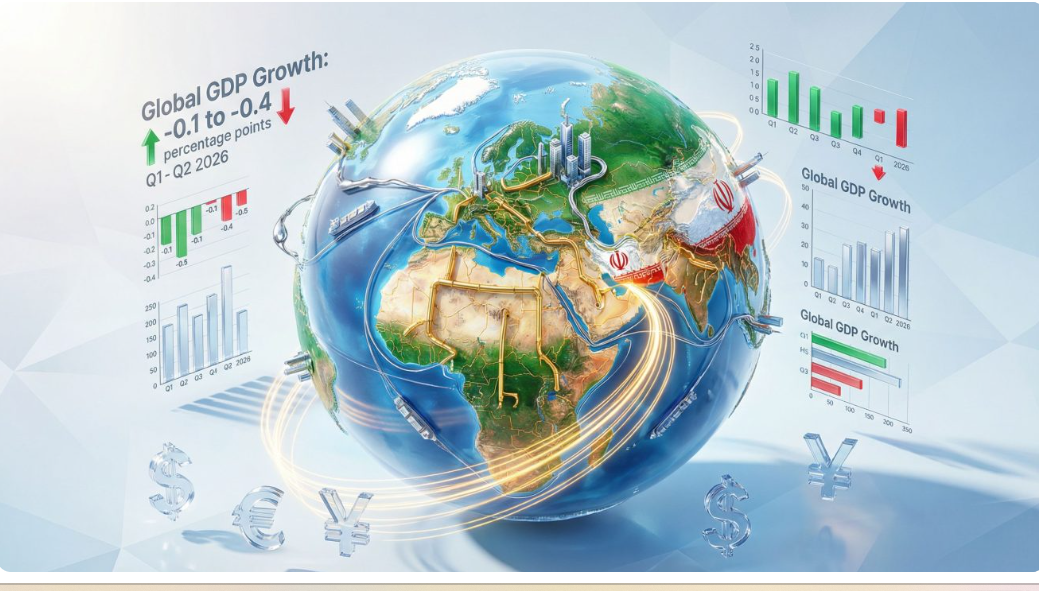
The Sustained Crisis (Oil at $100+): Should oil remain at triple digits for the rest of the year, global inflation could climb by a full percentage point, while GDP growth could be shaved by 0.3% to 0.4%. This is the “nightmare scenario” for central banks. The Federal Reserve and the Bank of England, both of which were preparing for a cycle of interest rate cuts, would be forced to keep rates “higher for longer” to prevent an inflationary spiral, potentially tipping their economies into a technical recession.
Emerging Markets: The Fiscal Fault Lines
For many emerging markets, the impact is softened initially by government fuel subsidies. However, this shift places the burden directly on the state’s balance sheet. While most emerging economies have stronger fiscal positions than they did twenty years ago, those with high debt and low reserves—such as Egypt, Tunisia, and Pakistan—are extremely vulnerable. A prolonged spike in global energy prices could unsettle their bond markets, leading to capital flight and a full-blown sovereign debt crisis.
Conclusion: While the “2026 Iran Shock” is currently viewed as manageable at the global level, its uneven distribution is creating a more fragmented world. If energy prices remain elevated through the spring, the global economy faces a period of sluggish growth and persistent inflation, where the only true winners are those who control the fuels of the future.
Source: Neil Shearing, Chatham House
PA Turkey intends to inform Turkey watchers with diverse views and opinions. Articles in our website may not necessarily represent the view of our editorial board or count as endorsement.
Follow our English YouTube channel (REAL TURKEY):
https://www.youtube.com/channel/UCKpFJB4GFiNkhmpVZQ_d9Rg
Twitter: @AtillaEng
Facebook: Real Turkey Channel: https://www.facebook.com/realturkeychannel/