The $41 Billion Vanishing Act: Can Turkey Survive a Long War?
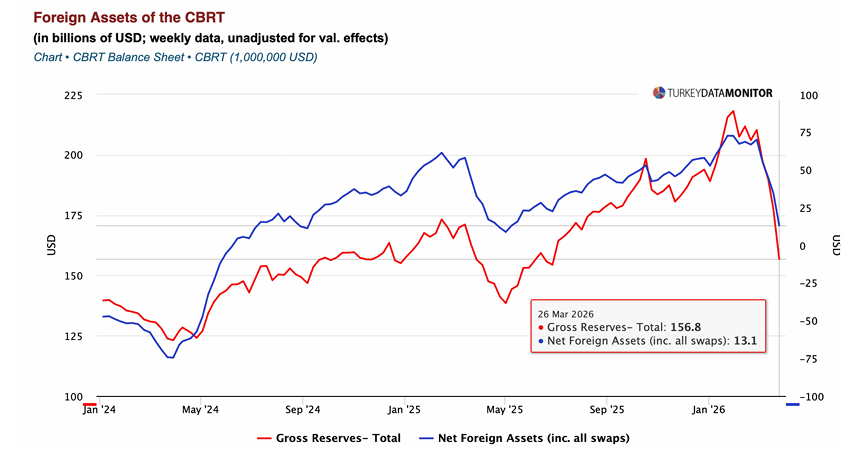 cbrt reserves 19march
By Cüneyt Akman
Let’s not beat around the bush: we are entering a period that I can only describe as “Geopolitical Stagflation.” If you think the current economic turbulence is just a passing cloud, you haven’t been paying attention to the data—or the sound of the drums beating in the Zagros Mountains and the Persian Gulf. After a brief hiatus, I’ve returned to the screen with Zeynep Ece Ulukaya to look at the cold, hard numbers provided by our “Ayda” AI model and our team at the finance lab. The diagnosis? It’s not pretty.
The $41 Billion Hole
The most alarming figure sitting on my desk today is the rapid depletion of the Central Bank of the Republic of Turkey’s (CBRT) reserves. Since February 27—the eve of this tragic conflict—our net reserves have plummeted by approximately $41 billion. As of March 19, gross reserves have shrunk to $177.5 billion.
Why is this happening? It’s a classic pincer movement. On one side, we have a massive exit of foreign “carry trade” and portfolio investment—roughly $16 billion has fled the country in a month. On the other side, the CBRT is desperately burning through dollars to keep the Lira from a total freefall. We are back in the shadow of the “128 Billion Dollar” debate, using swaps to mask a reality that is increasingly difficult to hide: our “owned” reserves are being replaced by “borrowed” ones.
ANALYSIS: CBRT Executes Historic $18 Billion Gold Drawdown Amid Regional Turmoil
The Gold Swap Strategy
You may have seen the headlines in Bloomberg about Turkey selling 60 tons of gold. Let’s clarify what’s actually happening. My colleague Kerim Karakaya—one of the best in the business—broke the news that Turkey moved about $8 billion worth of gold. According to the balance sheets, 34.4 tons were swapped (rented out for dollar liquidity) and 22.2 tons were sold outright.
Is gold still a safe haven? Yes, but it’s a volatile one. Last year, gold’s rise was driven by central banks. This year, it’s driven by private funds and ETFs. These funds don’t have the stomach of a central bank; they sell at the first sign of a margin call. This is why we saw gold prices dip just as the war intensified—a paradox that confused many, but was perfectly predicted by our models. In a crisis, everyone rushes for cash (liquidity), and gold is the most profitable “piggy bank” to break.
Geopolitical Stagflation: The Silent Killer
I’ve been using this term for three months, and while people scoffed initially, even Christine Lagarde at the ECB is now sounding the alarm. We are facing a supply-side shock from energy and food that will last for years, not months.
In Turkey, we are seeing the “double whammy.” Industrial capacity utilization is falling—down to 60% in some sectors—because raw materials like plastic and fertilizer simply aren’t arriving. When a factory runs at half speed, unit costs skyrocket. That is inflationary. Meanwhile, “broad unemployment” has hit a historic peak of 29%.
The “Fourth Murat” Trap
Minister Mehmet Şimşek recently said the Turkish economy is “resilient to shocks.” He’s right, but that’s a dangerous thing for a minister to say. It reminds me of an old story from the era of Sultan Murat IV’s wars with Iran. A man lost his eldest son to the war, then his middle son, and finally, the Sultan came for his youngest. The man said, “My Sultan, our state is great, and I will give my son—but tell the Sultan not to keep declaring war just because he’s counting on me. I’m out of sons.”
The Turkish people are resilient; they are used to uncertainty. But the economy management shouldn’t use that resilience as an excuse for “passive” or “absentee” policy. You cannot run a country’s finances on the hope that the people will just “tough it out” forever.
Deutsche Bank Turkey Forecast: A “Tougher Macro Path” in 2026
The Escalation: Beyond Hormuz
Finally, keep your eyes on the Bab-el-Mandeb strait. Everyone is talking about the Strait of Hormuz, but the Houthis in Yemen have signaled they are fully entering the fray. If they close the mouth of the Red Sea, the Suez Canal becomes a dead end. This would be a systemic shock to global trade equivalent to the closure of Hormuz itself.
Turkey is already “half-in” this war via the Kürecik radar, and the new NATO corps being established in Adana suggests our involvement may deepen. We are not just spectators; we are on the frontline of a global realignment. My advice? Tighten your belts, watch the physical gold premiums, and don’t trust the “everything is fine” narrative. The data says otherwise.
Related articles
Şimşek, Yılmaz ‘Proud’ of Industrial Production and Unemployment in December
FATF Inspection Behind Turkey’s Wave of Money Laundering Raids, Sources Say

Şimşek Sets His Sights on Manipulative Hedge Funds as Turkey Tightens Market Oversight