Saudi Arabia’s New Regional Strategy Finds a Natural Partner in Turkey
 rte mbs
Saudi Arabia’s evolving regional posture is entering a new phase, and Türkiye is emerging as one of its most credible strategic partners.
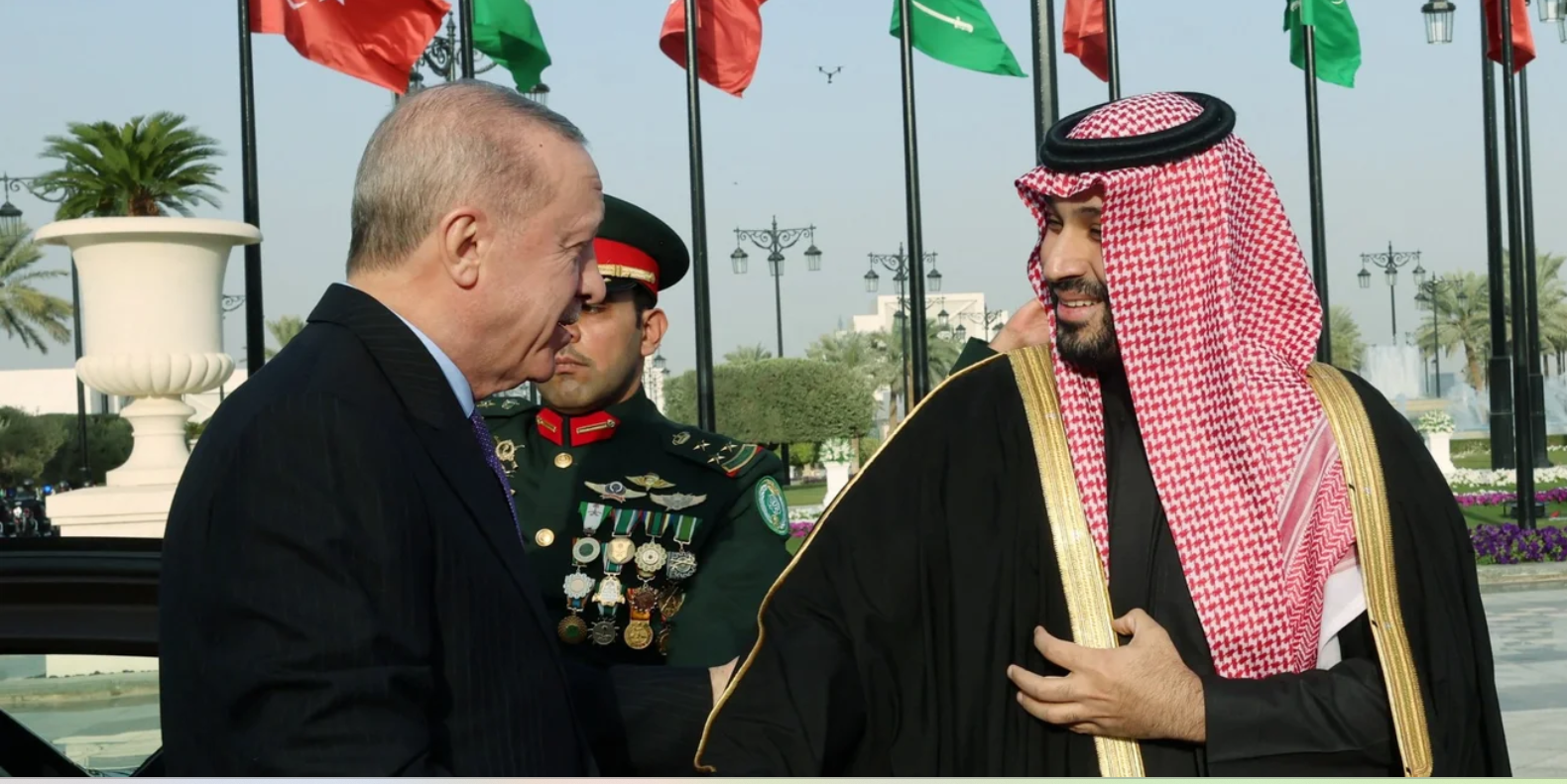
President Recep Tayyip Erdoğan’s recent visit to Riyadh came at a moment of shifting alignments across the Middle East, including growing Saudi–Emirati divergences over Yemen and the Horn of Africa, as well as renewed speculation over a potential Saudi–Pakistan security framework that could eventually include Türkiye.
While these issues are significant on their own, they point to a broader question: how does Türkiye fit into Crown Prince Mohammed bin Salman’s redefined vision of Saudi regional engagement—often described as the “new Saudiness”?
From Strategic Retrenchment to Selective Re-Engagement
Following the 2018 killing of journalist Jamal Khashoggi, Mohammed bin Salman deliberately reduced Saudi Arabia’s regional footprint, focusing instead on domestic consolidation and economic transformation under Vision 2030. This inward turn reflected a conscious recalibration: Riyadh would no longer carry the collective political and security burdens of the Arab world, after costly and inconclusive interventions in Yemen and Syria, and decades of stalemate on Palestine.
That posture began to shift after the collapse of the Assad regime in Syria in December 2024. Since then, Saudi foreign policy has grown more assertive—though notably more selective—seeking partners rather than unilateral leadership.
At the core of this transformation lies a redefinition of Saudi national identity. Vision 2030 promotes tourism, lifestyle change, and a reimagined historical narrative, while elevating monarchy and national pride and diminishing the centrality of Wahhabi religious authority. Demographics reinforce this shift: roughly two-thirds of Saudi citizens are now under 30, intensifying the demand for economic opportunity, social mobility, and stability.
Turkey’s regional rapprochement reshapes Middle East balance, Israeli media warn
Why Riyadh Needs Partners
Despite its domestic focus, Saudi Arabia cannot fully pursue regional stability alone. In Yemen, tensions with the UAE have sharpened as Abu Dhabi increasingly prioritises its own strategic interests, including support for southern separatist actors. In Palestine, Riyadh remains committed—at least rhetorically—to securing an end to the Gaza war, despite earlier momentum toward normalisation with Israel prior to October 2023.
The defining feature of the “new Saudiness” is not disengagement, but burden-sharing. Riyadh no longer seeks to dominate regional politics, but to shape outcomes alongside reliable partners.
Türkiye’s Strategic Fit
In this context, Türkiye’s regional posture has grown increasingly compatible with Saudi priorities. Ankara has positioned itself as a status-quo power across multiple theatres—supporting state institutions over militias in Africa and Yemen, and playing a role in mediation efforts related to Gaza.
This convergence has narrowed the gap between Ankara and Riyadh, while offering Saudi Arabia an alternative partner to the UAE’s more interventionist regional strategy.
Speculation over Türkiye’s potential involvement in a Saudi–Pakistan military framework underscores this emerging axis, even if no such arrangement has yet materialised. For Ankara, balancing between Emirati and Saudi regional agendas requires careful calibration—but it also expands Türkiye’s diplomatic leverage.
Turkey to become regional hegemon | Atilla Yesilada video commentary
Convergence on Regional Flashpoints
The substance of Erdoğan’s Riyadh visit reinforced this alignment. In a joint statement, Saudi Arabia and Türkiye rejected Israel’s recognition of Somaliland and reaffirmed Somalia’s territorial integrity. Erdoğan later reiterated this position in an interview with Asharq Al-Awsat, calling the Israeli move “null and void”.
On Yemen, both countries emphasised support for a unified state, opposing long-standing secessionist dynamics in the south. They also underscored shared positions on Sudan’s unity, the need for peace in Gaza, and an immediate Israeli withdrawal from Syria.
Regarding Syria’s post-Assad trajectory, Erdoğan articulated Ankara’s benchmark as “a Syria that does not threaten its neighbours, denies safe haven to terrorist organisations, and embraces all segments of society on the basis of equal citizenship.” Riyadh, now backing consolidation under President Ahmed al-Sharaa, appears increasingly aligned with this framework—provided reintegration of Kurds, Alawites, Druze and diaspora communities proceeds in earnest.
Defence Cooperation as a Pillar
Defence ties have become a central pillar of Saudi–Turkish cooperation. Previous agreements have focused on technology transfer, particularly as Riyadh seeks greater military self-sufficiency, including domestic drone production. The latest joint statement reaffirmed both sides’ commitment to activating existing defence cooperation frameworks to combat crime, extremism and terrorism.
A Partnership Still in Formation
Saudi Arabia is no longer standing still—neither domestically nor regionally. As it redefines its identity and recalibrates its alliances, Türkiye offers a partner capable of combining diplomatic reach, security capacity and strategic restraint.
Whether this partnership evolves into a durable regional axis will depend on execution, trust, and the ability of both sides to navigate an increasingly crowded Middle Eastern landscape. What is clear, however, is that the “new Saudiness” is no longer purely inward-looking—and Türkiye is well positioned to shape its external dimension.
About the Author
Betül Doğan-Akkaş is a researcher specialising in the Arab Gulf states. She holds a joint PhD in Gulf Studies from Durham University and Qatar University and is a co-convenor of the BISA Working Group on International Studies of the Mediterranean, Middle East and Asia. Her research focuses on GCC foreign policy, security strategies, political culture, the Yemen war, and Türkiye–GCC relations.
Source: MEE
PA Turkey intends to inform Turkey watchers with diverse views and opinions. Articles on our website may not necessarily represent the view of our editorial board or count as endorsement.
Follow our English YouTube channel (REAL TURKEY):
https://www.youtube.com/channel/UCKpFJB4GFiNkhmpVZQ_d9Rg
Twitter: @AtillaEng
Facebook: Real Turkey Channel: https://www.facebook.com/realturkeychannel/