Robin Brooks: Türkiye’s Growing External Imbalance Raises Red Flags
 robin brooks cad
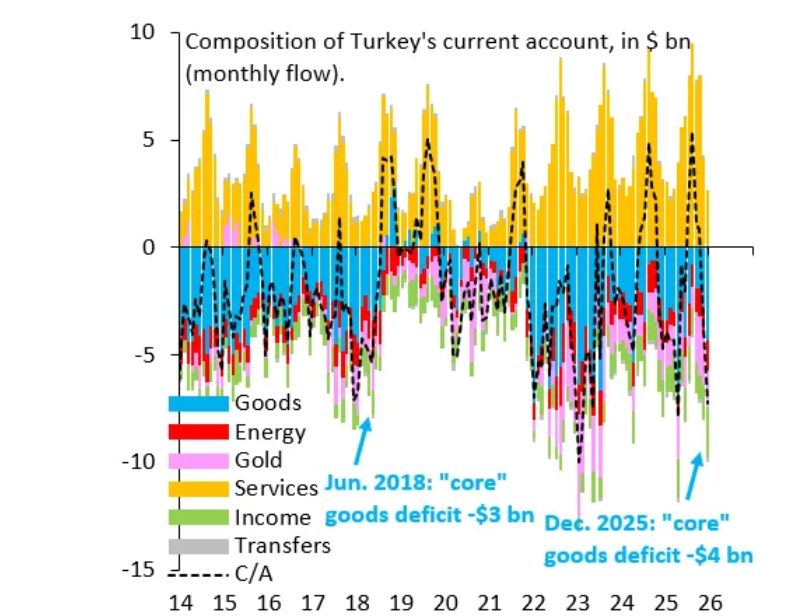
Economist Robin Brooks warns that Türkiye’s core current account deficit has returned to levels historically associated with currency crises. Stripped of volatile components like energy and gold, the underlying imbalance highlights a structurally overheated economy driven by credit expansion—and signals renewed risks for the Turkish lira.
A Credit-Fueled Growth Model Under Strain
Back in November, Robin Brooks argued that President Recep Tayyip Erdoğan has repeatedly leaned on Türkiye’s banking system to engineer successive credit booms.
The strategy is straightforward: keep the economy running “hot” ahead of elections to sustain political support. But this approach comes with a cost—large and persistent macroeconomic imbalances.
When an economy operates above its potential for prolonged periods, imports surge. In Türkiye’s case, this has translated into a chronic and sizable current account deficit. Historically, these deficits have not been benign—they have triggered currency crises and episodes of runaway inflation.
Why the Current Account Deficit Matters Most
For Türkiye, the current account deficit is not just another economic indicator—it is arguably the most critical one.
It effectively measures the gap between political ambition and economic reality.
Brooks’ latest analysis focuses on newly released data, showing that when volatile components such as gold and energy are excluded, the underlying—or “core”—deficit has widened to levels that previously proved unsustainable.
Atilla Yesilada: Damage Assessment: Taking Stock of the Economic Fallout
Understanding the “Core” Deficit
The concept mirrors that of core inflation.
Just as economists strip out food and energy prices to understand underlying inflation trends, Brooks removes:
- Energy imports (highly volatile due to global oil and gas prices)
- Gold imports (often driven by households hedging against inflation and currency depreciation)
What remains is the core goods trade balance—a clearer measure of structural external weakness.
In this framework, the “core” deficit reflects the true imbalance in Türkiye’s trade dynamics.
Back to Crisis Territory
According to December 2025 data, Türkiye’s core current account deficit is now wider than it was in the run-up to the 2018 Turkish currency crisis.
That episode culminated in a sudden stop in capital flows and a sharp depreciation of the Turkish lira.
The implication is stark: Türkiye has once again entered a familiar danger zone—one it has repeatedly occupied over the past decade.
Brooks attributes this to Erdoğan’s increasingly fragile political footing, which limits policy flexibility. In response, authorities continue to stimulate growth through credit expansion, further widening the external imbalance.
Imports Surge, Risks Rise
A closer look at trade data reinforces the warning signals.
When excluding gold and energy:
- Exports have grown steadily
- Imports, however, have surged sharply
The latest data point shows a pronounced spike in core imports—reminiscent of the aggressive credit stimulus deployed during the COVID-19 period.
This divergence between exports and imports is the key driver behind the widening deficit.
And historically, such import surges in Türkiye have ended in one way: currency depreciation.
The $41 Billion Vanishing Act: Can Turkey Survive a Long War?
A Familiar Cycle
Türkiye’s economic cycle has become increasingly predictable:
- Credit expansion fuels growth
- Imports surge, widening the deficit
- External imbalances build
- Capital flows reverse
- The lira weakens sharply
Brooks’ analysis suggests that the country may once again be approaching the later stages of this cycle.
Outlook: Pressure Builds on the Lira
While timing a currency adjustment is notoriously difficult, the structural signals are clear.
A widening core current account deficit—especially at levels previously associated with crises—points to mounting pressure on the Turkish lira.
Absent a shift toward more sustainable macroeconomic policies, Türkiye risks repeating a pattern that has defined much of its recent economic history.
PA Turkey intends to inform Turkey watchers with diverse views and opinions. Articles on our website may not necessarily represent the view of our editorial board or constitute endorsement.
Follow our English YouTube channel (REAL TURKEY):
https://www.youtube.com/channel/UCKpFJB4GFiNkhmpVZQ_d9Rg
Twitter: @AtillaEng
Facebook: Real Turkey Channel: https://www.facebook.com/realturkeychannel/***
Related articles
BofA Report: Elections in May – is Türkiye heading towards orthodoxy?

Turkish Market Preview: BIST 100 Eyes 15,000 as Global “Tariff War” Hits New Peak

Şimşek: Current Account Deficit to Stay at Sustainable Levels