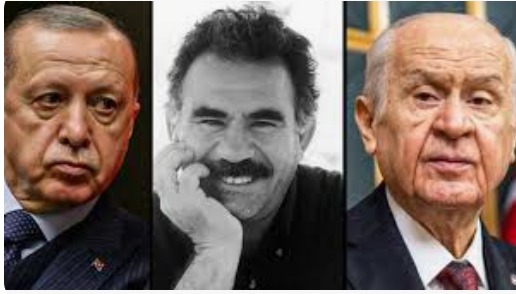
‘Right to Hope’ Likely Excluded From Parliament’s Peace Process Report Amid AKP–MHP Divide
 abdullah ocalan
Summary:
Turkey’s parliamentary commission overseeing the new peace initiative is unlikely to include the controversial concept known as the “right to hope” in its long-awaited joint report, amid growing disagreements within the ruling alliance. While the nationalist MHP is pushing for the concept to be acknowledged, the AKP remains cautious, fearing political backlash. The outcome is closely watched as the report is expected to shape the next phase of the peace process and signal the government’s long-term intentions.
A Politically Sensitive Report at a Critical Juncture
Preparations are continuing for a joint report by the National Solidarity, Brotherhood and Democracy Commission, established by the Turkish parliament as part of the renewed peace process. The document is widely seen as a key political reference point that could influence both legislative steps and the broader political narrative around conflict resolution.
However, parliamentary sources say the report will likely omit explicit reference to the so-called “right to hope” — a legal concept associated with the possibility of sentence review and conditional release for inmates serving aggravated life sentences. The issue has become one of the most contentious topics in commission deliberations.
According to sources familiar with the talks, the report’s delayed completion reflects not technical drafting difficulties but the need to manage growing disagreements within the governing bloc.
Why the ‘Right to Hope’ Matters for the Peace Process
The “right to hope” has emerged as a symbolic and substantive issue in the context of the peace process, as it indirectly touches on the future legal status of long-term prisoners linked to terrorism-related convictions. While no direct references to releases are being discussed, analysts say the concept carries strong political resonance, particularly in debates surrounding the PKK conflict and potential post-conflict normalization.
For this reason, whether or not the term appears in the commission’s report is viewed as a signal of how far the government is willing to go — at least rhetorically — in addressing the deeper legal and political dimensions of reconciliation.
AKP: Discussed, But Too Risky to Put in Writing
AKP figures involved in the commission say the issue is openly discussed behind closed doors but deliberately avoided in written form. Party officials argue that including the term in the joint report could be interpreted by the public as a political concession or a step toward early release, creating security-focused backlash within the party’s voter base.
As a result, AKP members are pushing for the report to remain a narrowly framed, minimum-consensus document, with controversial political concepts postponed to a later stage.
“There is a clear sense that the issue is talked about, but when it comes to putting it on paper, brakes are applied,” said one parliamentary source.
Preference for Technical Language Over Political Symbols
AKP representatives are instead advocating for a more technical framework grounded in execution law, focusing on criteria such as good conduct, disengagement from violence, and verified severance of organizational ties.
According to party insiders, this approach allows the government to maintain room for maneuver while minimizing political exposure. It also reflects concern that explicitly naming the “right to hope” could generate unease not only among voters but within the AKP itself.
MHP Pushes Back, But Avoids Deadlock
The nationalist MHP, by contrast, views the “right to hope” as a natural component of the broader process. Party sources say the concept appears in their own internal texts and position papers, though they acknowledge that its inclusion in the joint report depends on overall consensus.
While MHP figures are said to be insistent, they are also weighing the risk of blocking the report altogether — one of the main reasons the drafting process has dragged on.
CHP Opposes Broadening the Report’s Scope
The opposition CHP’s position has further shaped the debate. The party’s submission to the commission reportedly contains no reference to the “right to hope” or related concepts.
CHP Deputy Group Chair Murat Emir has stated that even provisions concerning the return of individuals not directly involved in violence were excluded from their report. Parliamentary sources say the CHP is wary of expanding the scope of the joint document or loading it with politically sensitive themes.
Öcalan Debate Lingers Indirectly
Although there is no explicit discussion of release or sentence reduction, sources say debates over Abdullah Öcalan’s incarceration conditions have surfaced indirectly through the “right to hope” framework.
Officials emphasize that no direct calls for legal changes regarding Öcalan are on the table. Nonetheless, even indirect references are said to trigger strong discomfort within AKP ranks, reinforcing resistance to including the term in the report.
Erdoğan’s Silence Adds to Uncertainty
President Recep Tayyip Erdoğan has so far remained publicly silent on the issue. According to party insiders, Erdoğan is waiting for the commission to finalize its work before taking a position and is reluctant to weigh in on unresolved issues prematurely.
This silence, sources say, has complicated deliberations, particularly on sensitive topics where clear political direction from the top would normally break deadlock.
Why the Report Is Taking So Long
The prevailing view in parliamentary corridors is that the delay stems from efforts to prevent visible fractures within the ruling alliance from spilling into the text. As a result, controversial headings are either being excluded entirely or softened through ambiguous language.
Even if the “right to hope” is left out of the joint report, sources say the issue is likely to resurface later — either through legislative debate or judicial interpretation — as the peace process moves forward.
For now, the priority appears to be keeping the process alive without triggering a political crisis.
PA Turkey intends to inform Turkey watchers with diverse views and opinions. Articles on our website may not necessarily represent the view of our editorial board or count as endorsement.
Follow our English YouTube channel (REAL TURKEY):
https://www.youtube.com/channel/UCKpFJB4GFiNkhmpVZQ_d9Rg
Twitter: @AtillaEng
Facebook: Real Turkey Channel – https://www.facebook.com/realturkeychannel/
Related articles
COMMENTARY: Did the DEM Party Fumble the Peace Process?

Gonul Tol comments on growing signs of a rift between allies Erdogan and Bahceli
BREAKING: Syrian Kurds strike deal with HTS to join national army