



Primer: Could a Kurdish Offensive Reshape the War in Iran?
 kurt gerilla
Speculation is growing that Kurdish armed groups could enter the escalating conflict between the United States, Israel and Iran. After U.S. President Donald Trump signaled support for such a possibility, questions have emerged about the role Iranian Kurdish organizations could play on the battlefield and the broader geopolitical implications. Experts warn that while Kurdish forces could stretch Iranian security resources, their involvement might also deepen regional instability and reshape internal Iranian politics.
Who Are the Iranian Kurds?
The Kurds are one of the largest ethnic minorities in Iran, making up roughly 10–12 percent of the country’s population. They have lived for centuries along Iran’s western frontier in regions bordering Iraq and Türkiye.
Distinct in language and culture from the Persian majority, Iranian Kurds have long demanded greater political autonomy and cultural rights. Their relationship with the central government has historically been tense.
During the 1979 Iranian Revolution, many Kurds initially supported the overthrow of the Shah, hoping the new Islamic Republic would grant greater regional autonomy. However, negotiations between Kurdish representatives and Tehran quickly collapsed.
In August 1979, Iran’s revolutionary leader Ayatollah Ruhollah Khomeini issued a fatwa ordering the military to crush Kurdish opposition. Revolutionary courts subsequently carried out executions of Kurdish activists and civilians, leaving a legacy of mistrust between Kurdish communities and the state.
Since then, Kurdish activists in Iran have frequently faced arrests, imprisonment and executions for demanding political and cultural rights.
Tensions resurfaced dramatically in September 2022, when the death of Mahsa Jina Amini, a young Kurdish woman detained by Iran’s morality police, sparked nationwide protests. Demonstrations that began in Kurdish regions quickly spread across all thirty-one provinces of Iran.
Kurdish Groups Signal Support for War Against Iran as Regional Tensions Escalate
Kurdish Political Groups and Their Objectives
Several Iranian Kurdish political and armed groups operate in exile, primarily from bases in Iraq’s Kurdistan Region.
In February, five major Kurdish opposition groups formed a coalition known as the Coalition of Political Forces of Iranian Kurdistan, later joined by a sixth organization.
The coalition includes several key factions:
-
Kurdistan Democratic Party of Iran (KDPI), one of the oldest Kurdish parties, led by Mustafa Hijri
-
Kurdistan Freedom Party (PAK), which has carried out attacks on Iranian Revolutionary Guard positions
-
Kurdistan Free Life Party (PJAK), an offshoot of the PKK with fighters operating from the Qandil Mountains
-
Smaller parties such as Komala and Khabat
The coalition says its objectives include:
-
overthrowing the Islamic Republic
-
securing Kurdish self-determination
-
establishing a democratic administrative system in “Eastern Kurdistan,” the Kurdish term for Iranian Kurdish regions
Despite these goals, Kurdish groups generally emphasize autonomy within Iran rather than outright independence.
Still, tensions remain between Kurdish activists and other Iranian opposition figures, including supporters of exiled royalist leader Reza Pahlavi, who accuse Kurdish groups of pursuing separatism.
Military Capabilities of Kurdish Forces
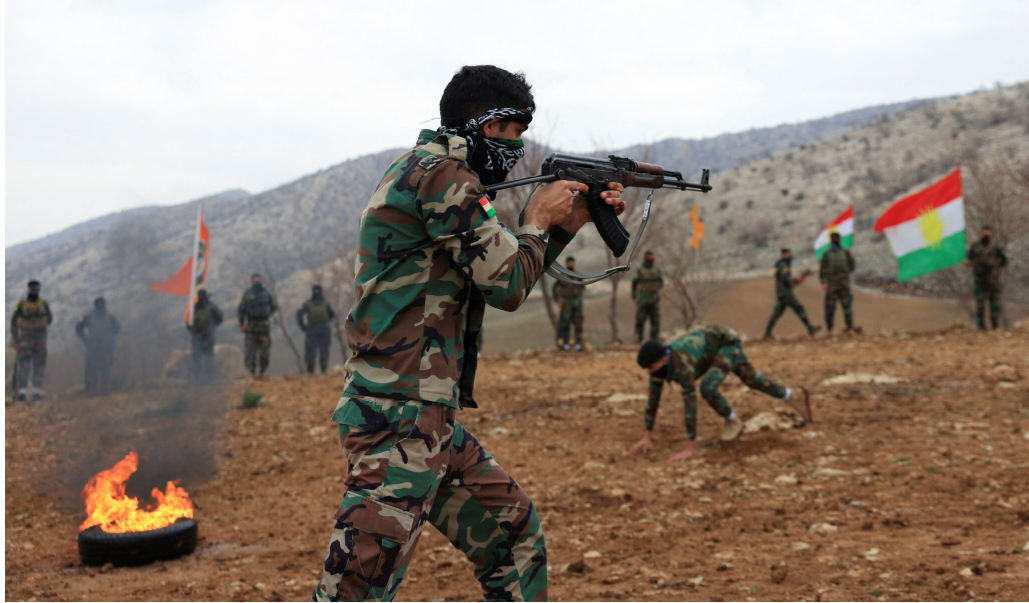
If Kurdish fighters were to enter the conflict, they would likely operate as light infantry insurgent units familiar with the mountainous terrain of northwestern Iran.
Many Kurdish groups maintain armed wings that have carried out sporadic operations against Iranian forces for years.
Their typical equipment includes:
-
AK-pattern assault rifles
-
rocket-propelled grenades
-
mortars
-
light infantry weapons
Some Kurdish security units also possess more advanced capabilities.
The Counter-Terrorism Group (CTG), an elite Kurdish special operations force trained by the United States in Iraq, has experience in intelligence operations, targeted raids and unconventional warfare.
These units operate with modern equipment such as:
-
M4 carbines
-
sniper rifles
-
night-vision systems
Experts say that with outside support, Kurdish fighters could conduct small-scale cross-border operations targeting Iranian Revolutionary Guard units.
Potential U.S. and Israeli Support
Military analysts say that the United States and Israel could potentially support Kurdish forces as part of a broader strategy to pressure Iran.
Possible forms of support could include:
-
intelligence sharing
-
aerial resupply of weapons and ammunition
-
artillery systems
-
close air support against Iranian forces
U.S. special operations advisers could also help coordinate precision strikes or assist Kurdish units operating inside Iranian territory.
Such cooperation would allow Kurdish fighters to open a new front in western Iran, forcing Tehran to deploy additional security forces away from other strategic areas.
Could a Kurdish Offensive Change the War?
Despite these capabilities, many analysts doubt that a Kurdish offensive would dramatically alter the course of the conflict.
Iran has historically been highly sensitive to territorial integrity, and any Kurdish insurgency could produce a strong nationalist backlash among the broader Iranian population.
Experts warn that the Iranian government could use the threat of separatism as a powerful propaganda tool, portraying the conflict as an attempt by foreign powers to fragment the country.
This narrative could help Tehran:
-
rally nationalist sentiment
-
divide the opposition movement
-
justify harsher repression in Kurdish regions
In a worst-case scenario, the involvement of Kurdish groups could even contribute to civil conflict inside Iran.
Strategic Benefits and Risks
Supporters of Kurdish involvement argue that Kurdish fighters could serve several strategic purposes.
They could:
-
tie down Iranian security forces in the west
-
weaken the government’s control over remote regions
-
create space for protests in major Iranian cities
If Kurdish forces were able to seize and hold territory near the border, they might even establish a buffer zone that could benefit Western and Israeli strategic interests.
However, such a scenario would require sustained political and military support, something Kurdish movements have historically struggled to secure from external powers.
The Kurdish experience over the past century is filled with episodes in which major powers backed Kurdish uprisings during conflicts but later withdrew support once geopolitical priorities changed.
Impact on Iraqi Kurdistan
The potential arming of Iranian Kurdish groups also creates risks for Iraq’s Kurdistan Region, where many of these organizations are based.
Leaders of the Kurdistan Regional Government (KRG) have repeatedly emphasized that they do not want their territory used as a launching ground for attacks against Iran.
Tehran has already conducted missile strikes against Kurdish opposition bases inside northern Iraq in the past.
Iran-aligned militias in Iraq have also targeted the region with drone and rocket attacks, particularly around Erbil and energy infrastructure sites.
Any Kurdish offensive against Iran launched from Iraqi territory could therefore trigger retaliation against Iraqi Kurdistan, placing its political leadership in a difficult position.
Türkiye’s Concerns
Another regional actor watching closely is Türkiye, which has long viewed armed Kurdish movements across the Middle East as interconnected security threats due to links with the PKK, designated as a terrorist organization by Ankara.
If Iranian Kurdish groups were able to establish territorial control in northern Iran, it could intensify Turkish fears of cross-border Kurdish nationalism spreading across the region.
Ankara might respond with stronger military or political measures aimed at preventing Kurdish territorial gains, similar to its actions in northern Syria.
A High-Risk Strategy
Ultimately, the impact of Kurdish involvement in the war will depend on the level of support provided by outside powers and the broader trajectory of the conflict.
If Kurdish fighters are drawn into the war without long-term political backing, analysts warn that the consequences could be severe not only for Kurdish communities but also for the stability of Iraq and the wider region.
The possibility of a Kurdish front in the Iran war therefore represents both a military opportunity and a geopolitical gamble.