



OPINION: After Erdogan: Who Will Control Turkey?
 rte-halefleri
Summary:
As President Recep Tayyip Erdogan approaches the later stages of his rule, speculation over Turkey’s post-Erdogan leadership is intensifying. A recent Washington-based analysis suggests that a quiet but consequential power struggle may already be underway within Erdogan’s inner circle, pitting trusted lieutenants and family members against one another. Rather than predicting a single successor, the analysis outlines the legal framework, political dynamics, and internal rivalries likely to shape Turkey’s eventual transition.
Signals from Washington and Ankara
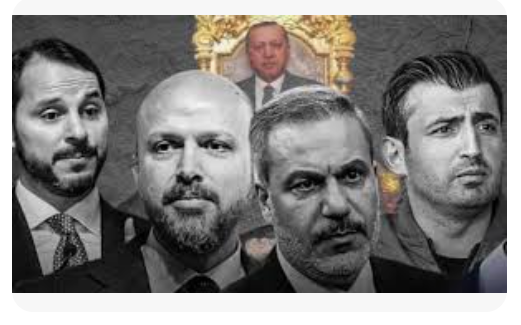
During President Erdogan’s September 2025 visit to the White House, a hot-mic exchange between two Turkish journalists appeared to hint at an emerging succession contest. According to the remarks — later reported by a dismissed NTV journalist — the United States was said to be “playing to” Foreign Minister Hakan Fidan during negotiations over fighter jet engine procurement. More notably, the exchange suggested an internal struggle among Bilal Erdogan, Hakan Fidan, and Erdogan’s son-in-law Selçuk Bayraktar to succeed the president.
If accurate, the episode points to the early stages of a high-level power contest within Erdogan’s most trusted circle — one that could destabilize the ruling AKP as Turkey approaches a leadership transition.
Succession Rules — and Erdogan’s Leverage
The analysis examines Turkey’s constitutional framework governing presidential succession, while emphasizing that legal limits alone may not constrain Erdogan’s actions. Despite term limits, Erdogan retains significant influence over the judiciary, security services, media, and party apparatus, giving him tools to shape both the timing and outcome of any transition.
Rather than offering firm predictions, the report focuses on the forces likely to determine succession: Erdogan’s personal endorsement, the suppression or containment of opposition challengers, candidates’ access to state institutions and media, and their proximity to the president himself.
Key Questions Shaping the Transition
Several unresolved questions dominate the succession debate:
-
Will Erdogan formally or informally designate a preferred successor?
-
How effectively can the government neutralize opposition figures?
-
How much will experience in governance, media control, and public recognition matter?
-
Can a candidate secure backing beyond the AKP’s core base?
The answers to these questions may evolve rapidly over the next two years.
Potential Successors from Erdogan’s Inner Circle
Hakan Fidan: The Security State Insider
Foreign Minister Hakan Fidan stands out as one of Erdogan’s closest confidants. A former military officer, Fidan served as head of Turkey’s National Intelligence Organization (MIT) from 2010 to 2023 before being appointed foreign minister following the 2023 elections.
Fidan’s long-standing reputation as an “untouchable” figure stems from his intelligence background and deep institutional knowledge. Erdogan has reportedly referred to him as his “keeper of secrets,” underscoring the trust between the two. Fidan’s influence over foreign policy and national security — particularly on Syria, refugees, and any potential PKK disarmament process — could bolster his standing with key voter blocs.
However, Fidan lacks experience in electoral politics and domestic governance. Opposition figures portray him as authoritarian and opaque, pointing to his intelligence past. His strained relationships with senior AKP figures, including current intelligence chief İbrahim Kalın, may also complicate efforts to consolidate party support.
Selçuk Bayraktar: Defense Power and Family Ties
Selçuk Bayraktar, chairman and chief technology officer of Baykar, is among Turkey’s most prominent private-sector figures. As the architect behind Baykar’s drone programs — including the TB2 and the Kizilelma unmanned fighter jet — Bayraktar has become synonymous with Turkey’s expanding defense footprint abroad.
Married to Erdogan’s daughter Sümeyye, Bayraktar benefits from both family ties and immense financial resources, with an estimated net worth of $1.8 billion. His reputation as a successful technologist and businessman could appeal to voters weary of economic instability and inflation.
Yet Bayraktar has no formal political experience and has shown limited public interest in holding office. His close association with Erdogan may alienate centrist and opposition voters, while longtime AKP politicians may resist backing a political outsider.
Bilal Erdogan: The Family Heir
President Erdogan’s son Bilal Erdogan has become increasingly visible in recent years, fueling speculation that he may be groomed as a successor. Educated largely in the United States, Bilal has built extensive networks across Turkey’s business, media, and Islamist civil society spheres.
He holds leadership roles in influential organizations such as the Science Dissemination Foundation and the Turkish Youth Foundation (TUGVA), both closely aligned with the ruling party. His proximity to power and access to state institutions are widely viewed as his greatest strengths.
At the same time, Bilal Erdogan faces significant liabilities. Allegations of corruption dating back to 2013, including leaked phone recordings, continue to haunt his public image. His association with Islamist activism — including support for Hamas-linked rallies — risks alienating secular voters. Reports also suggest resistance from nationalist coalition partner Devlet Bahçeli, whose backing remains crucial for AKP dominance.
Outlook: No Clear Heir, Rising Uncertainty
The analysis concludes that Turkey lacks a single, uncontested successor to Erdogan. Instead, succession is likely to be shaped by a complex interplay of family ties, security institutions, economic performance, and political suppression. Erdogan’s personal preferences will matter — but so will the AKP’s internal cohesion and the opposition’s ability to survive sustained pressure.
What is increasingly clear is that the post-Erdogan era may mark not merely a leadership change, but a fundamental reconfiguration of Turkey’s power structure.
By Sinan Ciddi and William Doran for Foundation for Defense of Democracies
PA Turkey intends to inform Turkey watchers with diverse views and opinions. Articles in our website may not necessarily represent the view of our editorial board or count as endorsement.
Follow our English YouTube channel (REAL TURKEY):
https://www.youtube.com/channel/UCKpFJB4GFiNkhmpVZQ_d9Rg
Twitter: @AtillaEng
Facebook: Real Turkey Channel: https://www.facebook.com/realturkeychannel/