No panic in Ankara despite CBRT reserve burn
 no panic
Turkey’s “Passive” Crisis Management Amid One Month of Iran-U.S. Conflict
As the conflict between Iran and the United States marks its first full month, the economic tremors are beginning to stabilize into a “new and dangerous normal” for Turkey. In the latest briefing from Mesele Ekonomi, veteran economic analyst Erdal Sağlam provides a sobering look at how Ankara is navigating a crisis defined by historic reserve depletion, soaring energy costs, and a pivot in policy priorities.
The $57 Billion Vanishing Act
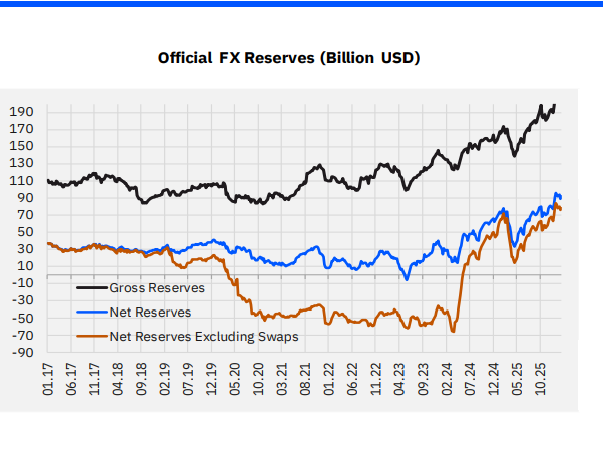
The most striking revelation in Sağlam’s analysis is the sheer velocity of the Central Bank of the Republic of Turkey’s (CBRT) reserve loss. Over the course of just 30 days, the bank’s net reserves (excluding swaps) have plummeted by approximately $57.5 billion, falling from $70.2 billion to a mere $13.5 billion.
Sağlam notes that while previous crises were driven by local citizens rushing to buy dollars, this current depletion is almost entirely fueled by foreign capital exit. “The locals have remained remarkably calm regarding the Lira,” Sağlam explains, “but the international flight from Turkish assets has returned our reserves to the precarious levels seen in March of last year.”
From Inflation to “Financial Stability”
Sağlam argues that the Turkish government has effectively abandoned its primary goal of inflation targeting. With President Erdoğan’s historical insistence on prioritizing growth, the administration has shifted its focus toward a “Passive Crisis Management” strategy.
Middle East War Pressures Turkey’s Economy: Growth Risks Rise as Inflation Outlook Deteriorates
The primary objective now is not to lower prices, but to maintain financial stability—essentially preventing a systemic collapse of the banking sector or a runaway currency spiral. This shift means that inflation, which was expected to cool in the spring, is now projected to remain high. International banks have already adjusted their 2026 inflation forecasts to a floor of 25%, while local economists warn that 30-35% is more realistic if the war continues.
The “Gold Shield” and the Swap Strategy
One of the few factors preventing a total currency panic has been Turkey’s massive gold holdings. Sağlam points out that the CBRT has begun utilizing these assets strategically. There are reports of the bank selling gold internally to satisfy local demand and engaging in gold-for-FX swaps in London to maintain dollar liquidity.
“Selling gold to the domestic market is one of the smartest moves available right now,” Sağlam says. “It satisfies the public’s appetite for safe-haven assets without permanently depleting the bank’s foreign exchange liquidity.” He dismisses “doomsday” speculation regarding gold sales, labeling them as necessary tactical maneuvers in a wartime economy.
S&P Raises Türkiye Inflation Forecast as Energy Shock Risks Intensify
Energy, Food, and the Bütçe (Budget) Burden
The “Eşel Mobil” system, which Turkey uses to subsidize fuel prices and shield consumers from global oil spikes, is reaching its limit. With oil prices flirting with $200 per barrel in some stress scenarios, the fiscal burden on the Turkish budget is becoming unsustainable.
Sağlam warns that the cost of this war will ultimately be paid through the budget. “We are seeing a systemic shock in global food supplies not seen in years, particularly with the closure of the Strait of Hormuz,” he notes. While the government has delayed hikes in electricity and natural gas to prevent social unrest, these subsidies are creating a massive deficit that will eventually require either sharp tax increases or further borrowing.
The Tourism Outlook: A Fragile Recovery
Despite the proximity of the war, the tourism sector remains cautiously optimistic. After an initial wave of cancellations in the first 15 days of the conflict, reservation rates have stabilized.
-
Market Shifting: While European tourists (particularly British and French) are showing hesitation, there is a noted shift in Russian tourists moving away from Egypt and Dubai toward Turkey.
-
Income Projections: The original goal of $60–65 billion in tourism revenue for 2026 may be out of reach, but industry insiders still believe $55 billion is achievable, provided the conflict does not escalate to involve Turkey directly.
Conclusion: A Strategic “Wait-and-See”
Erdal Sağlam concludes that the Turkish economy is currently in a “wait-and-see” loop. The lack of a clear exit strategy for President Trump and the defiant stance of Tehran make long-term planning impossible for Ankara.
For now, the CBRT will likely continue its “fine-tuning” through passive interventions and interest rate adjustments in the shadows. However, the analyst warns that the real pain is yet to come. As the “ammunition” in the budget is spent on supporting the industrial sector and maintaining the Lira, the broader population—pensioners, minimum wage earners, and the middle class—will face a deepening cost-of-living crisis that could redefine the political landscape heading into the 2027 elections.
PA Turkey intends to inform Turkey watchers with diverse views and opinions. Articles in our website may not necessarily represent the view of our editorial board or count as endorsement.
Follow our English YouTube channel (REAL TURKEY):
https://www.youtube.com/channel/UCKpFJB4GFiNkhmpVZQ_d9Rg
Twitter: @AtillaEng
Facebook: Real Turkey Channel: https://www.facebook.com/realturkeychannel/***