Middle East War Pressures Turkey’s Economy: Growth Risks Rise as Inflation Outlook Deteriorates
 tr iran savas
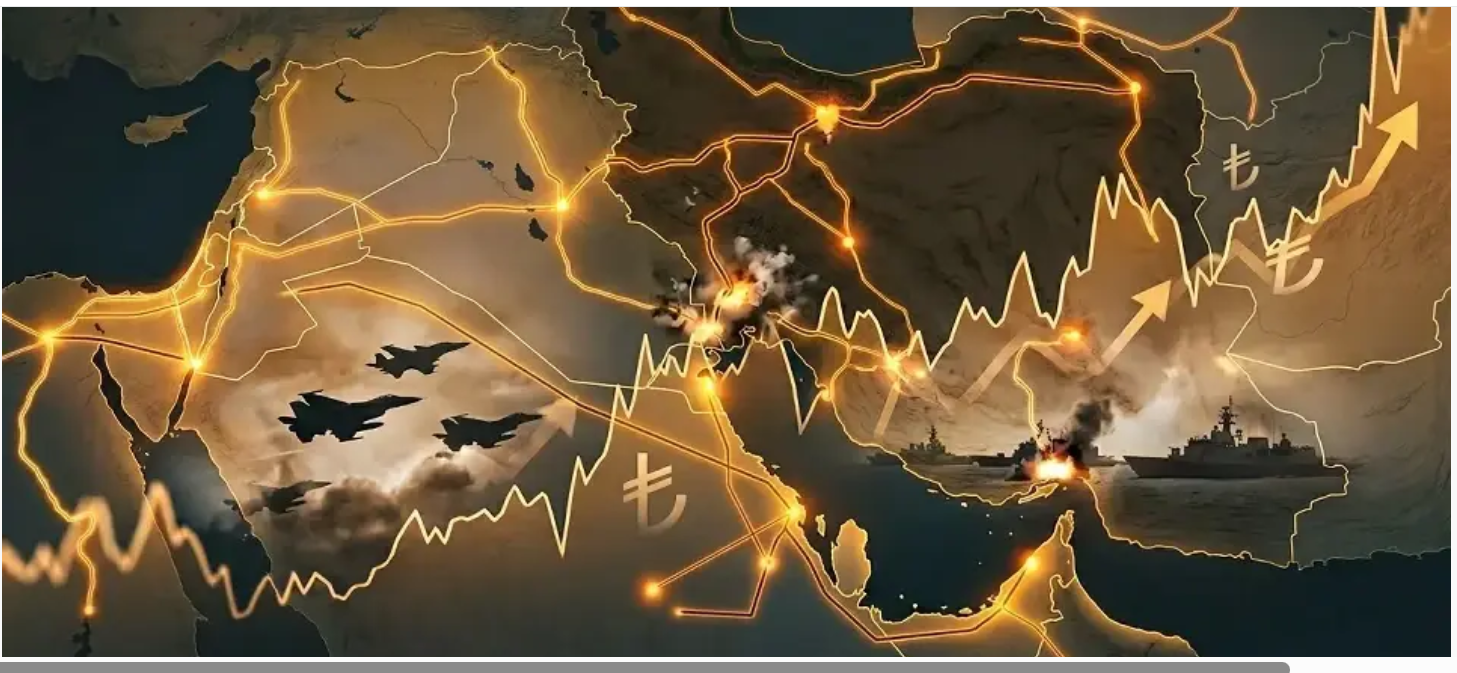
The escalating conflict in the Middle East is placing mounting pressure on Turkey’s economy, tightening financial conditions, accelerating reserve losses, and increasing inflation risks. While growth remains resilient for now, the outlook for 2026 is increasingly fragile as policymakers face difficult trade-offs between stability and expansion.
Tightening Financial Conditions and Reserve Pressures
The regional conflict has already triggered a sharp tightening in Turkey’s financial conditions, with pressure on foreign exchange reserves becoming a key concern.
Estimates suggest:
- The Central Bank of the Republic of Turkey (CBRT) has conducted implicit FX interventions exceeding $50 billion
- Between March 1 and March 25:
- Around $35 billion stemmed from foreign outflows
- An additional $15–20 billion reflected domestic demand for FX
Authorities have also relied on gold sales and swap operations to support liquidity and stabilize markets.
Looking ahead:
- Scope for monetary easing appears very limited
- Fiscal policy is expected to provide only modest support in the near term
Growth Outlook Faces Downside Risks
Turkey’s economy grew by 3.6% in 2025, but the outlook for 2026 is becoming increasingly uncertain.
Current projections indicate:
- GDP growth of around 3% in Q1 2026
- A 4% full-year growth forecast, though risks are tilted to the downside
Key pressures include:
- Rising external financing needs
- Weakening global risk appetite
- Higher energy costs
If the conflict deepens or persists, economists warn that growth could slow more sharply than currently expected.
Deutsche Bank Turkey Forecast: A “Tougher Macro Path” in 2026
Inflation Risks Re-Emerge
Turkey’s disinflation process was already losing momentum before the conflict, and recent developments have further complicated the outlook.
Current dynamics show:
- Monthly inflation consistently above 2%
- Rising energy prices and supply disruptions adding upward pressure
As a result:
- Year-end inflation is expected to exceed 25%
- A managed exchange rate framework may be required to contain volatility
The USD/TRY forecast is maintained at 52 by end-2026, although risks remain skewed toward further depreciation if inflation and external imbalances worsen.
Current Account and Capital Flows Under Strain
Higher energy prices and geopolitical uncertainty are weighing heavily on Turkey’s external balance.
Main risks include:
- Rising energy import costs
- Capital outflows
- Potential disruptions to tourism revenues
These factors could lead to:
👉 A widening current account deficit
At the same time:
- Rapid depletion of CBRT reserves
- Rising dollarization risks among residents
are adding pressure on the Turkish lira.
S&P Raises Türkiye Inflation Forecast as Energy Shock Risks Intensify
Currency Stability and Dollarization Risks
Economists highlight domestic FX demand as a critical variable.
Key concerns include:
- Sudden increases in dollarization
- Accelerated reserve losses
- Sharp currency volatility
This suggests that the CBRT will likely continue:
👉 Tight liquidity management and measures to limit FX demand
A Fragile Macroeconomic Balance
Turkey’s economy is currently navigating a delicate equilibrium:
- Growth is slowing
- Inflation risks are rising again
- The current account deficit is widening
- FX reserves are under pressure
This creates a difficult policy trade-off:
👉 Supporting growth vs. maintaining price and currency stability
Outlook: Geopolitics Will Be Decisive
The trajectory of the Middle East conflict will remain the dominant factor shaping Turkey’s economic outlook.
In the near term:
- Monetary policy is expected to remain tight
- Exchange rate management will stay central
- Growth forecasts may face downward revisions
Over the longer term, Turkey’s economic resilience will depend on:
👉 Its ability to absorb external shocks and restore confidence in macroeconomic stability
Excerpt from Garanti BBVA report
PA Turkey intends to inform Turkey watchers with diverse views and opinions. Articles in our website may not necessarily represent the view of our editorial board or count as endorsement.
Follow our English YouTube channel (REAL TURKEY):
https://www.youtube.com/channel/UCKpFJB4GFiNkhmpVZQ_d9Rg
Twitter: @AtillaEng
Facebook: Real Turkey Channel: https://www.facebook.com/realturkeychannel/***