



MHP Pushes Türkiye–Russia–China Axis as Strategic Debate Intensifies
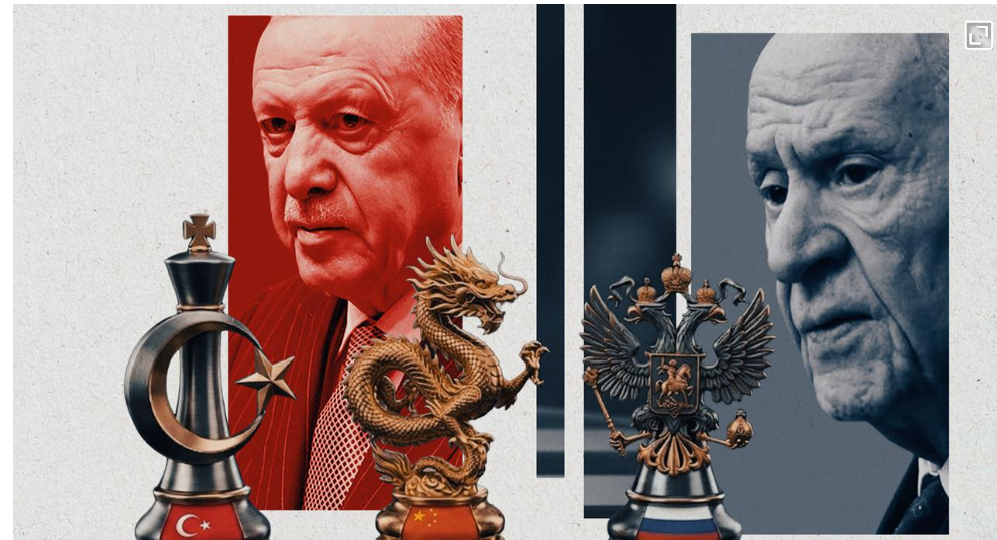 bahceli rte
Türkiye’s nationalist coalition partner MHP has renewed calls for a strategic alignment with Russia and China, elevating the proposal into a major foreign policy debate in Ankara. The initiative, championed by Devlet Bahçeli and senior party figures, reflects shifting geopolitical calculations as well as internal political dynamics ahead of the 2028 elections.
MHP Elevates Eurasian Alignment Proposal
The Nationalist Movement Party (MHP), a key ally in Türkiye’s ruling bloc, has intensified its advocacy for closer strategic cooperation with Russia and China.
The proposal, led by MHP leader Devlet Bahçeli, is gaining traction as one of the most consequential foreign policy discussions within Ankara’s political circles.
Party officials signal that the initiative goes beyond traditional anti-Western rhetoric and reflects a longer-term strategic positioning for Türkiye.
Moscow Visit Signals Policy Shift
Momentum behind the proposal increased after MHP Deputy Chairman İlyas Topsakal revealed that he traveled to Moscow in March under Bahçeli’s instructions.
During meetings with Russian officials, bureaucrats, and intellectuals, Topsakal promoted the idea of a trilateral Türkiye–Russia–China partnership.
He stated that the MHP’s primary political expectation is not government positions but the adoption of a strategic cooperation framework with Moscow and Beijing.
Strategic Vision: A Eurasian Framework
The MHP envisions a broader geopolitical architecture linking multiple Eurasian institutions, including:
- Shanghai Cooperation Organization (SCO)
- Commonwealth of Independent States (CIS)
- Collective Security Treaty Organization (CSTO)
- Organization of Turkic States (OTS)
The proposal aligns in part with Russian President Vladimir Putin’s “Greater Eurasian Partnership” concept.
Notably, Topsakal suggested that the MHP now views traditional pan-Turkist approaches as outdated, advocating instead for a “synergy” between the Russian and Turkic worlds.
Political Context: 2028 Elections Loom
Analysts interpret the renewed push as part of the MHP’s efforts to maintain influence within the ruling alliance ahead of the 2028 elections.
They argue that the party is seeking to redefine its strategic role as its traditional political base faces evolving dynamics.
However, MHP sources reject this interpretation, insisting the proposal is driven by geopolitical necessity rather than electoral concerns.
Bahçeli’s Broader Vision
Bahçeli first publicly proposed a Türkiye–Russia–China axis in September 2025, framing it as a counterbalance to what he described as a US–Israel-led global alignment.
He later expanded the idea to include a broader “World Peace Council” involving Türkiye, the United States, Russia, and the European Union.
Bahçeli has warned that rising global tensions could increase the risk of a wider conflict, calling for new mechanisms to preserve international stability.
Internal Turmoil Within MHP
The renewed foreign policy push comes amid internal restructuring within the MHP.
- At least 6–8 provincial party organizations have reportedly been dissolved or replaced in recent months
- The moves are widely seen as part of an effort to tighten central control and eliminate internal dissent
Observers suggest the reshuffles may be linked to:
- Preparing the party for the 2028 electoral cycle
- Consolidating Bahçeli’s authority within the party
- Aligning local structures with the party’s evolving strategic vision
While official explanations emphasize routine organizational adjustments, the scale and timing have drawn attention in Ankara political circles.
Strategic Implications
The proposal for a Türkiye–Russia–China alignment signals a potential shift in Ankara’s geopolitical orientation at a time of heightened global fragmentation.
Whether the initiative evolves into formal policy remains uncertain, but it underscores growing debate within Türkiye over its long-term strategic direction between Western alliances and Eurasian alternatives.
Source: Turkey Today, excerpt only, PA newsdesk