



Kanal Istanbul Reduced to 10,000 TL in 2026 Budget—What Happened?
 kanal istanbul
Turkey’s 2026 Public Investment Program signals a substantial expansion in public spending, with total investments rising by 32.98% year-on-year to TRY 1.92 trillion. Despite the sharp increase in headline figures, the program’s structure reveals a cautious approach to new initiatives. The overwhelming majority of resources are directed toward projects already underway, reinforcing a long-standing pattern in Turkey’s public investment strategy.
According to the program, TRY 1.569 trillion, corresponding to 81.19% of total investments, has been allocated to ongoing projects, while TRY 343.8 billion has been reserved for new projects. The relatively limited number of fresh investments underscores the government’s preference for completing or sustaining existing commitments rather than launching large-scale new ventures. Projects carried over from previous years continue to dominate the agenda, shaping both sectoral priorities and budget distribution.
State-Owned Enterprises Take a Growing Share
One of the most striking aspects of the 2026 program is the rising role of State-Owned Enterprises (SOEs / KİTs). Roughly one-third of total public investments will be carried out by these entities. SOE investments increased by 67.5% compared to the previous year, reaching TRY 679.25 billion.
Within this category, Turkish Petroleum Corporation (TPAO) stands out as the single largest contributor. TPAO investments account for approximately TRY 332 billion, nearly half of total SOE spending. This reflects a dramatic 132.2% increase in TPAO’s investment budget, highlighting the strategic emphasis placed on energy exploration, production, and security.
In proportional terms, the sharpest growth was recorded by the State Supply Office (DMO), whose investments surged by an extraordinary 418.3%. This was followed by TÜRASAŞ, with a 256.4% increase, and ETİ Maden, whose investments expanded by 105.2%. These increases point to intensified activity in industrial production, logistics, and mining-related sectors.
However, the trend is not uniform across all SOEs. Turkish Coal Enterprises (TKİ) experienced a steep contraction, with investments declining by 81.9% to TRY 309 million. This sharp drop suggests a deprioritization of coal-related investments within the broader public investment framework.
Kanal Istanbul Receives Only a Symbolic Allocation
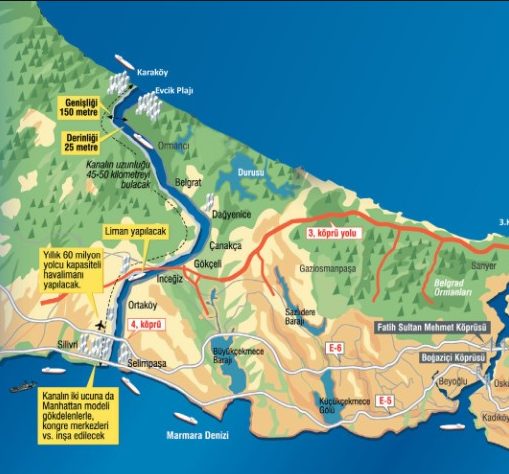
One of the most closely watched items in the public debate, the Kanal Istanbul Project, did not appear as a standalone investment category in the 2026 program. Instead, it was listed indirectly under “Transportation and Communication / Highway Transportation”, specifically as “Kanal Istanbul Connection Roads.”
For 2026, the allocated budget for this item is just TRY 10,000, a figure widely interpreted as symbolic rather than operational. Given the overall scale of the TRY 1.92 trillion investment program, the minimal allocation indicates that Kanal Istanbul is not a short-term spending priority, at least in terms of direct public investment for the coming year.
The lack of a dedicated heading and the small budget suggest that the project remains largely on hold within the current investment cycle, despite its long-standing prominence in public discourse.
Decades-Old Projects Still on the Agenda
While most projects in the 2026 program were launched in the 2020s or are scheduled to begin in the near future, some initiatives dating back several decades continue to appear in official plans. These legacy projects illustrate how long-term infrastructure investments can stretch across generations.
Under the Transportation and Communication category, projects managed by the General Directorate of Highways include the Karaman–Konya road, which was originally launched in 1964. With a total projected cost of TRY 4.17 billion, the project had absorbed TRY 592 million in spending by the end of 2025.
Despite its age and partial completion, the project has been allocated only TRY 10,000 for 2026, a level of funding that strongly suggests further delays rather than imminent completion. The continued presence of such projects highlights structural challenges in long-term planning, prioritization, and project finalization within public investment programs.
A Program Focused on Continuity Rather Than Expansion
Overall, Turkey’s 2026 Public Investment Program reflects a strategy centered on continuity, consolidation, and selective scaling rather than aggressive expansion into new areas. The significant increase in total investment volume is largely absorbed by ongoing projects and SOE-led initiatives, particularly in the energy sector.
The limited allocation for new projects, the symbolic funding for high-profile initiatives such as Kanal Istanbul, and the persistence of decades-old infrastructure projects all point to a cautious, controlled investment stance. While the program demonstrates fiscal ambition in size, its composition suggests that completing existing commitments remains the dominant priority shaping public investment policy in 2026.