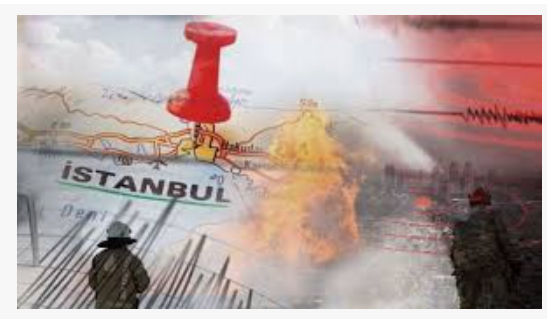
Istanbul Earthquake Fears Run Deep, New Study Shows
 Görsel bulunamadı
A new earthquake awareness study conducted by the Istanbul Planning Agency (İPA) reveals a striking gap between fear and preparedness among Istanbul residents. While an overwhelming majority of participants identify earthquakes as the city’s most serious disaster risk, the findings indicate that financial constraints and limited household-level preparation continue to leave millions vulnerable in the event of a major earthquake.
The research, titled “Disaster Awareness Study,” was carried out as part of the December thematic edition of the Istanbul Barometer, a monthly survey series published by İPA, which operates under the Istanbul Metropolitan Municipality (İBB). The survey was conducted among 761 participants and examined public perceptions across multiple dimensions, including disaster risk awareness, household safety measures, emergency preparedness, and basic disaster-response knowledge.
Earthquakes Dominate Public Fear in Istanbul
According to the survey results, 94.1 percent of participants identified earthquakes as the disaster they fear most, making it by far the dominant concern among Istanbul residents. Other risks lagged far behind, with fires cited by 17.5 percent of respondents and floods or water-related disasters by 10 percent.
These findings underscore the deeply ingrained awareness of Istanbul’s seismic risk, shaped by decades of expert warnings and memories of past earthquakes. However, the data also suggests that high awareness does not automatically translate into effective preparedness, particularly at the household and structural level.
One in Three Expects Severe Building Damage
Concerns about housing safety were a central focus of the study. Eighteen percent of respondents reported that they believe their building would collapse during a major earthquake, while an additional 14.3 percent expect their homes to suffer severe damage.
When asked how they would respond if their building were officially deemed unsafe, 68.1 percent said they would move to a safer residence. Notably, this willingness increased with socioeconomic status, indicating that financial capacity plays a decisive role in earthquake-related decision-making.
Among those who said they would be forced to continue living in a structurally unsafe building, 70.6 percent cited financial hardship as the primary reason. Among lower socioeconomic groups, this figure rose to 78.6 percent, underscoring how economic inequality directly amplifies earthquake risk.
Financial Barriers Shape Earthquake Vulnerability
One of the study’s most revealing conclusions is that economic limitations are the single most powerful factor preventing safer housing choices. Even when residents are aware of structural risks, many feel trapped by high rents, limited housing supply, and insufficient income.
The findings suggest that disaster preparedness in Istanbul cannot be addressed solely through awareness campaigns. Without affordable, safe housing options and stronger financial support mechanisms, a significant segment of the population remains exposed to life-threatening risks despite knowing the dangers.
Household Safety Measures Lag Behind Risk Perception
The survey also examined whether fear of earthquakes leads to concrete safety measures within homes. The results point to a troubling disconnect.
Only 26.4 percent of respondents reported having fully secured household items, such as wardrobes and shelves, against earthquake motion. Another 23.3 percent reported partially securing their furniture, while 50.3 percent reported taking no action.
This indicates that more than half of the participants have not adequately secured their homes, despite identifying earthquakes as the city’s most serious threat. Researchers noted that this gap illustrates how risk perception does not consistently translate into behavioral preparedness.
Strong Expectation of a Near-Term Earthquake
Public expectations regarding the timing of a major earthquake are also striking. Eighty-five point seven percent of respondents believe that Istanbul will experience a destructive earthquake in the near future, reflecting widespread anticipation of an impending seismic event.
Despite this expectation, confidence levels vary regarding personal responses. 57.7% reported knowing what to do during an earthquake and feeling confident in their actions. However, a significant minority expressed fatalistic views, with 37.1 percent agreeing that taking precautions would not change fate—a belief that experts often identify as a barrier to effective disaster preparedness.
Emergency Knowledge Is Uneven Across the City
The study assessed familiarity with key safety concepts and emergency tools. Sixty-four point eight percent of participants reported familiarity with the concept of the “life triangle,” a commonly discussed earthquake-survival principle, whereas 35.2 percent were unfamiliar with it.
Only 37.3 percent reported having an emergency kit at home that could be accessed immediately after an earthquake. While this represents a critical preparedness gap, awareness of utility safety was comparatively high. Eighty-eight point four percent reported knowing how to shut off the electricity, water, and natural gas supplies in their homes.
Knowledge of post-earthquake assembly points was more limited. Only 55.6 percent of respondents reported knowing the official gathering area in their neighborhood, raising concerns about evacuation and coordination in the aftermath of a major earthquake.
Related articles
German Seismologist: “The Big Istanbul Earthquake May Be Approaching”
Türkiye Seeks $41 Billion Global Aid to Boost Urban Resilience
April 23 Istanbul Earthquake Not Linked to Major Expected Marmara Quake, Says Leading Geophysicist