Is a Diplomatic Shift Underway? Türkiye–France Economic Ties Gain Momentum
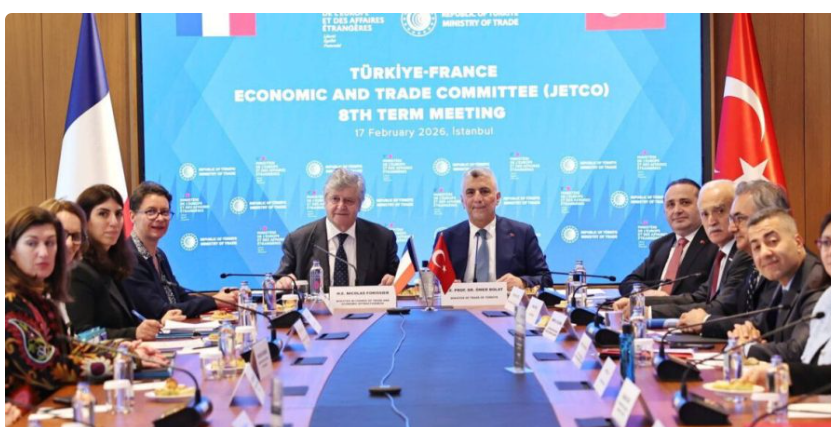 bolat jetco fransa
Türkiye and France signaled a marked improvement in bilateral economic relations this week as senior officials chaired a high-level business roundtable in Istanbul and reaffirmed support for deeper trade, investment and potential modernization of the EU–Türkiye Customs Union. Despite longstanding political differences — including Paris’ past opposition to Turkish EU accession — both sides appear to be prioritizing economic pragmatism amid shifting geopolitical and supply chain realities.
Trade Minister Ömer Bolat and French Minister Delegate for Foreign Trade Nicolas Forissier co-chaired the Türkiye–France Business Roundtable in Istanbul, organized by DEİK with the contribution of MEDEF International.
The meeting coincided with the eighth session of the Joint Economic and Trade Commission (JETCO), underscoring renewed institutional engagement between the two countries.
Bilateral Trade Hits Record High
Bolat said bilateral trade volume reached a historic high of $24 billion in 2025.
As of 2024, France’s direct investment stock in Türkiye stands at nearly $9 billion. Between 2020 and 2024, French firms invested approximately €3.6–4 billion in the Turkish economy. An additional €5 billion in investments is projected over the next three years.
French companies currently provide around 185,000 direct jobs in Türkiye, with broader employment impact approaching 400,000 positions. Franco-Turkish businesses account for roughly 1.6% of Türkiye’s GDP.
“These expanding commercial and economic ties have gained strong momentum,” Bolat said, adding that the next JETCO meeting is expected to take place in France in June.
Europe’s Security Architecture ‘Falls Short’ Without Türkiye, Erdoğan Says
Expanding Cooperation Beyond Borders
Officials highlighted growing cooperation not only bilaterally but also in third countries, particularly in Africa, Eastern Europe, Central Asia and the Middle East.
Both governments expressed readiness to support joint ventures in infrastructure, energy and development projects in these regions.
Existing cooperation spans sectors including:
-
Automotive
-
Aviation
-
Pharmaceuticals
-
Renewable energy
-
Construction and engineering
-
Textiles and food processing
-
Information and communication technologies
-
Finance and insurance
Improved logistics connectivity — including the Ro-Ro shipping line between Sete Port in southern France and Yalova in northwestern Türkiye — has facilitated trade flows and strengthened commercial integration.
Energy as Strategic Anchor
Energy cooperation has emerged as a focal point of the relationship.
Forissier pointed to Türkiye’s renewable energy expansion, noting its current installed capacity and its target of reaching 120 gigawatts of wind and solar power by 2035.
He cited the joint venture between TotalEnergies and Rönesans Enerji, which aims to develop 2 gigawatts of renewable capacity by 2028.
French industrial group Nexans is also active in Türkiye, producing cables that connect power plants to the grid.
“Complementarity between our two countries is particularly strong in energy efficiency and low-carbon technologies,” Forissier said.
Erdoğan–Mitsotakis Meeting: Managed Calm in a Troubled Relationship
Customs Union: Conditional Green Light
France signaled conditional openness to modernizing the EU–Türkiye Customs Union.
The Customs Union, in force since 1995, covers industrial goods and some processed agricultural products but excludes services, agriculture, digital trade and public procurement.
Forissier said modernization could reduce trade barriers and strengthen bilateral trade but stressed that progress depends on meeting conditions set by the European Commission.
“This debate does not concern France alone. It involves all European Union member states,” he said.
The European Union remains Türkiye’s largest trading partner, reflecting deeply integrated industrial supply chains.
Visa Facilitation and EU Dialogue
Bolat said France issued 163,000 visas to Turkish citizens last year — its second-highest global total after China. Officials noted reduced waiting times and simplified procedures, particularly for students and businesspeople.
“We reaffirmed that we will work together for the days when visas will be lifted,” Bolat said.
While Türkiye has been an EU candidate since 1999, accession negotiations have effectively stalled for years. However, recent months have seen signs of renewed engagement centered on economic cooperation rather than political accession.
Political Differences Remain
France has historically led opposition among major EU states to Turkish EU accession and has frequently criticized Ankara on issues ranging from Kurdish policy to Eastern Mediterranean disputes and the Nagorno-Karabakh conflict.
Yet the Istanbul roundtable suggested a softer tone.
Analysts suggest several structural drivers behind the warming trend:
-
European competitiveness concerns: The EU faces increasing pressure from U.S. protectionism and global supply chain restructuring.
-
Strategic autonomy debates: Strengthening industrial capacity within Europe may require closer integration with Türkiye’s scalable mid-tech manufacturing base.
-
Defense and security considerations: Türkiye’s expanding defense industry and NATO role contribute to Europe’s broader strategic calculations.
For France, maintaining constructive engagement with Ankara may serve both economic and geopolitical objectives.
Pragmatism Over Politics?
Despite lingering political disagreements, the tone of the Istanbul meetings reflected economic pragmatism.
Bolat said Turkish and French business leaders expressed satisfaction with the current investment climate and discussed further expansion plans.
Forissier, addressing Turkish companies directly, emphasized openness to reciprocal investment: “Come and invest in France,” he said.
While structural disputes between Türkiye and France remain — including EU accession debates and regional policy differences — the latest engagement suggests that economic cooperation is increasingly insulated from political friction.
Whether this marks a lasting shift or a tactical recalibration will depend on developments within the EU, NATO dynamics and broader geopolitical pressures.
For now, however, both capitals appear committed to deepening economic ties while managing — rather than escalating — their differences.
Author: PA Turkey News Desk
PA Turkey intends to inform Turkey watchers with diverse views and opinions. Articles on our website may not necessarily represent the view of our editorial board or count as endorsement.
Follow our English YouTube channel (REAL TURKEY):
https://www.youtube.com/channel/UCKpFJB4GFiNkhmpVZQ_d9Rg
Twitter: @AtillaEng
Facebook: Real Turkey Channel: https://www.facebook.com/realturkeychannel/
Related articles
Trade Minister highlights increasing US business interest in Turkey
Turkish Trade Minister Signals Possible Sunday Closures for Supermarkets Amid Consumer Protection Push
Turkey to Reopen Strategic Middle East Trade Corridor via Syria by 2026