Global Economic Growth: IMF Cuts Projections
 IMF
IMF
Global economic growth estimates have been revised downward by the International Monetary Fund (IMF) as geopolitical tensions in the Middle East continue to disrupt international trade and energy markets. According to the April edition of the World Economic Outlook report, the forecast for global expansion in 2026 has been lowered from 3.3% to 3.1%, citing significant supply chain interruptions and heightened uncertainty.
Revised Forecasts for the Turkish Economy
The IMF’s latest report presents a more cautious outlook for Türkiye than previous projections. Due to spillover effects from regional instability and shifting trade dynamics, growth expectations for the Turkish economy have been adjusted to 3.4% for 2026 and 3.5% for 2027. This marks a decrease from the January estimates, which had placed growth at 4.2% and 4.1%, respectively.
Inflation projections for the country have also been revised upward. The report estimates that Türkiye’s year-end inflation will reach 28.6% in 2026, before cooling to 21.4% in 2027. Additionally, unemployment rates are expected to hover around 8.3% this year, potentially rising slightly to 8.7% in 2027.
Impact on Major Economies and Energy Risks
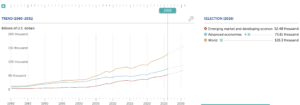
The downward trend is visible across most advanced economies, with the Eurozone and the United Kingdom seeing notable cuts to their growth forecasts. Germany and France, the engines of European industry, have had their 2026 targets lowered to 0.8% and 0.9%, reflecting the impact of energy costs and reduced external demand.
The report also highlights severe economic contractions in conflict-adjacent nations. Iran’s economy is projected to shrink by 6.1% this year, while Iraq and Qatar face significant volatility in their GDP figures due to disrupted oil exports.
IMF experts warned of a “downside risk” scenario: if energy infrastructure suffers further damage, global growth could plummet to 2.5%, pushing global headline inflation toward 5.4%. The report concludes that while falling tariffs and strong recent data provided some balance, the “asymmetric shocks” from the Middle East remain the dominant force slowing the global economic growth outlook.
Source: IMF
Related articles
Turkey’s Inflation Outpaces OECD Peers at Record Rates
ING forecasts slower disinflation and higher borrowing pressure for Türkiye

Brokerages Warn Inflation Risks Persist Despite Softer Data; Limited Room for Rate Cuts