ANALYSIS: Turkish Inflation Climbs, Geopolitical Risks Force CBRT to Reconsider Rate Cuts
 tufe subat2026
ISTANBUL — Turkey’s inflation outlook has become significantly more complicated following the release of February consumer price data and the rapid escalation of geopolitical tensions in the Middle East. While February’s inflation print largely met market expectations, brokerage analysts are shifting their focus from potential interest rate cuts to the inflationary risks posed by surging oil prices and regional instability.
February Inflation: The Tug-of-War
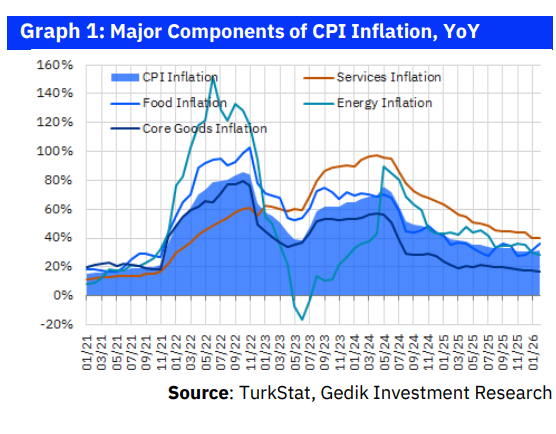
According to data released by the Turkish Statistical Institute (TÜİK), annual CPI inflation rose to 31.5% in February, up from 30.7% in January. On a monthly basis, the Consumer Price Index (CPI) increased by approximately 3.0%, aligning closely with market forecasts.
However, a closer look at the sub-indices reveals a complex narrative:
-
Core Inflation Improvement: Core indicators—specifically the “C” index—showed signs of deceleration, undershooting some analyst expectations. This was primarily driven by a sharp decline in clothing prices and a moderate performance in core goods, suggesting that the underlying disinflationary trend has not been entirely derailed.
-
The Food Factor: Food inflation remains a significant headwind, registering at roughly 6.9% monthly. Analysts at Gedik Yatırım and Tacirler Yatırım note that while fruit and vegetable prices contributed heavily to this volatility, the increase in “other processed food” and dairy/oil sub-items was unexpected.
-
Energy and PPI: The Domestic Producer Price Index (D-PPI) rose to 27.6% annually, driven primarily by energy costs, underscoring the risks of external shocks.
Geopolitical Headwinds: The “Oil” Risk
The most critical variable currently dominating market sentiment is the U.S.-Iran conflict and the subsequent closure of the Strait of Hormuz. Analysts from Gedik Yatırım, Tacirler Yatırım, and Şeker Yatırım all highlight the potential for a renewed energy shock to destabilize Turkey’s inflation path.
-
Tax Adjustments: Treasury and Finance Minister Mehmet Şimşek has hinted that the government may consider measures to limit the pass-through of rising fuel costs to consumers. Markets are speculating on a potential return of the “sliding-scale tax adjustment mechanism” (eşel-mobil) used between 2018 and 2020, where excise tax cuts were utilized to cushion pump price hikes.
-
Economic Impact: Estimates suggest that every 10% increase in oil prices could add roughly 1.0–1.5 percentage points to Turkey’s inflation over a 6–12 month horizon, not only through direct costs but also by widening the current account deficit and pressuring the Lira.
CBRT: A Pivot from Easing to Caution?
Before the recent escalation in the Middle East, the consensus among brokerage houses was that the Central Bank of the Republic of Turkey (CBRT) might initiate a modest easing cycle, potentially cutting rates by 50–100 basis points at the March 12 Monetary Policy Committee (MPC) meeting.
That outlook has now shifted dramatically.
-
Liquidity Measures: The CBRT’s recent decision to suspend weekly repo auctions and initiate Lira-settled forward foreign exchange sales to curb volatility signals a preference for tighter liquidity.
-
Policy Outlook: Brokerages now view a rate cut in March as “highly unlikely.” Analysts at Şeker Yatırım and Gedik Yatırım warn that if the conflict drags on—particularly if it impacts energy markets significantly—the Central Bank may be forced to maintain its current stance or even adopt a tighter posture to prevent inflationary expectations from unanchoring.
Bottom Line: While the disinflation process showed resilience in February’s core data, the external geopolitical environment has created an “upside risk” scenario. Markets are currently in a “wait-and-see” mode, with the March 12 CBRT decision now viewed less as an opportunity for rate cuts and more as a defensive stance against regional uncertainty.
Related articles
Erdogan: Turkish economy will grow more than 7% this year

The Istanbul Chamber of Commerce has announced that prices in the megacity increased by 5.46 percent in September compared to the previous month while the annual inflation was 73.18 percent.

Title corrected: Simsek promises fiscal rectitude to help CB lower inflation