Why the AK Party Cannot Solve Turkey’s Economic Crisis — Deniz Zeyrek’s Analysis
 kriz yok
Summary:
NEFES Columnist Deniz Zeyrek argues that the ruling AK Party cannot resolve Turkey’s economic crisis because it refuses to acknowledge that such a crisis exists. Zeyrek critiques recent statements by President Erdoğan, Vice President Cevdet Yılmaz, and Treasury and Finance Minister Mehmet Şimşek — especially remarks made during the presentation of the 2026 Budget in Parliament. He questions official growth and income projections, inflation targets, unemployment data, and claims of fiscal discipline. According to Zeyrek, as long as the government denies the presence of a crisis, no meaningful solution can be expected.
“You cannot fix a crisis you do not believe exists”
Deniz Zeyrek sets the tone of his commentary with a blunt opening: “The AK Party cannot solve the economic crisis because they do not believe there is one. How can you fight a crisis you think does not exist?” He bases this claim on public statements from top economic policymakers, including President Erdoğan, Vice President Cevdet Yılmaz, and Finance Minister Mehmet Şimşek.
The breaking point for Zeyrek was Vice President Cevdet Yılmaz’s recent budget presentation in the Turkish Grand National Assembly, which the journalist describes as “insulting the public’s intelligence.” He then dissects six key economic claims one by one.
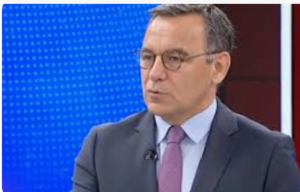
Columnist Deniz Zeyrek
1. Per capita income projection — unrealistic vs. lived reality
Yılmaz stated that Turkey’s per capita income will reach USD 17,748 by the end of 2025, positioning Turkey as the world’s 16th largest economy nominally and 11th in PPP terms.
Zeyrek agrees that this is mathematically achievable on paper, yet he asks a grounded question:
If the dollar is 42.5 lira, that level of income implies 63,000 TL per person per month.
He contrasts this with real incomes:
-
Widows/orphans: 12–13 thousand TL
-
Minimum pension: 16,881 TL
-
Minimum wage: 22,104 TL
“How then,” Zeyrek asks, “can per capita income be 63,000 TL in such a country?” Even TÜİK’s own inflation figure is over 30%. Exchange rates are tightly managed. Population growth has slowed. More importantly — wealth distribution is heavily skewed. Therefore, statistical GDP averages, he suggests, say nothing about ordinary living standards.
2. Claim: Turkey will surpass Italy economically
According to Yılmaz, Turkey will overtake Italy and become Europe’s 4th largest economy. Zeyrek checks the numbers:
-
Italy ≈ USD 2.5 trillion economy
-
Turkey ≈ USD 1.4 trillion
To surpass Italy, Turkey would need to expand by over 1 trillion dollars. Yet the government’s own growth target is just 3.8% annually. “How is such a leap expected to happen under these conditions?” he asks.
3. Inflation will fall below 20% in 2026 — and single digits in 2027
Zeyrek notes that government inflation targets have repeatedly been missed, even under optimistic official inflation readings. With price levels still rising, market inflation far exceeding household purchasing power, and disinflation slowing, he questions the plausibility of this path.
4. Fiscal discipline and public debt “under control” — but interest costs explode
The government claims fiscal discipline remains intact. But Zeyrek highlights a concern:
-
Interest payments in the next budget = 2.7 trillion TL
“How can discipline be maintained,” he asks, “when one-fifth of the entire budget goes to interest alone?” He also notes the absence of meaningful austerity measures.
5. Unemployment will fall below 8.5% in 2025
Despite mass layoffs even among large industrial firms, official unemployment has stayed around 8% for months. Broader unemployment is estimated near 30%.
Zeyrek ironically adds: “At least thank you TÜİK for not lowering unemployment further on paper.”
6. The 2026 budget is labeled “budget of stability and prosperity”
The government says the budget will prioritize efficient allocation of public resources. But Zeyrek points to procurement practices:
-
Many state tenders are conducted under Article 21B (invitation method)
-
When competitive open auctions are used instead, costs drop dramatically
He cites several examples:
-
An airport runway tender: 1.6B → 1.2B TL
-
Metro tender in Ankara: 300M TL saved
-
TSK food tender: 200M TL saved
Yet 21B remains dominant. Zeyrek challenges the idea that such a procurement system can deliver “efficiency, transformation, and growth.”
A political-economic conclusion: denial blocks solutions
Zeyrek argues that Erdoğan, Yılmaz, and Şimşek present an economy “in full flight” rather than one struggling with inflation, poverty, and declining purchasing power. In their narrative:
-
The poor are only “imagining hardship”
-
Hunger lines are “perception”
-
The middle class is collapsing “only in discourse”
-
If the crisis does not exist on paper — why solve it?
He concludes:
A government that does not recognize the crisis cannot solve it. Do not wait for the AK Party to end the economic downturn.
Related articles

What Turkish Boards of Directors Should Learn in the Age of Uncertainty

RTÜK fines three TV outlets over coverage of İstanbul mayor’s trial, one over the host “praising terrorism with mimics” during a program
The Truth About Turkish Defense Industry: İbrahim Kiras