



US Special Envoy Sets September 2026 Target for Reopening Halki Seminary
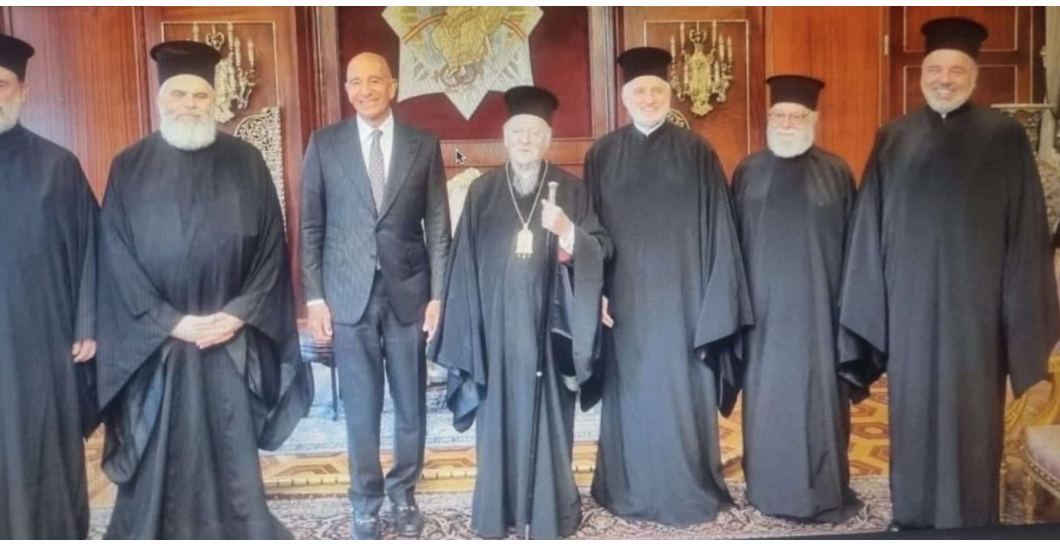 tom barrack papazlar
ISTANBUL — A high-profile U.S. envoy has set a definitive target date for the controversial reopening of the Halki Seminary (Heybeliada Theological School), a move that directly follows a high-level discussion between President Recep Tayyip Erdoğan and then-U.S. President Donald Trump.
Tom Barrack, who serves as a U.S. Special Representative (and was the former U.S. Ambassador to Ankara), stated that the goal is to open the school in September 2026.
Barrack made the announcement after meeting with Ecumenical Patriarch Bartholomew at the Fener Greek Patriarchate on Thursday, during his Thanksgiving visit.
“Our goal is to reopen the Halki Theological School in September 2026. This issue is extremely important for both President Trump and President Erdoğan,” Barrack told the press.
Erdoğan’s Pledge and Diplomatic Pressure
The issue of the Halki Seminary, which has been closed for over 50 years, was brought back to the diplomatic forefront during a meeting between President Erdoğan and President Trump at the White House last September.
Before the meeting, President Erdoğan responded to reporters’ questions regarding the seminary’s reopening by stating, “Whatever falls to us regarding the Halki School, we are ready to do it.”
The Ecumenical Patriarch Bartholomew also met with President Trump in the White House in mid-September, where the status of the Halki Seminary was reportedly a key topic of discussion.
Why is the Halki Seminary So Important? 🇬🇷🤝🇹🇷
The reopening of the Halki Seminary is far more than a simple educational issue; it is a geopolitical and religious flashpoint with significant implications for Turkey’s international standing and its relationship with Greece.
1. Key to Ecumenical Leadership
-
Training Center: Halki was the primary institution for training Orthodox clergy and metropolitans destined for leadership roles within the Ecumenical Patriarchate of Constantinople, which is spiritually recognized as the center of the Orthodox world, serving millions of believers globally.
-
Crisis of Succession: The closure has created a crisis for the Patriarchate, limiting its ability to adequately train its clergy within Turkey. Reopening the school is crucial for ensuring the continuity of the Patriarchate’s leadership and its presence in Istanbul.
2. Role in Turkey-Greece Relations
-
Symbol of Minority Rights: For Greece and the international community, the school’s closure is a potent symbol of minority rights in Turkey. Its reopening would be viewed as a major, positive gesture towards respecting the rights of the Greek Orthodox minority in Istanbul.
-
Reciprocity Demand: The issue is often linked to the reciprocal treatment of the Muslim Turkish minority in Western Thrace, Greece. Turkey often ties the status of Halki to the status of mosques, madrasas, and waqfs (foundations) in Greece. A major step on Halki would likely require similar positive steps from Athens.
-
U.S. and EU Pressure: The U.S. and the European Union have consistently used the Halki issue as a barometer for human rights and religious freedom in Turkey, making its resolution a frequent topic in high-level diplomatic talks.
Background on the Closure
The Halki Seminary, located on Heybeliada island off the coast of Istanbul, was founded in 1844.
It was closed by the Patriarchate in 1971 after a Turkish Constitutional Court ruling required all private institutions of higher education to be attached to Turkish universities or become public universities. The Patriarchate refused to integrate the school under the Ministry of National Education’s complete control, leading to its closure, which remains a key grievance of the global Orthodox community.
Proposed arrangements for reopening include re-establishing it as a “Theology Vocational School” under a private school status, with the administration overseen by the Greek Patriarchate but the overall audit and inspection remaining under the Ministry of National Education.