US Media Revives Claims Maduro Could Seek Refuge in Turkey
 madura rte
Analysis by Mustafa K. Erdemol, HalkTV.com.tr
Recent coverage in major US outlets — including Politico and The Washington Post — has revived a controversial claim: that Venezuelan President Nicolás Maduro, under mounting US pressure, may eventually seek political refuge in Turkey. The idea is not entirely new, but it has gained visible traction in Western media as tensions escalate between Washington and Caracas.
The Washington Post recently suggested:
“Facing U.S. pressure and potential military intervention, Venezuelan President Nicolás Maduro may consider Turkey as a safe haven. Turkey’s president, a close ally, could offer refuge with guarantees against extradition.”
These assessments have resurfaced amid heightened speculation about the future of Maduro’s presidency.
Secret Negotiations and a Search for De-Escalation?
As reported by The New York Times in October, Maduro allegedly signaled — through backchannels — a willingness to soften relations with Washington. Citing sources in both Washington and Caracas, the Times claimed that Maduro had explored a proposal that included:
-
granting US companies preferential access to Venezuelan oil and gold projects,
-
redirecting crude exports from China to the United States,
-
and scaling back energy cooperation with China, Iran, and Russia.
According to the Times, these contacts were meant to avoid a potential military confrontation.
Venezuela’s Vice President Delcy Rodríguez denied the claims, but the paper reported she had nonetheless approached the White House through Qatari intermediaries with a plan in which Maduro could step aside in two to three years — a timeline former President Donald Trump allegedly rejected as too long.
These accounts are unverified, but they have fueled speculation around Maduro’s next steps.
Washington’s Pressure Campaign Intensifies
In recent weeks, President Donald Trump has sharply escalated rhetoric and operations against Venezuela. The administration’s “Southern Spear Operation” has targeted vessels Washington accuses of drug trafficking. Local reporting suggests that the confrontations have already resulted in dozens of deaths, further compounding uncertainty about Caracas’s stability.
This atmosphere has contributed to renewed talk — partly informed, partly speculative — that Maduro might eventually consider leaving the country.
According to Mustafa K. Erdemol, this narrative may also be part of US psychological warfare, designed to unsettle Caracas by portraying Maduro as a leader preparing an escape route.
Would Turkey Be a Realistic Option for Maduro?
Erdemol notes that while Maduro still commands support from millions and is unlikely to flee easily, Turkey would be among the most logical destinations if he ever felt compelled to leave Venezuela.
There are several reasons:
-
Strong personal and political ties:
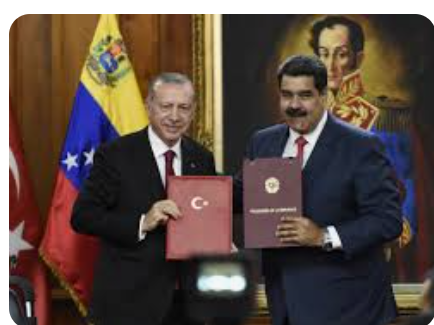
Maduro has cultivated a close relationship with President Recep Tayyip Erdoğan, whom he views as a partner in an anti-imperialist front. Erdoğan was one of the first leaders to congratulate Maduro when he was declared the winner in the contested July 2024 election. -
Cultural affinity:
Maduro is known for his enthusiasm for Turkish culture and television dramas, particularly Diriliş: Ertuğrul. He even visited the series set during a trip to Turkey. -
Economic connections:
As Bloomberg previously reported, during the height of US sanctions in 2018, Turkey became a major buyer of Venezuelan gold, importing nearly $900 million worth — a factor that strengthened bilateral ties. -
Turkey’s track record as a perceived safe harbor:
Turkey has previously hosted individuals and groups under international scrutiny.
Erdemol notes that Hamas leaders operated from Turkey, and that the Ankara government facilitated the Reza Zarrab scheme that helped Iran circumvent US sanctions via Halkbank.
These dynamics may shape Maduro’s perception of Turkey as a “safe” geopolitical environment.
Why Not Cuba or Russia?
According to Erdemol:
Cuba
Although Havana has historically been Venezuela’s closest ally, Cuba is:
-
under a 65-year US blockade,
-
extremely close to US territorial waters,
-
and vulnerable to US pressure if a high-profile figure like Maduro sought refuge there.
For these reasons, Erdemol argues that Cuba is not a realistic sanctuary.
Russia
While Moscow is a military ally of Caracas, Erdemol notes that the relationship between Vladimir Putin and Donald Trump is unpredictable. Seeking refuge in Russia could leave Maduro under direct Kremlin control, a scenario Erdemol sees as risky and politically limiting.
Thus, Turkey remains the most plausible option, if geopolitical pressures force Maduro to leave Venezuela.
A Psychological Warfare Narrative?
Erdemol emphasizes that none of these claims should be taken as established fact.
They may reflect:
-
US psychological operations aimed at weakening Maduro’s morale,
-
strategic leaks designed to create divisions within Venezuela’s political ranks,
-
or media amplification of speculative scenarios.
The analyst stresses that if Maduro truly sees himself as a Chavista patriot, he may choose to stay and confront the United States from within Venezuela rather than seek exile abroad.
Conclusion
For now, the claims remain speculative — but increasingly prominent in US media discourse. Whether Maduro ultimately stays or leaves will depend not only on Washington’s next moves but also on internal dynamics within Venezuela.
As Mustafa K. Erdemol concludes, the decision will shape how Maduro enters the historical record.