Two Major Earthquake Scenarios Threaten Istanbul, New Study Warns
 istanbul earthquake
A major scientific study published in Science has reignited concerns over Istanbul’s earthquake risk, outlining two critical scenarios that could define the city’s seismic future. Evaluating the findings, Dr. Yasemin Korkusuz Öztürk, an assistant professor at Erzincan Binali Yıldırım University’s Earthquake Technologies Institute, stated that the Marmara region may face either two powerful earthquakes in succession or a single, significantly larger rupture.
Drawing on her own three-dimensional earthquake simulations, Öztürk explained that the Marmara Sea could experience either two separate earthquakes in the magnitude range of 6.2 to 6.8 or a single, more destructive earthquake reaching around magnitude 7.3 if multiple fault segments rupture together. Her assessment aligns closely with the conclusions of the international research published in Science, one of the world’s most prestigious academic journals.
Marmara Identified as Europe’s Most Dangerous Seismic Zone
The study, led by Germany-based GFZ Helmholtz Centre for Geosciences, characterizes the Marmara Sea as “Europe’s most critical seismic hotspot.” According to the researchers, the region combines dense population, complex fault geometry, and a long history of stress accumulation, making the potential consequences of a significant earthquake particularly severe.
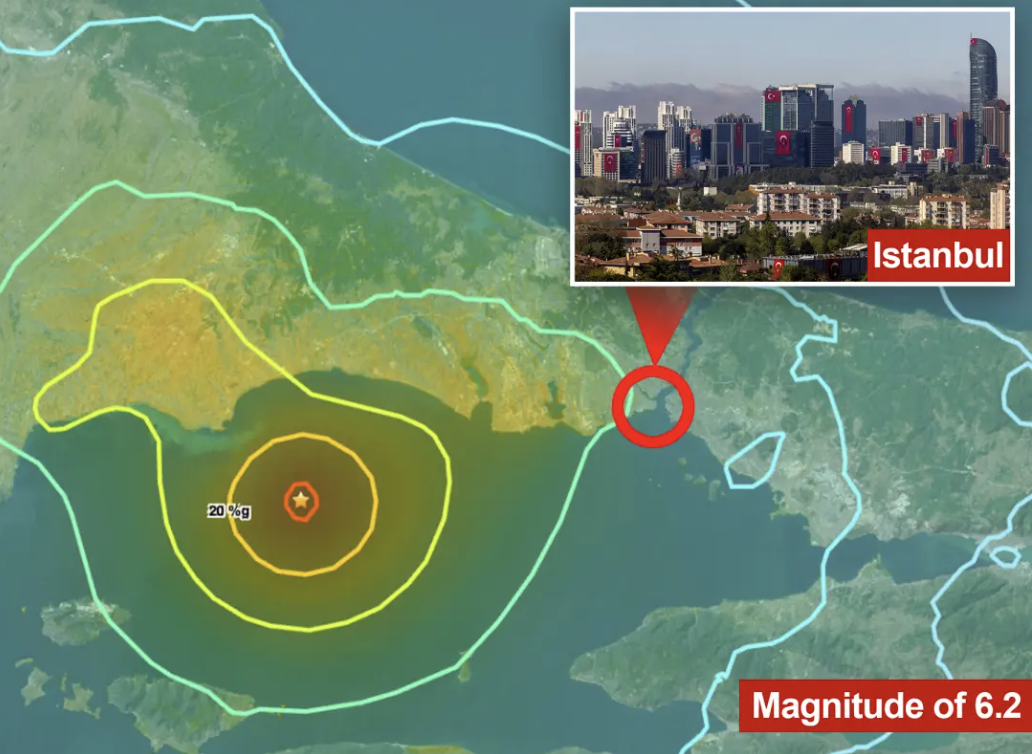
Experts emphasize that the findings are significant in countering claims that Istanbul is no longer at risk following the magnitude 6.2 earthquake that struck off the coast of Silivri on April 23. On the contrary, scientists argue that recent seismic activity may indicate stress transfer rather than stress release.
The “Locked” Princes’ Islands Segment Raises Alarm
One of the most striking conclusions of the Science study concerns the Princes’ Islands (Adalar) segment, located south of Istanbul. Researchers found that this segment remains essentially “locked,” meaning it has not released accumulated seismic energy for a long time. This condition significantly increases the likelihood that, if rupture occurs, it will be highly destructive.
Scientists also warn of a “directivity effect,” which could intensify seismic waves toward the ends of the fault rupture. In practical terms, this means that densely populated districts of Istanbul could experience much more vigorous shaking than areas closer to the rupture’s origin.
Scientific Consensus: A Major Earthquake Is Inevitable
Geological engineer Prof. Dr. Okan Tüysüz, a member of the Turkish Academy of Sciences, stressed that the broader scientific community is united on this issue. “A major earthquake in Istanbul is not a hypothesis, it is a mathematical certainty,” he said. “It may happen today or 50 years from now, but this fault will eventually rupture.”
Tüysüz underlined that the only uncertainty lies in timing, not in whether such an event will occur. This perspective reinforces decades of warnings issued after the devastating 1999 İzmit earthquake.
Historical Seismic Activity Supports the Risk
The Science article also points to a pattern of recent seismic activity that may reflect ongoing energy transfer along the Main Marmara Fault. Notable earthquakes include magnitude 5.1 and 5.2 events offshore Tekirdağ and Marmara Ereğlisi in 2011–2012, a magnitude 5.8 earthquake near Silivri in September 2019, and the magnitude 6.2 Silivri earthquake in April 2025.
Rather than reducing risk, experts suggest these events may have redistributed stress toward still-unbroken fault segments closer to Istanbul.
Two Possible Earthquake Scenarios
Speaking to BBC Turkish, Dr. Öztürk elaborated on the implications of the Science study and on its consistency with her earlier peer-reviewed research published this year. She explained: “The study analyzes earthquakes larger than magnitude 5.0 that occurred on the Main Marmara Fault over the past 15 years and shows that epicenters have migrated from west to east over time.”
According to Öztürk, the Avcılar Fault alone can generate an earthquake of around magnitude 6.0. However, the study does not rule out the possibility of a joint rupture involving both the Avcılar and Adalar faults. “If these two faults rupture together, a much larger earthquake could occur,” she said.
Referring to her own work titled Three-Dimensional Simulations of a Possible Main Marmara Fault Earthquake, Öztürk outlined two main scenarios: “In the first scenario, the earthquake occurs only on the Avcılar Fault, followed by a later rupture of the Adalar Fault, resulting in two separate earthquakes between magnitude 6.2 and 6.8. In the second scenario, both faults rupture together and produce a single earthquake of around magnitude 7.0 to 7.3.”
Where the Next Big Earthquake Is Expected
Prof. Tüysüz also explained where scientists believe the highest risk is concentrated. According to him, unbroken fault segments beneath the Marmara Sea lie between the offshore area of Büyükçekmece and the Gulf of İzmit. “There are unruptured fault sections in the Marmara Sea, and if these break, they will create severe shaking in Istanbul and other Marmara-region cities,” he said.
He noted that some sections, such as the area between the Tekirdağ Basin and Kumburgaz, slide without significant friction and therefore do not accumulate stress. Other segments, including those that ruptured in 1912, have not yet rebuilt enough stress to produce a major earthquake. This leaves the Büyükçekmece–İzmit corridor as the most likely source of a magnitude 7.2 event.
April 23 Earthquake May Have Increased Risk
According to Tüysüz, aftershocks following the April 23 earthquake migrated eastward and stopped near Büyükçekmece. This behavior suggests resistance in a fault segment that has absorbed transferred stress. “The fact that aftershocks stopped at a specific point indicates a stress transfer, or in simple terms, a triggering effect,” he explained.
He added that the Science study supports long-standing warnings: “Rather than saying there will be no earthquake in Istanbul, this research suggests that the expected major earthquake may have moved slightly closer in time.”
Preparation Is the Only Real Solution
While experts stress that it is impossible to predict the exact timing of earthquakes, they agree that preparedness is non-negotiable. Prof. Tüysüz emphasized that limiting Istanbul’s population growth is essential to reducing potential casualties. He also warned that a major Marmara earthquake would severely disrupt Türkiye’s economy and industrial base.
“The key issue is not knowing when the earthquake will happen,” he said, “but taking action now to reduce its impact.”
Related articles
NYT Warns Istanbul Could Face One of the Worst Humanitarian Disasters in Recent History
Marmara Fault May Break in Segments, Not One Giant Earthquake

Istanbul Earthquake Fears Run Deep, New Study Shows