Türkiye Records Current Account Surplus in October
 Current-Account
Türkiye’s external balance showed a notable improvement in October, with the current account posting a surplus of $457 million, according to data released by the Central Bank of the Republic of Türkiye (CBRT). The figures highlight the growing role of services revenues—particularly tourism and transportation—in offsetting the country’s structural foreign trade deficit and supporting external financing stability.
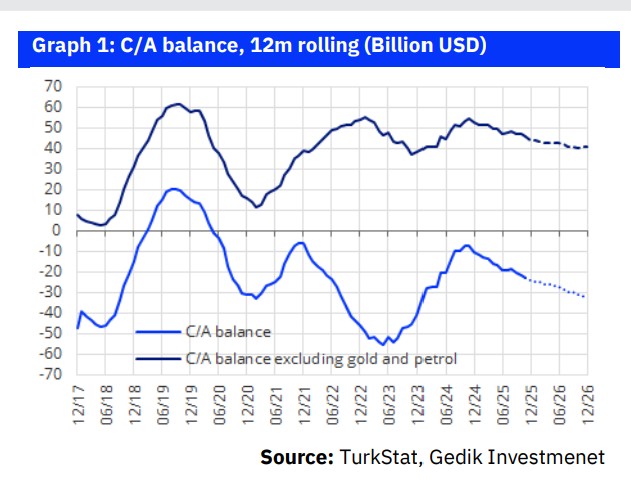
The CBRT data indicate that when gold and energy are excluded, the current account delivered a much stronger performance, recording a surplus of $7.028 billion in October. This underscores the underlying strength of non-energy external flows, even as global trade conditions remain challenging.
Trade Deficit Persists, but Services Provide a Strong Cushion
Despite the headline surplus, Türkiye continued to run a sizable trade gap. The balance of payments–defined foreign trade deficit reached $5.963 billion in October, reflecting ongoing import demand and external price pressures.
On a 12-month rolling basis, the current account deficit stood at approximately $22.0 billion as of October. Over the same period, the balance of payments–defined foreign trade deficit widened to $67.3 billion, highlighting that goods trade remains the main drag on external balances.
However, this weakness has been substantially offset by the services balance, which generated a $63.2 billion surplus on an annualized basis. In contrast, the primary income balance recorded a deficit of $17.6 billion, while the secondary income balance posted a smaller deficit of $328 million.
Tourism and Transport Drive Services Surplus
Services income once again proved decisive in October’s positive outcome. Net inflows stemming from services reached $7.588 billion during the month, providing a strong counterweight to the trade deficit.
Within this category, travel revenues remained the dominant contributor, delivering net income of $5.860 billion, reflecting the continued strength of tourism. Transportation services also made a significant contribution, generating $2.462 billion in net income. These figures confirm that Türkiye’s services exports—especially tourism and logistics—remain critical pillars of external balance.
Financing the Current Account: Loans Take the Lead
CBRT data also shed light on how the current account deficit has been financed over the past year. As of October 2025, the financing structure shows a heavy reliance on external borrowing, alongside more modest contributions from investment inflows.
On a rolling annual basis, net foreign direct investment (FDI) contributed $5.2 billion to financing, while net portfolio investments added only $0.2 billion, indicating relatively subdued appetite for portfolio assets. In contrast, loans accounted for $26.9 billion, making them the largest single source of financing. Trade credits added a further $0.8 billion.
Offsetting these inflows, net cash and deposits had a negative impact of $3.9 billion, while the Central Bank’s net foreign exchange reserves declined by $13.3 billion, reflecting intervention and balance-of-payments dynamics.
Capital Outflows in Direct Investments
October saw net outflows of $838 million in direct investments, pointing to outward capital movement during the month. While foreign residents increased their direct investments in Türkiye by $128 million, domestic residents raised their direct investments abroad by $966 million, resulting in the net outflow.
Real estate investments revealed a more balanced picture. Residents purchased $225 million worth of real estate abroad, while non-residents recorded net real estate purchases of $240 million in Türkiye, suggesting that property demand from foreign buyers remained resilient.
Portfolio Investments Record Net Outflows
Portfolio flows were negative in October, with net outflows totaling $1.023 billion. According to the CBRT breakdown, foreign investors sold $44 million in equities and $98 million in government domestic debt securities (GDDS).
In the international bond market, flows were mixed. Foreign investors recorded net purchases of $529 million in bank-issued bonds and $606 million in bonds issued by other sectors. However, they posted a net sale of $646 million in General Government bond issuances, reflecting selective risk positioning.
Credit Inflows and Other Investments
External borrowing remained robust in October. Banks used $829 million in net external loans, while the General Government recorded $850 million in net loan usage. Other sectors borrowed $3.139 billion, highlighting continued reliance on foreign credit to support economic activity.
Under other investments, deposits held by foreign banks in Türkiye showed divergent trends. Turkish lira–denominated deposits increased by $2.229 billion, while foreign currency deposits declined by $190 million, resulting in a net increase of $2.039 billion.
Official Reserves Decline
Finally, CBRT data showed a net decline of $1.610 billion in official reserves during October. This decrease reflects a combination of financing needs, market conditions, and balance-of-payments management.
Related articles

Turkey’s Inflation Expectations Flatten as Economy Seeks a New Equilibrium

A British couple share their experience during Turkey vacation

Turkish trade hindered by earthquakes and adverse calendar impact in April