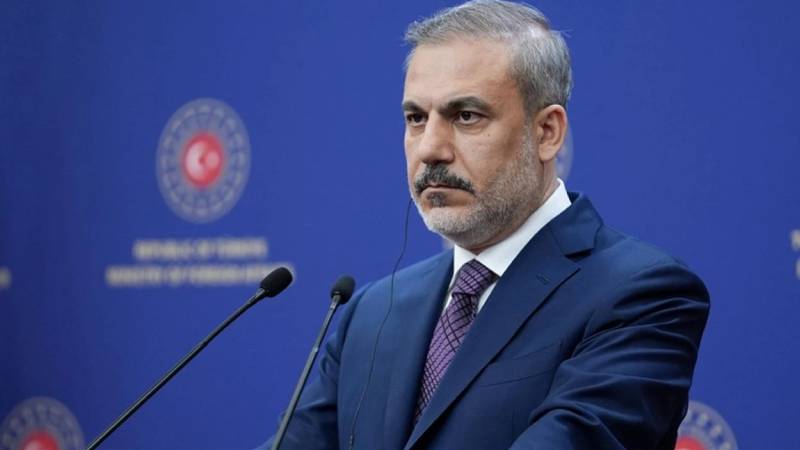
Türkiye Claims SDG Is Backed by Israel as Fidan Threatens Military Force
 hakan fidan
Turkish Foreign Minister Hakan Fidan issued one of his strongest warnings yet to the Syrian Democratic Forces (SDG), saying the group is emboldened by Israeli support and must abandon armed struggle in favor of political engagement.
“If you have an ideological struggle, you come and do politics. If you continue with weapons, you will find weapons in return,” Fidan said.
His remarks came during a wide-ranging assessment of developments inside Syria since the fall of the Assad government on 8 December 2024, a period he described as far more dynamic than widely recognized.
Post-Assad Transition: “Chains Must Be Removed”
Fidan said major steps have been taken in Syria but remain “unseen,” citing heavy structural obstacles left behind by years of sanctions and administrative paralysis.
One significant turning point, he noted, was the recent lifting of the U.S. Caesar Act—a sanctions regime that had blocked foreign investment in Syria for years.
“The destruction is enormous. To even begin rebuilding, several international chains had to be removed,” he said.
Investment, Reconstruction and Returns
According to Fidan, coordinated work by regional states, Europe, and the U.S. has led to early signs of investment returning to Syria.
But the reconstruction requirement is massive:
-
Large-scale infrastructure is needed for returnees
-
Basic services remain limited
-
Stability remains fragile
“The Syrian people are modest,” Fidan said. “They simply want safety and an end to chaos.”
Türkiye’s Role: Merging Armed Groups Under One Command
Fidan highlighted Türkiye’s role in integrating armed opposition groups into a unified national military structure.
“Türkiye encouraged the opposition forces it supported to join the national army. This brought together many disparate groups that resisted Assad under one command,” he said, calling it an underappreciated contribution.
He described the process as one where groups “sacrificed narrow power bases for the greater national interest,” adding that Türkiye’s strategic guidance had been essential.
Rising Risks in Southern Syria
While some Western narratives claim Damascus does not control all of Syria, Fidan disagreed, saying governance has been re-established in most areas.
He identified two remaining high-risk zones:
-
SDG-controlled territories in the northeast — requiring resolution under the 10 March Agreement
-
Southern Syria — currently “the most concerning risk area”
The minister warned that Israel’s involvement in the south amplifies tensions:
“The risk does not come from local dynamics alone but from Israel’s intervention, which could trigger wider escalation.”
Israel’s Regional Strategy
Fidan accused Prime Minister Benjamin Netanyahu’s government of pursuing a policy aimed at reshaping the region.
He cited a pattern of Israeli attacks in:
-
Lebanon
-
Syria
-
Gaza
-
The West Bank
-
Iran
-
Qatar
“Israel builds its security by producing insecurity for others,” Fidan said, adding that continued intervention was likely unless major international actors intervened.
Role of the United States and the Trump Administration
Fidan emphasized that the United States must play a decisive role, noting President Donald Trump’s dual-track regional engagement:
-
Sponsoring a Gaza peace framework jointly with Türkiye
-
Supporting the Syria process
He said Trump had repeatedly thanked President Erdoğan for Türkiye’s role.
Fidan also stressed that Washington must apply pressure on Israel at this stage.
“Yes, SDG Is Encouraged by Israel”
Responding to a question on whether SDG draws confidence from Israel, Fidan was blunt:
“Definitely. This is not new.”
He said SDG never cooperated with Syrian opposition groups against Assad and that Israel had long opposed efforts to remove the Syrian leader.
He pointed out that past U.S. policymakers influenced by Israeli positions had also withdrawn support for the opposition.
A Call to the SDG: Return to the Political Track
Fidan urged the SDG leadership to shift course:
“SDG must step back from its current position, reach an agreement with Damascus, and fulfill its obligations under the 10 March Agreement.”
He stressed that such a move is vital not only for Syria’s stability but also for Türkiye, Iraq, and Jordan, all of which regard SDG as a national-security concern.
Türkiye, he said, will continue encouraging dialogue and “a climate of peace and security” between the Syrian government and SDG.
PA Turkey intends to inform Turkey watchers with diverse views and opinions. Articles on our website may not necessarily represent the view of our editorial board or count as endorsement.
Follow our English-language YouTube videos @ REAL TURKEY:
https://www.youtube.com/channel/UCKpFJB4GFiNkhmpVZQ_d9Rg
Twitter: https://twitter.com/AtillaEng
Facebook – Real Turkey Channel:
https://www.facebook.com/realturkeychannel/
Related articles
Hakan Fidan’s Iran War Briefing Reshapes Government Agenda in Türkiye
Steven Cook and Sinan Ciddi: Post-Erdogan Turkey Is Finally Here
FM assures Blinken: Türkiye won’t let terrorists exploit Syria’s crisis