Turkey’s 2026 Budget Targets “Stability and Prosperity,” Focuses on Investment, Employment and Disinflation
 cevdet yilmaz butce
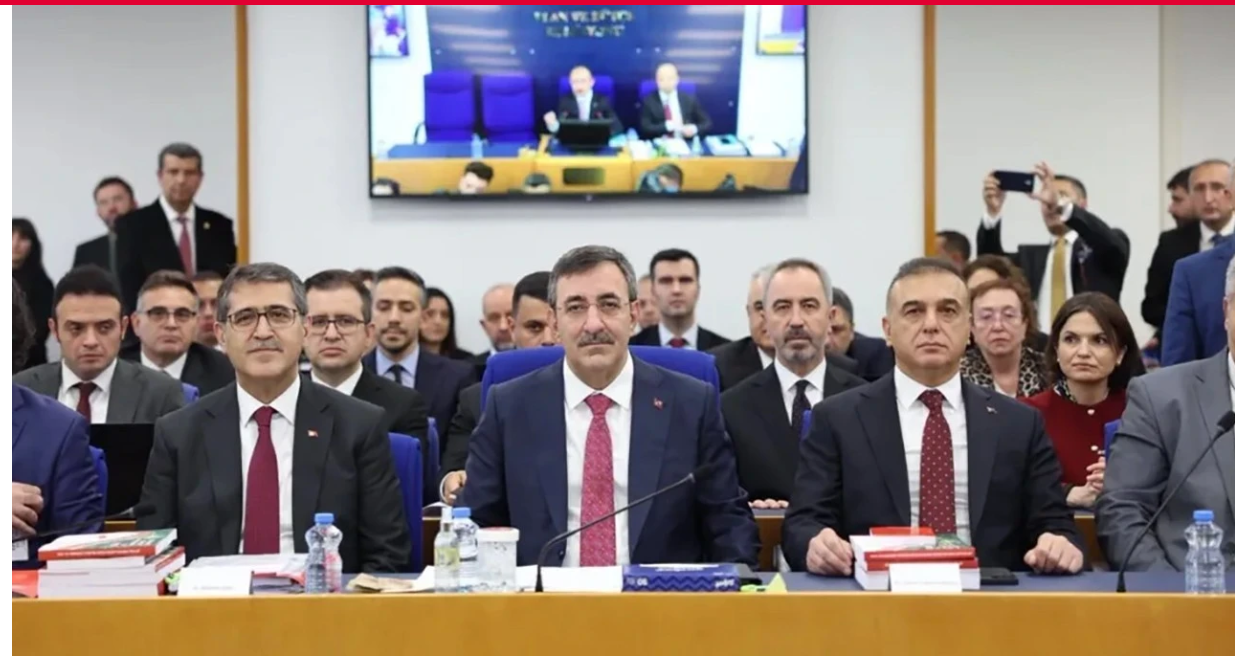
Vice President Cevdet Yılmaz presented the 2026 Central Government Budget Bill to parliament’s Planning and Budget Committee, framing it as a budget designed to support investment, production, employment and exports, while preserving fiscal discipline and advancing the disinflation process.
Macro Framework and Growth Outlook
-
Turkey expects GDP growth of 3.3% in 2025, broadly in line with the Medium-Term Program (OVP).
-
Growth is projected to accelerate to 3.8% in 2026, driven by investment, productivity gains and domestic demand stabilization.
-
Per capita income is forecast at $15,325 in 2024, rising to $17,748 in 2025 and $18,621 in 2026.
-
Authorities continue to signal commitment to disinflation, noting persistent inertia in services prices but aiming to cool demand and increase supply in critical areas such as food and housing.
Budget Size and Fiscal Balance
-
2026 central government expenditures: TL 18.93 trillion
-
2026 central government revenues: TL 16.22 trillion
-
Budget deficit-to-GDP ratio: targeted at 3.5% in 2026
-
Interest expenditures-to-GDP: also projected at 3.5%
-
A TL 29 billion primary surplus (non-interest surplus) is envisaged for 2026.
-
For 2025, the budget deficit is expected at 3.6% of GDP.
-
For 2024, spending was TL 10.78 trillion versus TL 8.67 trillion in revenues, implying a deficit of TL 2.11 trillion; excluding earthquake-related costs, the 2024 deficit ratio was closer to 3% of GDP.
Revenues, Social Spending and Household Support
-
Tax revenues for 2025 are projected at TL 10.73 trillion, with TL 1.73 trillion in non-tax income.
-
The ongoing tax exemption on wages up to the minimum wage level implies a foregone revenue of roughly TL 1.09 trillion in 2026.
-
The government plans to allocate TL 373 billion to electricity and natural gas support in 2026 to keep household utility costs contained.
-
When combined with tax exemptions and other transfers, total “social support–type” allocations rise to TL 2.38 trillion, equivalent to about 12.6% of the 2026 budget.
Capital Spending and Investment Envelope
-
Total planned investment envelope for 2026: TL 2.01 trillion, including:
-
TL 1.31 trillion in capital expenditures,
-
TL 525 billion in capital transfers (of which TL 345 billion earmarked for post-disaster housing and related infrastructure),
-
TL 169 billion in “investment acceleration” funding.
-
-
Priority areas include water and irrigation projects, rail, ports, airports, logistics corridors, resilient urban infrastructure and digital/green transformation.
Priority Sectors and Allocations
Education
-
Education spending is set at TL 2.90 trillion in 2026.
-
The Ministry of National Education’s budget alone accounts for TL 1.94 trillion.
-
Education’s share in the central budget is targeted at 15.3%, versus roughly 9% in the early 2000s.
-
Funds will go to new classrooms, school reinforcement against earthquakes, digital infrastructure and connectivity.
Health
-
The 2026 central government allocation for healthcare is TL 1.59 trillion.
-
Including the Health Ministry, higher education hospitals and the Social Security Institution, total public health spending reaches TL 3.31 trillion.
Agriculture
-
Agriculture receives TL 888 billion in 2026.
-
TL 168 billion for direct support schemes,
-
TL 190 billion for agricultural investment programs,
-
TL 268 billion for subsidized credit, state economic enterprises and export support.
-
-
The strategy emphasizes food security, irrigation and climate resilience.
Social Housing / Urban Resilience
-
The government plans to continue large-scale social housing programs and post-earthquake rebuilding, with TL 100 billion earmarked in the 2026 budget to finance affordable housing and urban transformation.
Labor Cost Support and Competitiveness
-
Total real-sector support excluding agricultural credit subsidies: TL 493 billion in 2026.
-
TL 283 billion to cover parts of employers’ social security contributions,
-
TL 70 billion in subsidized SME/merchant credit via Halkbank,
-
TL 50 billion in industrial/technology incentives,
-
TL 29 billion for vocational training support,
-
TL 60 billion for export and other competitiveness-oriented schemes.
-
-
Investment incentive allocations are planned to rise 58%, from TL 31.7 billion in 2025 to TL 50 billion in 2026.
Defense / Security / Strategic Industries
-
Defense and security allocations, including the Defense Industry Support Fund, total TL 2.16 trillion in 2026 — roughly 11.4% of the central budget.
-
The government highlights localization in defense production and continued growth in defense and aerospace exports, which reached about $7.2 billion in 2024.
Employment and Labor Market
-
The unemployment rate is projected at 8.5% in 2025 and 8.4% in 2026, with a medium-term path toward below 8%.
-
Authorities expect total employment to continue rising, aiming for a cumulative 2.5 million additional jobs within three years.
-
Officials stress productivity as a structural objective: in the first half of 2025, total factor productivity (TFP) accounted for more than half of recorded GDP growth (3.6% in that period).
External Position and Reserves
-
As of September 2025, rolling 12-month exports stand at $269.7 billion; imports are projected at $367 billion for 2025 under the Medium-Term Program.
-
As of 17 October 2025, gross international reserves reached $198.4 billion, up roughly $39.1 billion year-on-year, marking an all-time high.
-
The authorities link this to efforts to strengthen external buffers and reduce vulnerability to global shocks.
Structural Focus Areas
The 2026 budget narrative repeatedly highlights three strategic priorities:
-
Green and digital transition: Support for high value-added production, R&D, advanced manufacturing, AI and digitalization — framed as both a productivity push and an energy efficiency / import-substitution strategy.
-
Resilient infrastructure and housing: Continued funding for earthquake-resistant urban transformation, public works, logistics and energy security.
-
Disinflation with social cushioning: Bringing inflation down to single digits over the Medium-Term horizon via tighter demand management, while partially offsetting the cost-of-living burden through subsidies and wage/tax measures.
Takeaways for Investors
-
Fiscal stance: The government is signaling a controlled deficit (3.5% of GDP) and even a small primary surplus in 2026, which is consistent with a disinflation story rather than an outright stimulus story.
-
Growth mix: Public capex, productivity and export competitiveness are positioned as the main growth pillars, instead of pure credit-driven consumption.
-
Risks: Authorities acknowledge lingering stickiness in services inflation, elevated wage and housing pressures, and a still-fragile global backdrop (high rates, weak external demand, ongoing supply-chain and tariff risks).
Related articles
Minister Şimşek Defends Tax Fairness: ‘Reduced Burden on Low Income Families’
Central Bank Chief Karahan Signals Continued Tight Policy Until Inflation Stabilizes
Turkey to Launch ‘Citizenship Wage’ in 2026: A Structural Reform in Social Welfare