Turkey Is Underperforming Emerging Markets Despite Reform Pledges
 turkey-em
Mounting political prosecutions and municipal takeovers are eroding faith in Finance Minister Mehmet Şimşek’s reform agenda, deepening Turkey’s financial underperformance against its emerging-market peers, writes Bloomberg. Deep discounts, improving earnings outlook and CBRT pledges to stick to strong TL policy has now convinced EM Funds.
Legal Storms Hit Opposition—and Markets
A fresh wave of political crackdowns is undermining investor hopes for a decisive Turkish market recovery. The latest flashpoints come this week, led by an October 24 court hearing that could threaten the very existence of the main opposition party, the Republican People’s Party (CHP).
Judges are set to examine the legality of the CHP’s 2023 internal leadership vote—a ruling against it could trigger a broad selloff across Turkish stocks and bonds, exacerbating their steep underperformance.
On the same day, Istanbul Mayor Ekrem İmamoğlu, President Recep Tayyip Erdoğan’s chief rival, will appear in court over alleged tender irregularities from his earlier tenure as a district mayor. A separate case will probe his role in the 2022 protest movement that swept Turkish cities.
These proceedings come amid a surge of investigations and arrests targeting opposition-run municipalities, journalists, and even former central bankers. Dozens of corporate executives have also been questioned in connection with local government contracts.
While Finance Minister Mehmet Şimşek continues to promote policy normalization and fiscal discipline, investors’ patience appears to be wearing thin.
“Constant headlines over legal actions lead to weariness among investors,” said Adnan El-Araby, co-manager of the Barings Eastern Europe Fund, who confirmed he has recently reduced exposure to Turkish assets.
CBRT’s strong TL policy hedge against political uncertainty.
In fact, CBRT gurantees a real rate of dollar return for the foreseable for rates and credit. It also caps the underside for equities by keeping options volatility low. CBRT does have strogn firepower in case global fudns or retialers rush on the curreny because of further politcla shokcs, but no-one seems impressed with this pledge.
Markets Lose Faith
Since March, when İmamoğlu’s arrest ignited protests nationwide, investors have been pulling capital out. Foreigners withdrew $2 billion from local stocks and bonds, according to central bank data—reversing nearly half the inflows recorded in early 2025.
The central bank’s heavy currency interventions to defend the lira have drained billions of dollars from reserves, while broader market sentiment has soured.
Yet, despite growing investor alarm, Western governments have offered little diplomatic pushback. The U.S. and EU, relying on Erdoğan’s cooperation over Ukraine and Gaza, have largely avoided criticism, leaving markets to price in the instability on their own.
Turkey’s Underperformance Deepens
Turkey is now one of the worst-performing emerging markets of 2025.
-
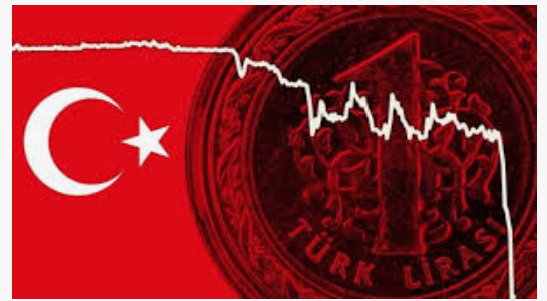
The MSCI EM currency index is up over 6%, while the lira has fallen 16% against the dollar.
-
The Borsa Istanbul 100 index has erased nearly all its year-to-date gains; in dollar terms, it ranks among the bottom global performers.
Adding to the gloom, several major conglomerates—Koç Holding, Akfen Holding, and others—have seen sharp share declines after executives were summoned for questioning in corruption probes tied to opposition-run Istanbul Metropolitan Municipality.
“The recent series of corporate investigations and state interventions has added further uncertainty,” said Bassel Khatoun, research head at Franklin Templeton’s Templeton Global Investments.
“Valuations are cheap—about a 75% discount to EM peers—but without visibility and policy predictability, investors won’t return.”
Inflation and Policy Headwinds
At the start of 2025, investors piled into Turkish assets on expectations that Şimşek and central bank governor Fatih Karahan would tame inflation through tighter monetary policy.
Instead, political turmoil and a weakening lira have blunted those efforts.
-
Turkish bonds have returned just 1.6% this year versus 7.4% for the EM average.
-
Ten-year yields have surged nearly 400 basis points since March.
-
Inflation accelerated in September, breaking a year-long downward trend.
The central bank is expected to cut its policy rate—currently 40.5%—by 100 basis points this Thursday, with another cut likely in December. But several institutions, including JPMorgan, now warn that “domestic political developments” may force a pause in rate reductions and raise next year’s inflation projections.
“Hopes have consistently been disappointed,” said Sebastian Kahlfeld of DWS Investment GmbH. “Turkey’s inflation remains stubbornly high, and political volatility keeps policy credibility out of reach.”
Long-Term Risks for Investment
The deeper concern among economists is structural: political uncertainty is driving up the cost of capital and deterring foreign direct investment (FDI).
According to the International Investors Association in Istanbul, Turkey’s FDI inflows peaked at $22 billion in 2007 but fell to $11.3 billion last year—a near halving over two decades.
“The tensions clearly create a very dicey environment for foreign direct investors,” said Erik Meyersson, strategist at SEB Bank. “It’s harder for investors to commit beyond liquid assets—and that ultimately robs the Turkish economy of much-needed capital.”
The great upside: Trump-Erdogan relationship
Trump calls Erdogan a great friend, relying on him to bring HAMAS to the table. The US and Turkey also have common business in South Caucus in the context of Zengezur Corridor, which can re-route Central Asian trade to Mediterrean and Europe from the Russian corridor–norther route. Also, Turkey claims to posses huge rare earth mineral deposits, suggesting that US FDI can exploit these to end Chinese dependance.
Bottom Line
After a brief surge of optimism early this year, Turkey’s markets are once again trapped in a cycle of political risk and investor fatigue.
With the lira sliding -in nominal terms, yields climbing, and equities losing momentum, the promised reform-led recovery is being eclipsed by authoritarian drift and legal uncertainty.
Unless Ankara restores policy credibility and institutional stability, Turkey may continue to underperform even its riskier emerging-market peers—a sharp reversal for a country once hailed as the comeback story of 2025.
The Trump upside will only appear on the radars of EM funds, when politcal shocks dissipate or Trump does a concrete favor for Turkey, such as the Justice Department dropping the case against state-lender Halkbank.