



Scientists Have Finally Measured the Speed of Quantum Entanglement
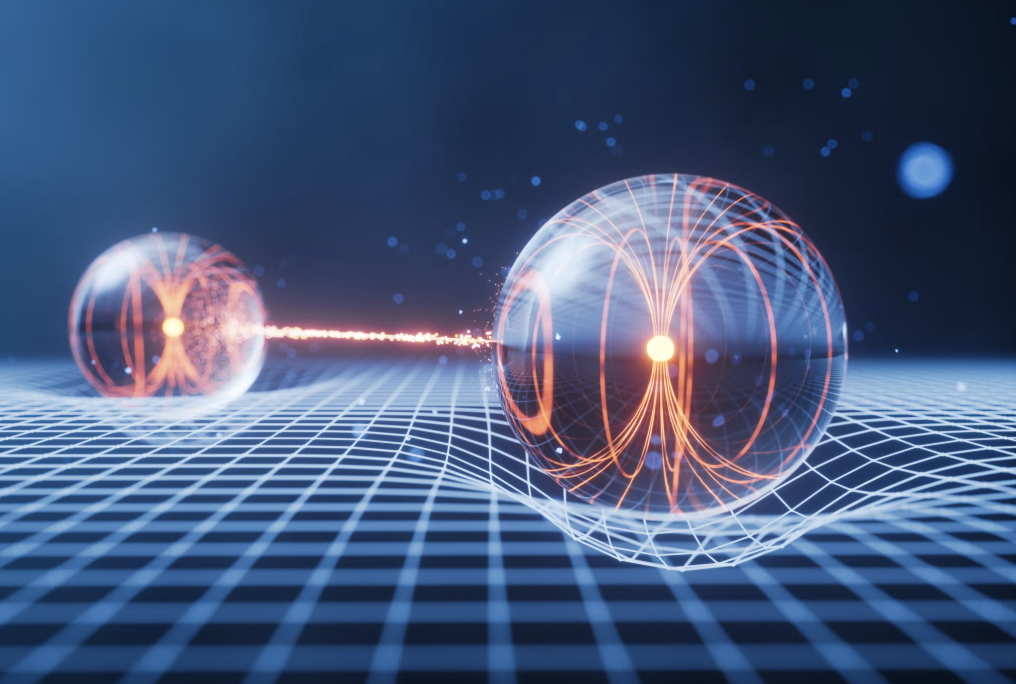 Quantum Entanglement
In a groundbreaking study published in Physical Review Letters, scientists at TU Wien have provided the first evidence that quantum entanglement does not occur instantaneously as once believed—but instead unfolds at unimaginably fast speeds measured in attoseconds (a billionth of a billionth of a second). This challenges long-standing assumptions in quantum physics and marks a major leap in understanding how entangled particles form connections.
Quantum Entanglement: A Brief Refresher
In the bizarre realm of quantum mechanics, particles like electrons, photons, and neutrons can exist in multiple states simultaneously, a principle known as superposition. One of the strangest phenomena is quantum entanglement—a state in which particles, no matter how far apart, remain mysteriously linked. Altering one instantly changes the state of the other, even across light-years of distance.
But how instantaneous is this “instant”?
“You could say that the particles have no individual properties, they only have common properties. From a mathematical point of view, they belong firmly together, even if they are in two completely different places,” said Prof. Joachim Burgdörfer, from the Institute of Theoretical Physics at TU Wien.
How the Experiment Worked: Measuring the Birth of Entanglement
Until now, it was assumed that entanglement happened instantly. But TU Wien physicists have demonstrated that it emerges over time, albeit a tiny window of time measured in attoseconds—each one a quintillionth of a second.
To analyze the exact moment entanglement occurs, the researchers used intense, high-frequency laser pulses to blast atoms. The laser ejects one electron from the atom, while sometimes affecting a second electron that shifts to a higher energy state but stays bound to the nucleus. This interaction triggers quantum entanglement between the two.
“You can only analyze them together,” Burgdörfer explained. “A measurement on one reveals information about the other.”
Using dual laser beams, the team was able to link the timing of the ejected electron’s departure to the energy state of the remaining electron. When the leftover atom had higher energy, it suggested the ejection occurred earlier. When the atom retained lower energy, entanglement took place later—on average, 232 attoseconds later.
Electrons Spill, Not Snap
“The electron doesn’t just jump out of the atom,” added Dr. Iva Březinová, assistant professor at TU Wien. “It is a wave that spills out of the atom—and that takes a certain amount of time. It is during this phase that entanglement occurs.”
This wave-like behavior marks the quantum birth of entanglement, providing a measurable window for observing how subatomic particles interconnect.
Why This Matters for Quantum Computing
As global efforts accelerate toward quantum computing, understanding exactly how entanglement forms is crucial. The ability to measure and even manipulate entangled particles in real-time could define the next era of communication, encryption, and computing.
This research does more than revise quantum timelines—it reshapes how scientists understand the formation of quantum correlations, offering a new foundation for next-generation quantum technologies.