Robert Ellis: Can Turkey be an honest broker?
 ukraine talks
Friday’s collapse of the projected peace talks between the two leaders, Vladimir Putin and Volodymyr Zelensky, does not conceal the fact there was no problem in agreeing on Istanbul as the venue. This underlines the role that Erdoǧan’s Turkey would like to play as the mediator between East and West.
A recent analysis by Fatih Yurtsever (a pseudonym) in Turkish Minute explores the paradox between Erdoǧan’s role as the mediator abroad and the strongman at home, and concludes: “Whether Erdoğan’s growing international stature can be reconciled with Turkey’s democratic decline — or whether it simply fortifies his grip on power — remains the defining paradox of his leadership”.
Erdoǧan’s character as a leader was formed by his tough upbringing in a working-class neighbourhood in Istanbul and later at a religious (‘imam-hatip’) high school. Like Putin, he could speak the jargon, so he bonded with the voters.
Erdoǧan’s mindset was formed at the same time. In 1975 he was head of the youth branch of the Islamist National Salvation Party (MSP], led by Necmettin Erbakan, the father of political Islam in Turkey, and wrote, directed and acted in a play called “Mas-Kom-Yah” (Freemason-Communist-Jew).
When the MSP was banned in the 1980 military coup, its successor, the Welfare Party (RP) became Turkey’s largest political party, but in 1998 was dissolved by the Constitutional Court for being a “centre of activities contrary to the principles of secularism.”
In 2017, Erdoǧan, who had been elected as the Welfare Party’s mayor of Istanbul in 1994, revealed in his referendum campaign for an executive presidency he had been planning to concentrate all power in one person when he was mayor.
In 2018 Necmettin Erbakan’s son, Fatih, founded a new Welfare Party (YRP), which won five seats in the 2023 elections. The following year, in an interview with TR24, which stands for independent journalism, Fatih Erbakan condemned the AKP as “a superficial version of Islam” and for an economic policy based on unjust distribution. In a media event he also ruled out any further support for the AKP.
Despite trade with Israel anti-Semitism is deeply rooted in the governing AKP (Justice and Development Party), which was demonstrated in a two-hour feature, “The Mastermind,” aired on a pro-AKP tv channel in 2015. This “documentary” alleges that a mastermind, originating in Israel, plans for global domination.
A skilful 4-minute video, “The Red Apple”, released by Turkey’s Directorate of Communications in 2020, makes Turkey’s intentions clear. Turkey’s support for Hamas also dates back to the official invitation to its leader Khaled Mashal to visit Ankara in 2006.
There is a Turkish proverb, you tell the rabbit to run and tell the greyhound to catch him, and Turkey, an earlier staunch member of NATO, has for a number of years played the ends off against the middle. It has coquetted with membership of ‘rogue NATO’, the SCO, together with Russia and China, has applied to join BRICS, and for years hammered on the doors of the EU, Turkey’s largest trading partner and primary source of foreign direct investment.
Seven years ago Erdoǧan’s head of international relations, Ayşe Sözen Usluer, stated that Turkey for the previous 10-15 years had felt no need to choose between the West and the East, or between the U.S. and Russia. It no longer saw its foreign policy within the framework of the Cold War or East v. West alliances.
In a keynote speech at the Istanbul Forum in 2012, Islamic scholar, Ibrahim Kalın, who became Erdoǧan’s chief advisor and is now head of MIT (National Intelligence Organization), provided the ideological basis. Kalın spoke of a new geopolitical framework which rejects the Western-centric political and economic order. He also rejected the European model of secular democracy, politics and pluralism.
In a speech to an Ankara military academy Erdoǧan made plain, “If you don’t have enough military, political and economic might, you should know that nobody will take you seriously.” The Global Fire Power index ranked Turkey in 2025 as a top 10 global military power, and in a military briefing the Financial Times has deemed Turkey vital to European security.
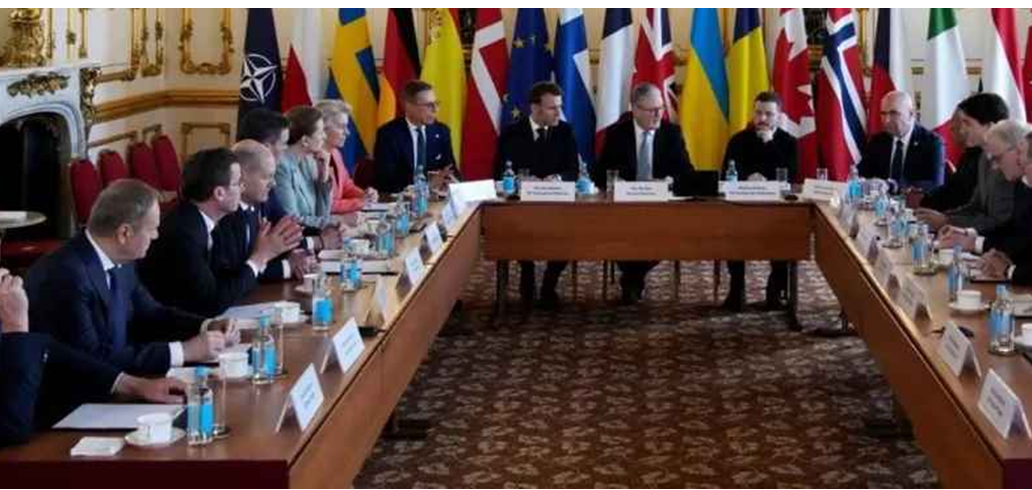
British prime minister Keir Starmer and French president Emmanuel Macron in London proposed a “coalition of the willing” to underpin European peacekeeping efforts in Ukraine, but Azeem Ibrahim, research professor at the Strategic Studies Institute, finds the proposal “heavy on symbolism but dangerously light on credibility.”
Turkish foreign minister Hakan Fidan, who was invited to the London meeting, is interested in Turkey being included in a new European security structure. At an informal meeting of NATO foreign ministers in Antalya Fidan cautioned that NATO’s foundational principles of peace and stability are under severe strain. However, he ignored that NATO’s foundational principles are democracy, individual liberty and the rule of law.
The European Parliament rules out a restart of accession talks because Turkey fails to live up to the accession criteria, democracy, the rule of law and human rights. These are absolute criteria, “not issues subject to transactional strategic considerations and negotiations”. Yet the report reiterates Turkey is a strategic partner and NATO ally, and urges the EU and Turkey to work towards a closer, more dynamic and strategic partnership.
Sinan Ciddi at the FDD in Washington writes there is a growing consensus in the West that in order to confront Russia’s irredentist threats towards Europe, they must give Turkey a seat at the table, including a restart of Ankara’s stalled EU accession process. Only a Europe that includes Turkey with its vast military capabilities can meet the existential security challenges posed by Russian aggression.
However, Ciddi asks the moot question. What makes them believe that Turkey will have Europe’s back?
Robert Ellis is an analyst and commentator on Turkish affairs. He is also an international advisor at the Research Institute for European and American Studies in Athens.
Reprinted by the permission of the author