Prof. Esfender Korkmaz Warns: “Turkey’s External Deficits Have Become Structural”
 esfender korkmaz
Despite a short-lived current account surplus over the summer, economist Esfender Korkmaz says Turkey’s foreign deficits are now chronic due to deep structural imbalances, weak foreign investment, and ongoing import dependence.
Turkey’s central bank data showed a modest $1.1 billion current account surplus in September, broadly in line with market forecasts. Yet both Akbank and independent economists say the improvement is largely seasonal, masking a renewed deterioration trend.
According to Akbank’s economic research unit, after a period of strong improvement in July and August, the foreign trade balance weakened sharply in September, returning to June levels. The bank expects another $1 billion surplus in October, supported by tourism revenues, but projects the 12-month rolling deficit to rise to $21.5 billion.
For 2025, Akbank forecasts a current account deficit of $18 billion, equivalent to 1.2% of GDP, compared with the government’s Medium-Term Program target of $22.6 billion.
Three months of surplus, but trend remains fragile
The Central Bank of the Republic of Turkey (CBRT) reported three consecutive months of current account surpluses in July, August, and September:
-
July: $1.76 billion surplus
-
August: $5.42 billion surplus
-
September: $1.11 billion surplus
However, the broader picture remains negative.
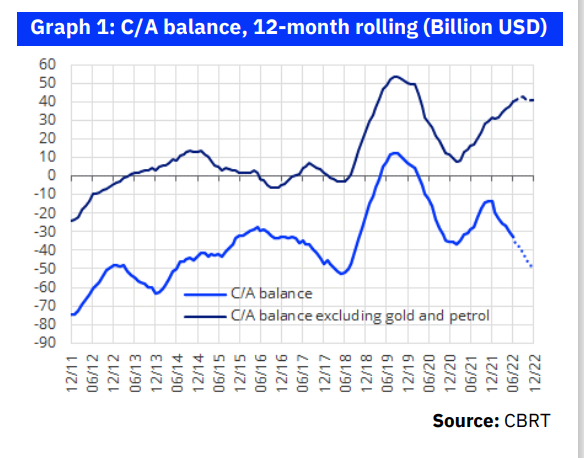
In the first nine months of 2024, Turkey’s current account deficit stood at $5.16 billion, while in the same period of 2025 it widened sharply to $14.89 billion.
Foreign investment flows remain weak
Prof. Korkmaz emphasized that the quality of the recent current account improvement is questionable, as foreign capital continues to flow out rather than in.
In September, net foreign direct investment recorded an outflow of $162 million, while foreign real estate purchases in Turkey totaled $180 million — less than the $211 million Turkish residents spent on property abroad.
Portfolio investments also saw a net outflow of $300 million in the first nine months of the year.
“Net errors and omissions” raise red flags
Perhaps most worrying, according to Korkmaz, is the “net errors and omissions” item, which recorded a negative $12.35 billion.
“A negative net errors and omissions figure means unexplained capital outflow,” he said. “If that item were zero, the real current account deficit would approach $27 billion. These figures don’t inspire confidence — you can’t build an investment or stabilization program on such data.”
Temporary surplus, structural deficit
Korkmaz noted that while three months of current account surplus look positive on paper, they are seasonal and temporary.
“Tourism revenues peak in summer, gold imports were restricted, energy imports declined thanks to solar generation, and oil prices remained stable. These are all temporary factors,” he said.
He warned that Turkey’s import-dependent production model remains intact, with no sign of import-substitution policies or new incentives for domestic manufacturing.
“Without addressing structural issues, the deficit will inevitably return,” he added.
Energy and China trade imbalances deepen the gap
Korkmaz also pointed to Turkey’s heavy reliance on imported energy, particularly costly oil from Russia, as a persistent source of deficit pressure.
“Every year we run a $40 billion trade deficit with China,” he said. “It’s not even technology imports driving this — it’s consumer goods. The government could reduce this easily, but no action is taken. It’s clear that there’s a China import lobby in Turkey.”
Rising borrowing costs and savings gap
Korkmaz stressed that high external borrowing costs and a domestic savings shortfall continue to force Turkey to depend on foreign financing.
He also dismissed the idea that exchange rate adjustments alone could correct the imbalance:
“Around 70% of Turkey’s export production depends on imported inputs. When the lira weakens, export costs also rise. The exchange rate alone can’t fix this problem,” he said.
Policy complacency and lack of direction
According to Korkmaz, the government is underestimating the gravity of the current account problem and failing to prioritize policies that would strengthen domestic industry, reduce import dependence, or attract stable foreign investment.
“The economic management is ignoring the current account deficit. Under current conditions, a lasting solution is impossible,” he warned.
Bottom line: Seasonal relief, structural vulnerability
While official data point to a temporary improvement in Turkey’s external balance, analysts agree that structural weaknesses remain unresolved.
Energy dependence, import intensity, and weak foreign investment inflows are keeping the deficit dynamic alive, suggesting that the short-term surpluses seen this summer will not last.
PA Turkey intends to inform Turkey watchers with diverse views and opinions. Articles in our website may not necessarily represent the view of our editorial board or count as endorsement.
Follow our English-language YouTube videos @ REAL TURKEY: https://www.youtube.com/channel/UCKpFJB4GFiNkhmpVZQ_d9Rg
Twitter: @AtillaEng
Facebook: Real Turkey Channel