Netanyahu’s Rhetoric Risks Pushing Türkiye Toward Military Confrontation, Former Israeli Envoy Warns
 netanyahu-rumlar yunan
Israel’s increasingly confrontational rhetoric toward Türkiye is backfiring and could push Ankara toward accelerated military preparations, raising the risk of a new regional clash, possibly in Syria, according to Israel’s former ambassador to Türkiye Alon Liel. His warning comes as Israel deepens defense coordination with Greece and Cyprus in what analysts see as a bid to deter Ankara in the Eastern Mediterranean.
Israel’s hardline messaging toward Türkiye is fueling security anxieties in Ankara and increasing the risk of a new regional conflict, Israel’s former ambassador to Türkiye has warned, as Jerusalem simultaneously moves to strengthen military coordination with Greece and Cyprus.
Speaking on North Radio 104.5 FM, Alon Liel, a former director-general of Israel’s Foreign Ministry, said Prime Minister Benjamin Netanyahu’s public warnings to Recep Tayyip Erdoğan are producing the opposite of their intended effect.
“Israel feels it is intimidating everyone — Iran, Hezbollah, Hamas, and now Türkiye,” Liel said. “But in reality, this rhetoric is pushing the Turks to upgrade their air defenses and air force.”
Syria Emerges as a Potential Flashpoint
Liel warned that Türkiye is actively preparing for a broader regional confrontation that could involve Israel, Greece, and Cyprus, with Syria emerging as the most dangerous flashpoint. Israel maintains influence in southern Syria, while Türkiye operates militarily in the north.
“In the absence of clear rules or understandings, the two militaries could collide indirectly in Syria,” Liel said, adding that such a confrontation could have spillover effects extending as far as Gaza.
He cautioned that such a scenario could open what he described as an “eighth front” for Israel, following nearly two years of multi-front conflict across the region.
Gaza, Türkiye, and Diplomatic Exclusion
On Gaza’s future, Liel said Israel has worked to block Türkiye from participating in any international force tasked with disarming Hamas, citing Israeli influence on U.S. policy and Ankara’s exclusion from a recent conference hosted in Qatar.
Yet he acknowledged a strategic dilemma. “Someone has to go into Gaza and disarm Hamas, and I don’t see many volunteers,” Liel said, adding that Türkiye might be one of the few actors willing to engage, potentially through political rather than direct military means.
Liel also pointed to Türkiye’s regional diplomacy, including efforts to persuade Azerbaijan — a close Israeli security partner — not to deploy troops to Gaza. He warned that Ankara’s growing ties with Baku could complicate Israel’s regional balance.
“Losing Azerbaijan would not be simple,” he said. “We’ve already dealt with seven fronts in two years. God forbid we open an eighth.”
Israel, Greece, and Cyprus Explore Rapid-Response Force
Against this backdrop, Israeli officials are discussing the possible creation of a joint rapid-response force with Greece and Cyprus, according to people familiar with the talks cited by Israeli media.
The initiative, still at a preliminary planning stage, is intended to strengthen deterrence against Türkiye’s expanding military and strategic footprint in the Eastern Mediterranean. The proposed force would not be permanent but could be deployed quickly by land, sea, or air during crises.
Senior Israeli defense bodies, including the Israel Defense Forces, the Israeli Air Force, and the Navy, are reportedly involved in the discussions through inter-agency coordination.
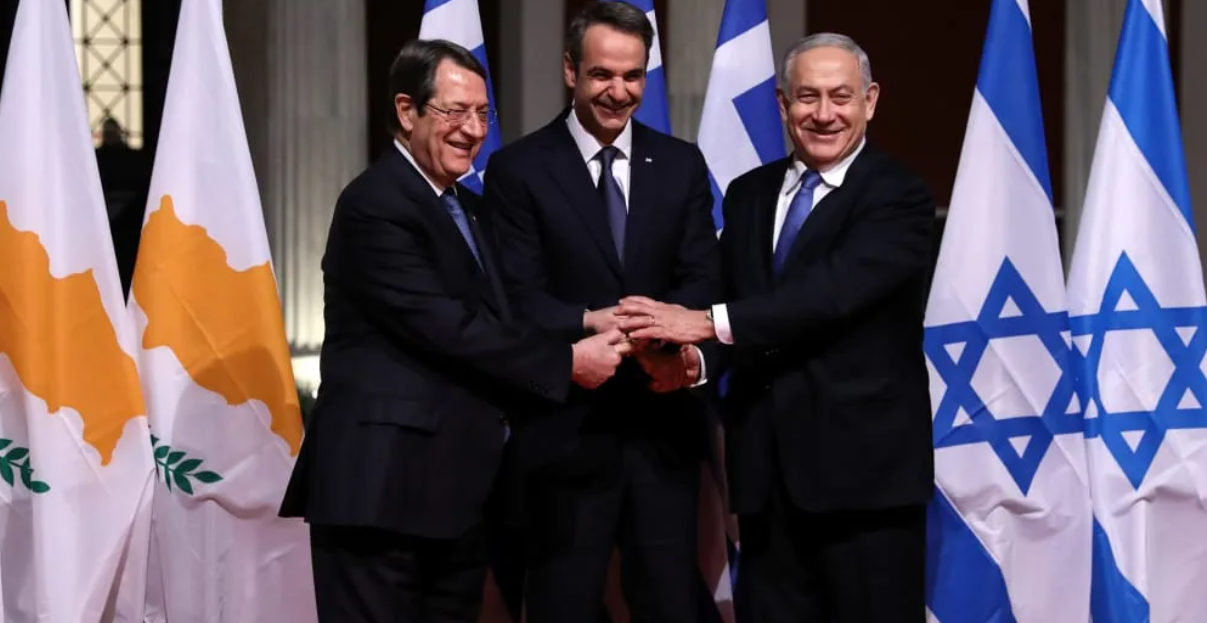
Greek Prime Minister Kyriakos Mitsotakis and Cypriot President Nikos Christodoulides are expected to travel to Israel next week for a summit with Netanyahu, where security cooperation is expected to feature prominently.
Signaling Ankara
According to Greek media reports, the proposed unit could include roughly 2,500 personnel — around 1,000 troops each from Israel and Greece, and 500 from Cyprus. While discussions are ongoing, analysts say even debating such a force sends a political signal.
“This would be a natural extension of the deepened military cooperation of the last 15 years,” said Greek security analyst Angelos Athanasopoulos. “The country most likely to react strongly is Türkiye.”
Israel, Greece, and Cyprus have in recent years conducted multiple joint naval and air exercises. Greece is also moving toward full operational integration of Israel’s Spike NLOS missile system, with deployment expected around the eastern Aegean islands and the Evros River region.
Ankara’s Regional Calculus
At the same time, Türkiye is seeking to expand its regional influence, from deploying air-defense systems in Syria to pursuing a role in a potential multinational force in Gaza. Ankara is also in talks with rival administrations in Libya over a possible new maritime agreement that could reshape power dynamics in the Eastern and Northern Mediterranean.
Analysts warn that as Israel consolidates alliances with Greece and Cyprus, Ankara is likely to counter by strengthening its own regional axis — raising the risk that deterrence efforts on all sides could harden into confrontation.
Source: JFeed, The Jerusalem Post
PA Turkey intends to inform Turkey watchers with diverse views and opinions. Articles in our website may not necessarily represent the view of our editorial board or count as endorsement.
Follow our English YouTube channel (REAL TURKEY):
https://www.youtube.com/channel/UCKpFJB4GFiNkhmpVZQ_d9Rg
Twitter: @AtillaEng
Facebook: Real Turkey Channel: https://www.facebook.com/realturkeychannel/***