Turkey’s Labor Costs Jump 44% in Q2 2025 as Industry Struggles
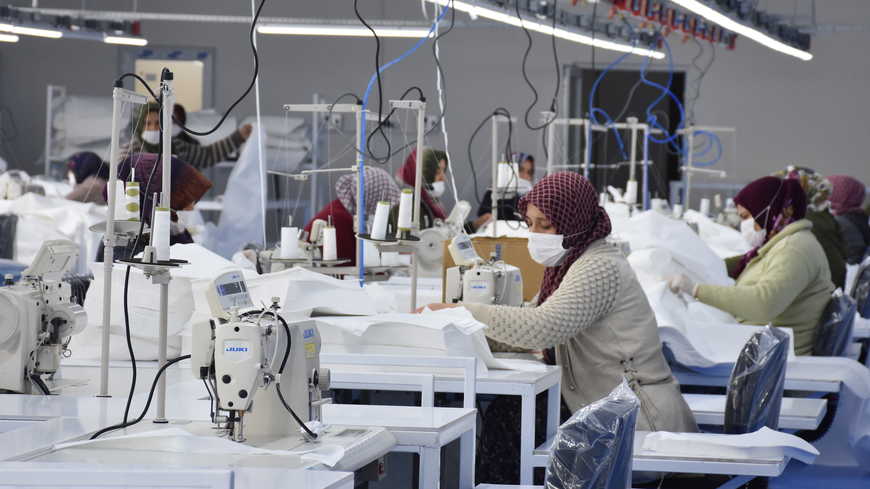 Textile factory turned into medical suits production plant in Turkey’s Afyonkarahisar
Türkiye’s employment index across industry, construction, and trade-services sectors rose 1.9% year-on-year in the second quarter of 2025. However, sectoral performance diverged:
-
Industry employment declined by 2.2%.
-
Construction employment surged 6.7%.
-
Trade and services employment increased by 3.2%.
On a quarterly basis, employment across all three sectors rose 0.6% compared to Q1 2025. The construction sector once again led with a 2.6% gain, while trade-services rose 0.9%. Industry, however, fell by 0.7%, reflecting ongoing challenges in manufacturing.
Hours Worked: A Shrinking Trend
The hours worked index showed a more restrained picture. Year-on-year, total hours worked rose just 0.6%. Yet the breakdown reveals sectoral contrasts:
-
Industry fell sharply by 3.7%.
-
Construction climbed by 4.4%.
-
Trade and services rose 2.3%.
Quarterly data paints a starker picture: total hours worked declined 2.7% compared to Q1 2025. Hours fell 4.3% in industry, 2.5% in construction, and 1.8% in trade-services, suggesting productivity shifts or increased reliance on automation in certain areas.
Wages and Salaries: A Sharp Jump
The most striking development lies in compensation. The gross wages-salaries index rose 44.3% year-on-year in Q2 2025:
-
Industry wages increased 38.3%.
-
Construction wages jumped 47.7%.
-
Trade-services wages soared 47.8%.
Quarter-on-quarter, gross wages rose 10.8%, with trade-services again recording the sharpest growth at 11.3%, followed by construction (12.1%) and industry (9.9%).
Labor Cost Indices: Sharp Annual Gains
The hourly labor cost index also surged 44.3% year-on-year across all three main sectors. Within this:
-
Industry costs rose 44.6%.
-
Construction costs climbed 42.8%.
-
Trade-services costs advanced 45.2%.
Quarterly data showed the same upward momentum, with labor costs rising 13.9% compared to Q1. Increases were strongest in industry (14.8%) and construction (14.6%), while trade-services grew by 13.4%.
Hourly Earnings: Strong Growth
The hourly earnings index rose 43.4% annually:
-
Industry earnings grew 43.6%.
-
Construction earnings increased 41.5%.
-
Trade-services earnings jumped 44.5%.
On a quarterly basis, hourly earnings climbed 13.9%. Construction saw the largest rise (15.0%), followed closely by industry (14.9%) and trade-services (13.3%).
Non-Wage Labor Costs: Rising Even Faster
Interestingly, non-wage labor costs—which include social security contributions, severance obligations, and other employer-paid expenses—rose even faster than wages. The index surged 48.7% year-on-year:
-
Industry increased 49.6%.
-
Construction grew 49.0%.
-
Trade-services advanced 49.1%.
Quarter-on-quarter, non-wage labor costs also rose 13.9%, mirroring the pattern in wages.
Interpreting the Trends
The Q2 2025 data underscores a paradox:
-
Employment and hours worked rose only modestly (or even fell in some subsectors),
-
Yet labor costs and wages surged at record rates.
This divergence suggests that while the number of people employed and hours worked remained nearly flat, compensation costs exploded, likely reflecting:
-
Türkiye’s persistently high inflation environment.
-
Minimum wage adjustments.
-
Rising labor demand in construction and services.
-
Increased social contributions and benefits.
Implications for Businesses and the Economy
The steep rise in labor costs poses challenges for employers, especially in manufacturing sectors already struggling with reduced working hours. For businesses, higher wage bills could pressure profit margins unless productivity gains or price adjustments offset the costs.
For workers, however, the data suggests some relief: earnings are rising faster than employment, signaling that wage growth is finally catching up with cost-of-living increases.
In construction, strong growth in both employment and wages suggests continued expansion, likely supported by infrastructure projects and real estate activity. Trade-services, meanwhile, reflect ongoing consumer demand despite economic headwinds.
Wages Up, Industry Lagging Behind
Türkiye’s Q2 2025 labor indices reveal an economy where workers are earning significantly more, but industrial activity is lagging. With employment stable and hours worked down, productivity and competitiveness will be critical issues in the months ahead.
If wage growth continues at this pace, policymakers may need to balance labor cost inflation with measures to support businesses, particularly in export-oriented sectors.
Related articles