



Istanbul Quake May Be Smaller Than Feared, Says Geologist
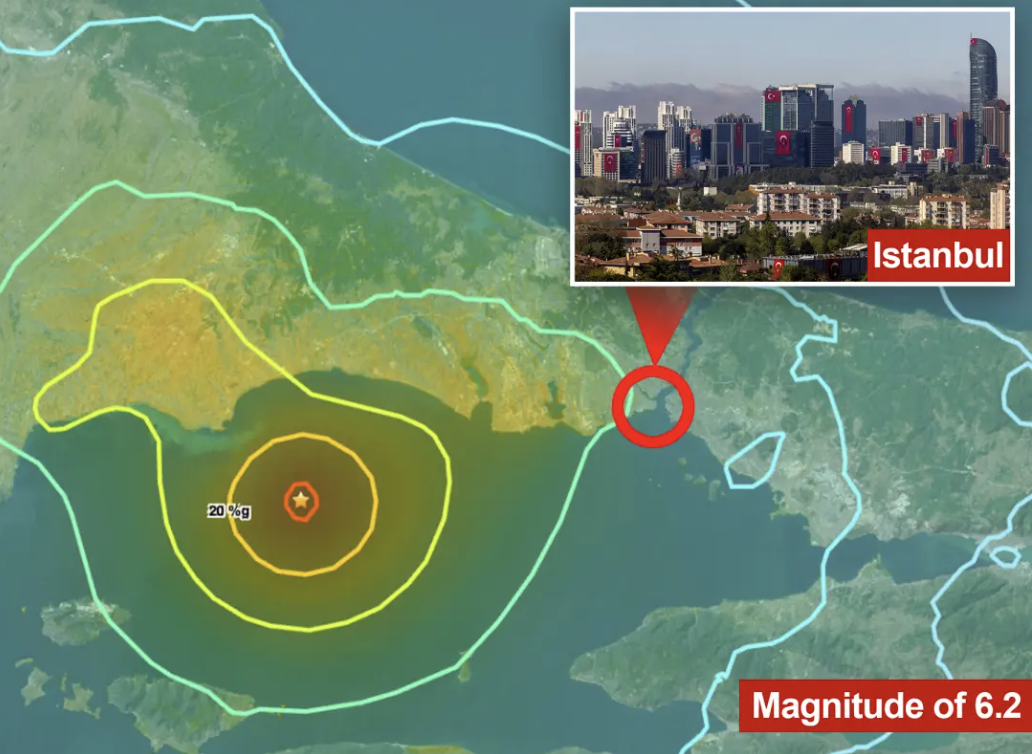 istanbul earthquake
In a groundbreaking assessment that challenges mainstream assumptions, Prof. Dr. Osman Bektaş, a respected geologist and academic, has questioned the long-held belief that Istanbul is due for a magnitude-7 or greater earthquake. Citing recent scientific data and comparative fault modeling, Bektaş argued that the North Marmara Fault may not be “locked” as widely assumed—but instead undergoing slow slip, or “creep”—potentially limiting the size of any future earthquake to below magnitude 7.
Bektaş shared his findings in a video on his YouTube channel, stating:
“The ‘major Istanbul earthquake’ scenario does not align with current scientific evidence… We must focus on science-based preparation, not panic or fear.”
Challenging the Dominant Earthquake Narrative
For years, experts have warned of a magnitude 7+ earthquake striking Istanbul within 30 years. But Bektaş says this model, which relies on the migration theory of quakes moving westward along the North Anatolian Fault (NAF) since the 1939 Erzincan earthquake, may be flawed.
According to him, this earthquake migration did not continue toward Istanbul via the fault’s northern branch, but instead diverted along its southern segment through Mudurnu Valley—where significant quakes occurred in 1957 and 1967.
“The seismic energy didn’t shift toward Istanbul as expected,” he explained. “It took a different path.”
Claim: The 1999 İzmit Earthquake Was Triggered from the West
One of Bektaş’s more controversial points involves the 1999 İzmit earthquake, often cited as part of this westward progression. Contrary to popular belief, Bektaş argues that the quake wasn’t triggered from the east, but rather initiated by a microseismic event in the Marmara Sea, west of the epicenter.
Backed by studies published in Science and Nature, he stated:
“A microquake was detected in the Marmara Sea 44 minutes before the main shock. The rupture then moved eastward toward Düzce. This suggests seismic activity is migrating from west to east, not the other way around.”
The Marmara Fault May Be Creeping, Not Locked
The most striking revelation concerns the physical state of the Marmara fault. Unlike previous assumptions of a “locked fault” building massive pressure, Bektaş asserts the region is experiencing “creep”—a slow, gradual movement that releases energy over time.
“Our models, aligned with global analogs, suggest the fault is not locked. It’s slowly moving, partially releasing stress, which could cap the earthquake magnitude at around 6.5 to 6.6,” Bektaş said.
This would significantly reduce the projected impact, though Bektaş stresses that this should not lead to complacency.
Critical Warning: No Room for Complacency
Although the potential for a sub-magnitude-7 quake may sound reassuring, Bektaş emphasized that Istanbul remains extremely vulnerable due to its fragile building stock and dense population.
“Even a 6.5 quake could cause devastating damage,” he warned. “That’s why urban transformation, building safety, and public preparedness must not be delayed.”
He concluded with a call to action:
“Istanbul’s future cannot be gambled on earthquake scenarios. This requires a unified effort from the state and society.”