Why the Next Istanbul Earthquake Could Be One of History’s Worst Disasters
 istanbul-earthquake
Concerns over a long-anticipated major earthquake in Istanbul have intensified after a detailed analysis published in the US press warned that the city could face “one of the worst humanitarian disasters in recent history.” The study, written by volcanology expert Dr. Robin George Andrews and highlighted by Independent Türkçe, draws on newly published scientific research and underscores how both geological dynamics and human factors are converging into a potentially catastrophic scenario.
Locked Faults Beneath the Marmara Sea Heighten the Risk
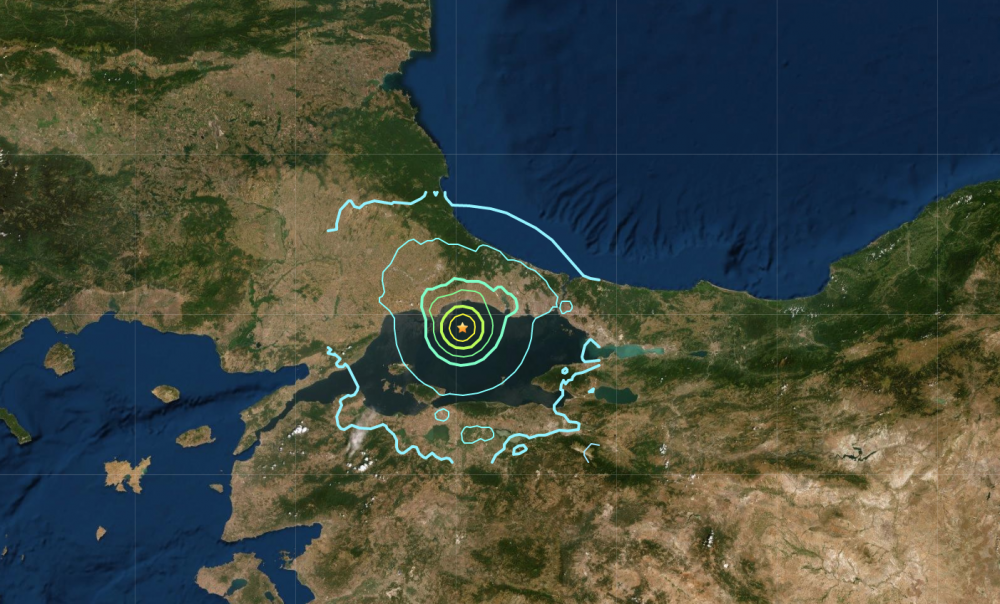
At the center of the warning is the Main Marmara Fault, a critical segment of the North Anatolian Fault system running beneath the Marmara Sea. According to a peer-reviewed study published in the journal Science, seismic activity over the past two decades suggests that stress is progressively migrating toward a locked section of this fault. Locked faults are hazardous because they accumulate strain over long periods, which can be released suddenly as powerful earthquakes.
Scientists involved in the research estimate that this process could result in an earthquake of magnitude 7.0 or higher, directly threatening Istanbul, a megacity of roughly 16 million residents. Even more minor earthquakes, experts caution, could cause widespread damage given the city’s structural vulnerabilities.
A Pattern of Escalating Seismic Activity
The Science study analyzed earthquakes along the Main Marmara Fault over the last 20 years, revealing a troubling pattern. In 2011, a 5.2-magnitude earthquake struck the western segment of the fault. This was followed in 2012 by a 5.1-magnitude event on the eastern side. In September 2019, a stronger 5.8-magnitude earthquake occurred in the central section of the fault. Most recently, an earthquake measuring 6.2 struck just east of that same central zone.
Researchers warn that these events may not be isolated incidents but rather indicators of increasing stress along the fault line. A future quake, they suggest, could be even stronger, potentially pushing stress eastward and triggering the long-feared major rupture closer to Istanbul.
“Earthquakes Cannot Be Predicted”
Despite the alarming projections, scientists are careful to emphasize that earthquakes cannot be forecast with precise timing. Patricia Martínez-Garzón, a seismologist at Germany’s GFZ Helmholtz Centre for Geosciences and lead author of the Science study, stresses the importance of preparedness rather than prediction.
“Earthquakes cannot be predicted. We need to focus on early detection of any unusual signals and on reducing their potential impacts,” Martínez-Garzón says.
Her comments highlight a central theme of the research: while the timing remains uncertain, the risk itself is well-established, and the focus must shift to mitigation and readiness.
Human Factors Could Turn a Natural Disaster Into a Tragedy
Beyond geology, experts agree that the human dimension may ultimately determine the scale of devastation. Dr. Andrews notes that, as seen in Türkiye’s 2023 twin earthquake disaster, natural hazards become far deadlier when combined with structural weaknesses and policy failures.
Judith Hubbard, an earthquake scientist at Cornell University, offers a stark assessment: “A huge earthquake near Istanbul would be one of the worst humanitarian disasters in recent history.”
She points to decades of uncontrolled urban expansion, extreme population density, and inconsistent enforcement of building standards as critical risk multipliers. Many structures in Istanbul are built on unstable or uneven ground, further increasing the likelihood of collapse during strong shaking.
Direction of Fault Rupture Matters
Another factor influencing potential damage is the direction of fault rupture. Previous studies co-authored by Martínez-Garzón suggest that a rupture propagating eastward—toward Istanbul—is more likely than one moving westward. Such a scenario would channel seismic energy directly toward the city, amplifying destruction.
Even an earthquake of magnitude 6.0 or slightly above could cause significant harm, scientists warn, particularly in older neighborhoods with aging infrastructure.
Preparedness Is the Only Defense
The consensus among researchers is clear: while the earthquake itself is inevitable, the scale of human loss is not. Investments in earthquake-resistant construction, stricter enforcement of building codes, urban renewal projects, and public awareness could dramatically reduce casualties.
The message emerging from the scientific community is not one of panic, but of urgency. Istanbul’s location atop one of the world’s most active fault systems is an unchangeable reality. How the city prepares for that reality will determine whether the next major earthquake becomes a manageable disaster—or a historic tragedy.
Related articles
Marmara Fault May Break in Segments, Not One Giant Earthquake
NYT Warns Istanbul Could Face One of the Worst Humanitarian Disasters in Recent History
Earthquake Warning: Experts Say the Threat Goes Far Beyond Istanbul