Government Raises Minimum Wage by 27% for 2026, Labor Unions Cry Foul
 asgari ucret2026
Türkiye’s government has announced a 27% increase in the minimum wage for 2026, setting net monthly pay at 28,075 lira. The decision, taken without the participation of the country’s largest labor confederation, has triggered a sharp backlash from trade unions, opposition parties, and economists, who argue that the new wage remains below both inflation and the hunger threshold, deepening pressure on low-income workers and intensifying political tensions ahead of a likely election year.
Türkiye has moved to the final stage of setting its minimum wage for 2026, with the government unveiling a 27% increase that has immediately drawn criticism from organized labor and opposition figures. Labor and Social Security Minister Vedat Işıkhan announced late Monday that the net monthly minimum wage would rise to 28,075 Turkish lira, while the gross wage would be set at 33,030 lira.
The decision was taken at the third and final meeting of the Minimum Wage Determination Commission, which convened at the Ministry of Labor at 6:00 p.m. Notably, the talks once again proceeded without representatives of the main labor confederation, Türk-İş, underscoring a widening rift between the government and organized labor.
Wage Increase Falls Short of Union Demands
Speaking after the meeting, Minister Işıkhan said the government’s primary objective was to ensure that the minimum wage does not “lose its effect against inflation” and that workers’ purchasing power is protected. He also announced that the state-funded minimum wage support for employers, which stood at 1,000 lira last year, would be increased to 1,270 lira in 2026.
Despite these assurances, labor unions argue that the increase fails to keep pace with rising living costs. According to union estimates, the new minimum wage remains below the hunger threshold, a benchmark widely used in Türkiye to measure the minimum income required for basic nutrition for a family.
The commission’s structure and legitimacy have been at the heart of the controversy. Türk-İş, which represents a large share of unionized workers, has boycotted the commission since December 2024, citing what it describes as a lack of democratic representation and transparency.
A Commission Without Workers
The Minimum Wage Determination Commission held its first meeting on December 12, chaired by Labor Ministry Director General Oğuz Tuncay. That session lasted roughly 90 minutes and included government officials and representatives from the Turkish Confederation of Employer Associations (TİSK), but no worker representatives.
The second meeting, held on December 18, followed the same pattern. Officials from the Treasury and Finance Ministry, the Trade Ministry, and the Turkish Statistical Institute (TÜİK) presented economic data and reports to commission members, again in the absence of Türk-İş.
Ahead of the final session, Türk-İş Deputy Chairman Ramazan Ağar held a preliminary meeting with Minister Işıkhan. However, the union later issued a written statement reiterating its refusal to take part in the process.
“Türk-İş announced on December 24, 2024, that it would not participate in commission meetings until the body is made genuinely fair and democratic,” the statement said. “In the nearly one year since then, no improvements have been made to the commission’s structure or functioning. For this reason, Türk-İş stands by its decision and will not take part in the 2026 minimum wage process.”
Worker Anger on the Streets
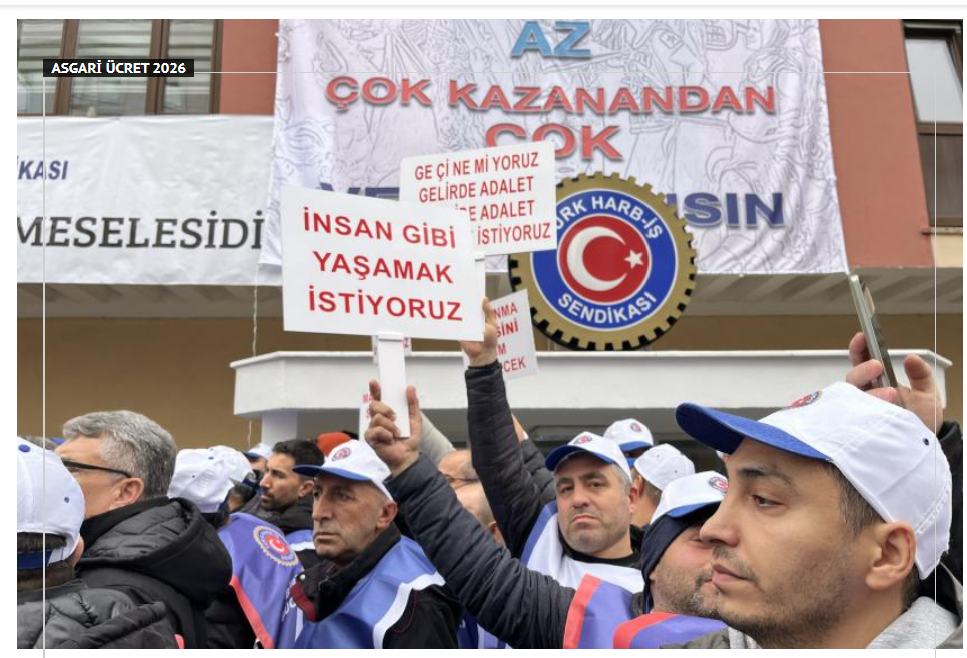
The announcement of the new wage sparked immediate reactions from workers across multiple sectors, including textiles, cleaning services, and manufacturing. Many said the new figure would not cover rent, utility bills, and basic necessities.
“This is not a living wage,” one worker was quoted as saying in local media. “It’s mockery. You cannot survive on this.”
Left-leaning daily Evrensel ran a front-page headline accusing the government of siding with employers and creditors at the expense of workers, arguing that millions would be left below the hunger line.
Economists and labor experts echoed these concerns, warning that the real value of the minimum wage could quickly erode if inflation remains elevated. Türkiye has struggled for years with high inflation, which has disproportionately hit low-income households.
Political Backlash Intensifies
The wage hike has also fueled political tensions. Opposition figures were quick to frame the decision as evidence of a broader failure in economic governance.
Seyit Aslan, leader of the left-wing Labor Party (EMEP), rejected the new minimum wage outright. “We do not accept a hunger wage,” he said, arguing that the government was asking workers to shoulder the burden of economic mismanagement.
The strongest reaction came from Özgür Özel, leader of the main opposition Republican People’s Party (CHP). Özel described the new minimum wage as a “disgrace” and placed direct responsibility on President Recep Tayyip Erdoğan.
“This is the AK Party’s system,” Özel said. “No one should be mistaken. The sole person responsible for this figure, for this outrage, is Mr. Erdoğan. If 2026 cannot be a year of living, then it is a year of elections.”
Özel’s remarks underscore how the minimum wage debate is increasingly intertwined with Türkiye’s broader political trajectory, as opposition parties seek to capitalize on public frustration over the cost of living.
Economic and Social Implications
The minimum wage affects millions of workers in Türkiye directly and sets a benchmark for wages across the broader economy. While the government argues that the 27% increase strikes a balance between protecting workers and safeguarding employment, critics warn that insufficient wage growth could dampen domestic demand and deepen social inequality.
At the same time, employers have expressed concern about rising labor costs, particularly in labor-intensive sectors already under pressure from weak global demand and tight financial conditions. The increase in state support for the minimum wage is aimed at easing that burden, but analysts say it may not be enough to offset higher payroll expenses.
With unions sidelined from the formal process and public anger growing, the minimum wage decision is likely to remain a flashpoint in Türkiye’s economic and political debate in the months ahead.
PA Turkey intends to inform Turkey watchers with diverse views and opinions. Articles in our website may not necessarily represent the view of our editorial board or count as endorsement.
Follow our English YouTube channel (REAL TURKEY):
https://www.youtube.com/channel/UCKpFJB4GFiNkhmpVZQ_d9Rg
Twitter: @AtillaEng
Facebook: Real Turkey Channel: https://www.facebook.com/realturkeychannel/***
Related articles
Turkish government inquires Istanbul municipality staff over alleged militant ties
Turkish Appeals Court Upholds Prison Sentence and Political Ban for Istanbul Mayor Ekrem İmamoğlu

Polls: What Are Turks Most Concerned About — And How Do They View the Peace Process?