Erdoğan Urges Putin to Consider a ‘Limited Ceasefire’ for Ports and Energy Facilities
 putin rte
Summary:
Turkish President Recep Tayyip Erdoğan pressed Russian President Vladimir Putin to consider a “limited ceasefire” covering energy infrastructure and port facilities, as Ankara intensifies diplomacy amid rising Black Sea tensions and expanding maritime risks linked to the Russia–Ukraine war.
Erdoğan: Limited Ceasefire Could Support Diplomacy
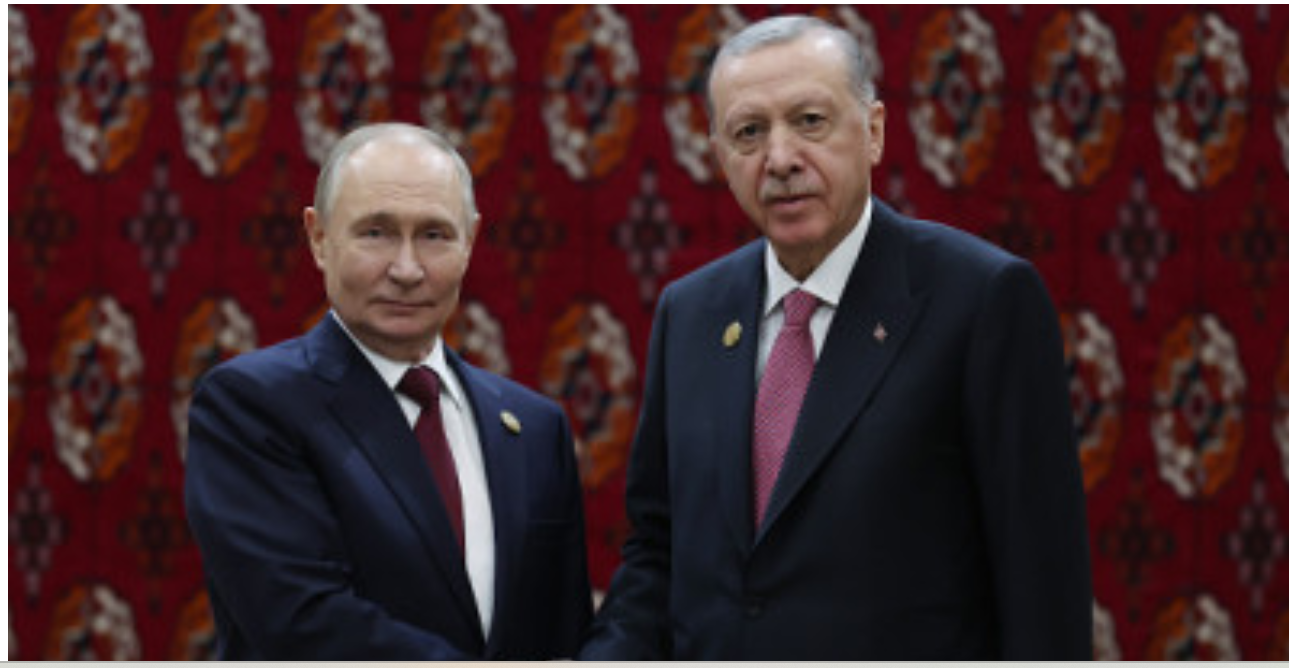
During a bilateral meeting on the sidelines of a summit in Turkmenistan, Erdoğan told Putin that targeted de-escalation could help open space for broader diplomatic efforts.
According to a statement from the Turkish Presidency:
“Implementing a limited ceasefire targeting energy facilities and ports in particular could be beneficial.”
The proposal follows a series of attacks on Russia-linked tankers in the Black Sea, some claimed by Ukraine and others disputed, prompting sharp warnings from Ankara.
Russia Strikes Ukrainian Ports, Damages Three Turkish-Owned Vessels as Black Sea Risks Escalate
Ankara Alarmed by Escalation at Sea
Turkey last week summoned both the Russian and Ukrainian ambassadors after several tanker strikes, calling the incidents a “worrying escalation” and warning of risks to navigation safety, energy infrastructure, and regional stability.
The Black Sea has become increasingly volatile following Ukraine’s use of maritime drones against Russia’s so-called “shadow fleet,” used to bypass sanctions and transport crude.
Zelensky: Turkey Working on an Energy-Focused Ceasefire Plan
Ukrainian President Volodymyr Zelensky said in Kyiv that Ankara is actively exploring a proposal focused specifically on protecting energy facilities and shipping routes.
“President Erdoğan mentioned this to me. I told him we would support it,” Zelensky said.
He added that Turkey aims to organize negotiations, first at staff level and later at the leaders’ level.
Zelensky also noted that the United States believes an agreement is within reach but said Russia insists it will not accept any interim ceasefire unless tied to a full peace deal.
Turkey’s Strategic Position: Gatekeeper of the Black Sea
Turkey has maintained working relations with both Moscow and Kyiv since the start of the war, even as fighting has escalated around shipping lanes.
As the guardian of the Bosphorus and Dardanelles under the Montreux Convention, Turkey controls access between the Black Sea and the Mediterranean — a central passage for Ukrainian grain and Russian oil exports.
Ankara has already expanded mine-clearing cooperation with Romania and Bulgaria, though any broader NATO role would likely fall primarily on the Turkish Navy.
Turkish Delegation and the Return of the “Istanbul Process”
The Erdoğan–Putin meeting included senior officials:
Hakan Fidan, Alparslan Bayraktar, İbrahim Kalın, Burhanettin Duran, Akif Çağatay Kılıç and Halit Yerebakan.
Earlier in the day, Erdoğan told the Turkmenistan summit that Ankara aims to build a “belt of peace and security” with neighboring states.
He reiterated Turkey’s readiness to revive the Istanbul Process — direct negotiations hosted in 2022 that produced progress on prisoner exchanges but not a ceasefire.
The last meeting in this format was held in summer 2025.
Context: Trump’s 28-Point Ukraine Plan
Erdoğan’s outreach comes as U.S. President Donald Trump’s 28-point peace plan gains diplomatic attention.
Commenting on the plan, Erdoğan said:
“A just peace has no losers. If both sides’ legitimate expectations and security needs are met, an agreement is possible.”
The Kremlin said Putin told Erdoğan the U.S. proposals “could form the basis” for future discussions.
Assessment
Erdoğan’s call for a focused ceasefire on ports and energy infrastructure reflects Turkey’s effort to prevent further destabilization in the Black Sea — a region vital to global food and energy flows.
Ankara’s bargaining power remains significant as one of the few actors able to engage both Russia and Ukraine directly.
PA Turkey intends to inform Turkey watchers with diverse views and opinions. Articles in our website may not necessarily represent the view of our editorial board or count as endorsement.
Follow our English-language YouTube videos @ REAL TURKEY: https://www.youtube.com/channel/UCKpFJB4GFiNkhmpVZQ_d9Rg
And content at Twitter: @AtillaEng
Facebook: Real Turkey Channel: https://www.facebook.com/realturkeychannel/***
Related articles
Ambassador states importance of Turkey-EU ties amid Ukraine war
Turkey and Slovakia Secure U.S. Waiver Extensions for Russian Gas Payments
Turkey, Russia talks: Ukraine grain deal might be on the table soon