Black Sea Attack Shakes Global Oil Market, Posing Critical Threat to Turkey’s Energy Security
 novorisk attack ukraine
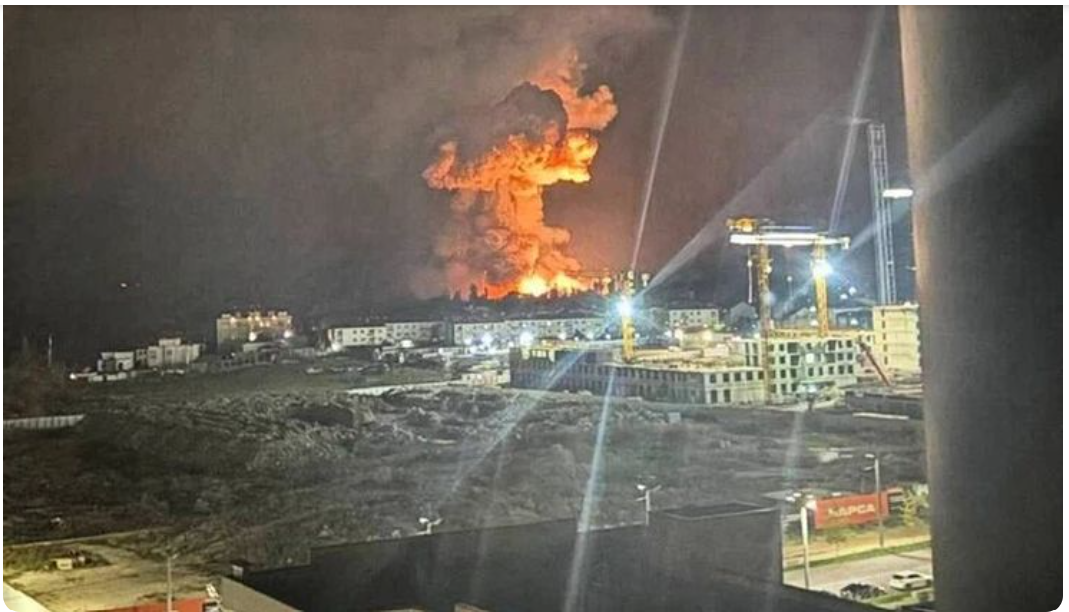
The war in Ukraine has dramatically intensified its strategic focus on degrading Russia’s economic lifeline, shifting the target from inland refineries to critical export infrastructure. This escalation reached a peak on Friday with a major Ukrainian missile and drone attack on Russia’s Novorossiysk Black Sea port, one of the largest export hubs for Russian crude and refined products.
The attack immediately crippled a vital segment of global oil trade, forcing a temporary suspension of all oil exports from the terminal. According to industry sources, this halt immediately affected a supply volume equivalent to 2.2 million barrels per day (bpd), representing approximately 2% of the global supply. Global oil prices instantly rallied by more than 2% on acute supply fears, highlighting the market’s sensitivity to Black Sea instability.
Kyiv’s General Staff confirmed its forces utilized Neptune cruise missiles and various strike drones in the attack, aiming “to reduce the military and economic potential of the Russian aggressor.” The severity of the strike forced Russia’s pipeline oil monopoly, Transneft, to suspend supplies to the port. Damage was reportedly inflicted on two oil berths at the Sheskharis terminal, including those handling large 140,000-deadweight-ton tankers. While the nearby Caspian Pipeline Consortium (CPC) terminal, which exports Kazakh oil, resumed loading after a brief alert, the damage to Novorossiysk’s Sheskharis complex—a major endpoint for Russian pipelines—is confirmation that the Black Sea is now a major theater for energy warfare.
This event creates a severe and immediate threat to the energy supply chain of the Turkish Republic.
Ankara’s Direct Exposure to the Novorossiysk Disruption
Turkey’s energy import portfolio is deeply integrated with the Black Sea route. In the wake of Western sanctions on Russia, Turkey significantly increased its reliance on discounted Russian crude and refined products, making it one of Ankara’s largest suppliers. The Novorossiysk terminal is the single most important exit point for these supplies.
1. The Dependence on Urals Crude
Novorossiysk is the primary gateway for exporting Urals crude oil—the specific grade heavily favored by Turkish domestic refiners, such as the facilities operated by TÜPRAŞ. This crude is economically advantageous and logistically convenient due to the short distance via the Black Sea.
The disruption at Sheskharis means that a substantial volume of Turkey’s contracted crude supply is now frozen, potentially for days or weeks, depending on the extent of the damage to the docks and loading equipment.
2. Quantifying the Vulnerability
While the exact portion of Turkey’s total Russian imports flowing through Novorossiysk is proprietary, the overall reliance is massive. Türkiye’s total daily imports of Russian crude and refined products (like diesel) have consistently hovered between 400,000 and 500,000 bpd—a critical volume needed to keep the country’s industrial base running and transport operational.
If a major portion of this volume, specifically the supply relying on the damaged berths, is lost, the direct consequences for Turkish energy security are three-fold:
| Impact Area | Effect of Novorossiysk Halt | Implication for Turkey |
|---|---|---|
| Physical Supply Loss | Contracted volumes of Urals crude cannot be loaded. | Refiners must immediately scramble for replacement barrels. |
| Increased Freight Costs | Supply must be sourced from distant markets (e.g., Middle East, Africa). | Tanker routes lengthen, leading to a massive spike in navlun (freight) costs and insurance premiums. |
| Cost of Crude | The price advantage of Russian crude (the discount) diminishes due to higher risk/insurance. | The net cost of energy imports for Turkey rises sharply. |
The disruption forces Turkish refiners to seek alternative suppliers in geographically distant regions. Shifting supply routes from the Black Sea to the Gulf or West Africa requires significantly longer sailing times, dramatically increasing the cost of shipping and adding strain to Turkey’s current account balance.
Geopolitical Risk and Insurance Fallout
Beyond the immediate operational halt, the sustained Ukrainian campaign against Russian energy infrastructure escalates the geopolitical risk premium associated with all Black Sea trade.
- Marine Insurance Costs: Ship owners and insurers will now demand substantially higher war risk premiums for all vessels entering and operating within the Russian side of the Black Sea. This financial burden is ultimately passed down to the buyer—in this case, Turkish importers and, eventually, Turkish consumers.
- Long-term Instability: The attack confirms that no Russian export terminal along the Black Sea coast is truly safe. This long-term instability undermines the cost-effectiveness of relying heavily on the short Black Sea supply chain, potentially forcing Ankara to structurally diversify its sourcing away from its discounted Russian lifeline.
In essence, while the physical loss of oil supply is manageable in the short term by drawing down strategic reserves, the more damaging, persistent impact for Turkey will be the inflationary shock caused by inflated insurance and freight costs necessary to keep its refiners running. The attack transforms a convenient, cheap supply route into a high-risk, high-cost zone.