AKP Seen Hoarding Resources for Pre-Election Spending Spree
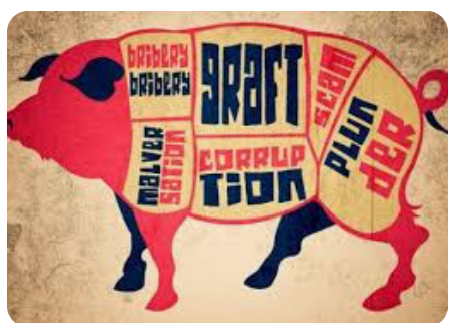 pork barreling
Turkey’s economic management is expected to maintain tight fiscal and monetary policies until the next election cycle, with ruling AKP insiders suggesting that major wage hikes and credit expansion will be postponed and deployed only as part of a pre-election stimulus package. Signals from budget talks indicate austerity will continue through at least mid-2026.
Author Nuray Babacan

Austerity to Continue, Wages on Hold
Deliberations during parliamentary budget talks at the Treasury and Finance Ministry have reinforced expectations that the government will avoid meaningful increases in the minimum wage and pensions in the near term, according to political and economic sources.
Behind closed doors, the prevailing view within the economic administration is that belt-tightening policies will remain in place until a likely election window approaches. One senior figure was quoted as saying that “any stone left to throw will be thrown as voter incentives during the election period.”
Planning Anchored to June 2026
According to ruling-party sources, economic planning is currently anchored to June 2026, with inflation targets taking precedence over political considerations. Achieving those targets, officials say, requires strict fiscal discipline.
Even if political pressure forces minor adjustments, the economic team is expected to resist what it describes as “disproportionate increases” in wages or pensions. This stance has reportedly unsettled AKP politicians already struggling with voter discontent.
Crackdown on Illicit Finance Seen as Non-Negotiable
Several recent enforcement campaigns—targeting illegal betting networks, the informal economy, and money laundering—are described as non-negotiable steps driven by the Treasury and Turkey’s Financial Crimes Investigation Board (MASAK).
Officials cite concerns about Turkey’s international standing and the risk of being returned to the FATF grey list. According to insiders, the reputational damage abroad is viewed as severe enough to justify domestic political costs.
Public Spending Requests Rejected
Despite resistance from ministries and public institutions, austerity in public spending remains in force. Budget increase requests submitted by ministries have reportedly been returned with instructions to resubmit proposals reduced by 5% from the previous year’s allocations.
Party officials say they have conveyed concerns that aggressive tax enforcement has disproportionately burdened low-income groups and small tradespeople. Following internal warnings, some pressure on small businesses has reportedly been eased.
Election Period Seen as Turning Point
Within AKP circles, the consensus is that fiscal restraint will be relaxed only once the country enters the formal election period. Party insiders point to a possible early election by November 2027 at the latest.
Ahead of such a vote, the government is expected to roll out a broad “election package” that could include subsidized housing and car loans, increases to the minimum wage and pensions, and pay rises for public sector workers.
Speculation Over Şimşek’s Future
Some AKP figures speculate that Treasury and Finance Minister Mehmet Şimşek—who has championed orthodoxy and fiscal discipline—could part ways with President Recep Tayyip Erdoğan if election-driven spending undermines the current economic program.
“There are those who argue that if Şimşek and his team manage to steer the party safely to the election threshold, their role may end once it is time to spend what has been saved,” one party insider said.
Inflation Debate Rekindled
Budget talks also reignited controversy over official inflation figures. Şimşek stated that inflation, which he said peaked at 85% in 2022, is expected to fall to around 31% by 2025.
Critics note that the government did not formally acknowledge an 85% inflation rate at the time, when the Turkish Statistical Institute (TÜİK) reported a peak of 64%, while independent economists at ENAG estimated inflation as high as 134%. Opposition figures argue the discrepancy underscores long-standing concerns over data credibility.
Minimum Wage Tax Exemption Criticized
Another flashpoint was the government’s presentation of the minimum wage tax exemption as a major social gain. Şimşek emphasized that foregone tax revenue from the exemption—1.092 trillion lira—would account for roughly one-third of total tax expenditures in 2026.
Critics argue that framing the issue solely in fiscal terms ignores the reality facing minimum-wage earners, whose incomes remain well below the hunger threshold, and reflects what they describe as an “inhumane” economic perspective.
Author: Nuray Babacan
Source: Nefes
PA Turkey intends to inform Turkey watchers with diverse views and opinions. Articles in our website may not necessarily represent the view of our editorial board or count as endorsement.
Follow our English YouTube channel (REAL TURKEY):
https://www.youtube.com/channel/UCKpFJB4GFiNkhmpVZQ_d9Rg
Twitter: @AtillaEng
Facebook: Real Turkey Channel: https://www.facebook.com/realturkeychannel/